
Column
Research, in business language.
We rewrite Affectosphere Group's research into something useful for business and practical decision-making. Each piece is a 5-minute read.
2026 / 06 / 16
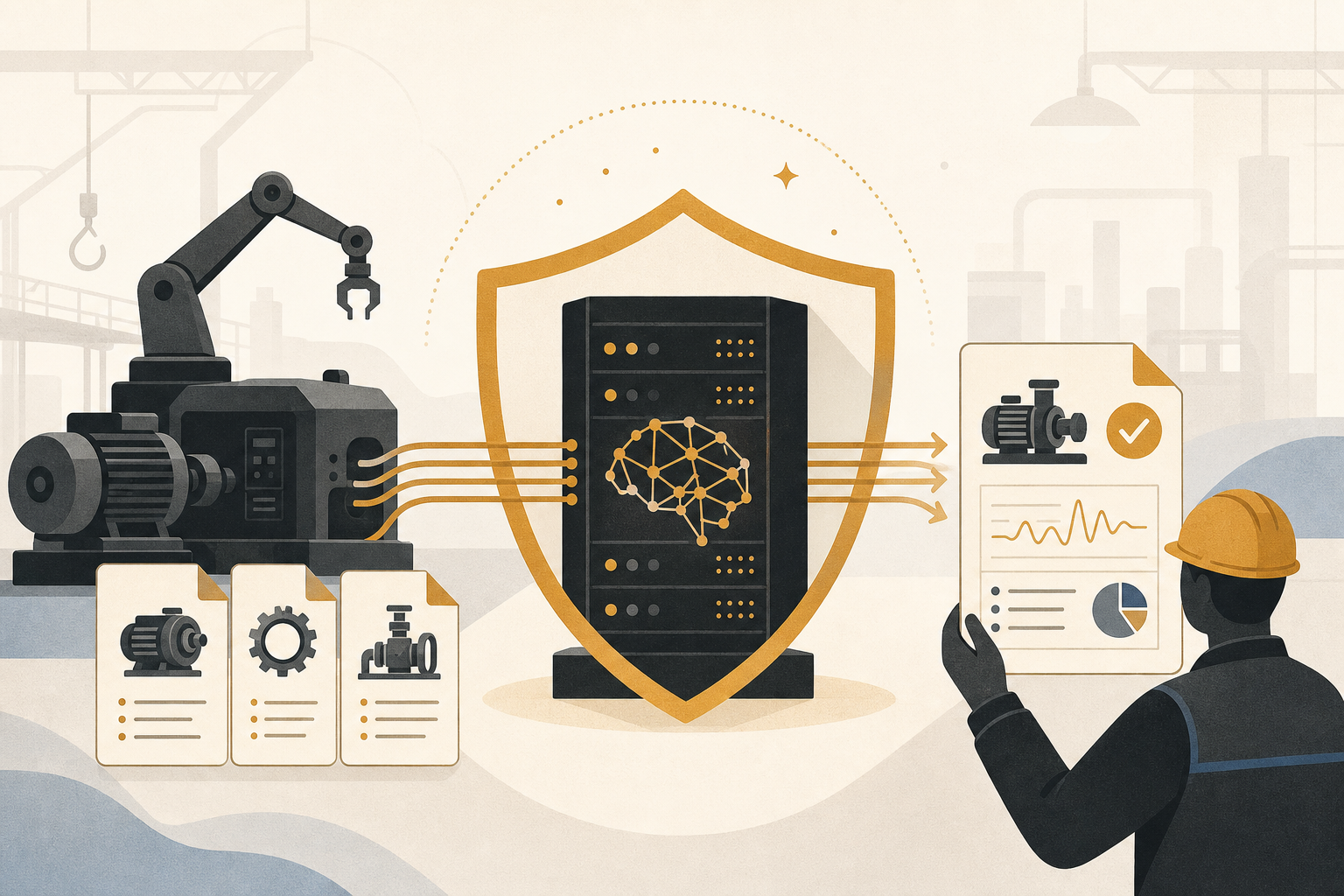
Don't Send Factory Manuals to the Cloud ── What Manufacturers Need Before Deploying LLMs
Manufacturers want LLMs for equipment fault diagnosis. But sending proprietary technical documents to an external API is a security non-starter. FactoryLLM — an open-source framework for local, safe LLM evaluation in smart factories — addresses this head-on. Here's what DX teams, maintenance engineers, and IT vendors can take away.

2026 / 06 / 16
You Only See Your Doctor for 1 Hour a Year. The Other 8,759 Hours Are Where Health Is Made
A new architecture called Personal Care Utility reimagines health management as everyday infrastructure — the kind that reaches you like electricity or running water, not just when you visit a clinic. Here's what HR teams, PHR developers, and chronic disease SaaS builders can take away from it.

2026 / 06 / 16
What If You Could Actually Converse With Your BI Dashboard? ── TwinBI and the Idea of Analytical Continuity
When an AI remembers what you just did in your BI dashboard and you can pick up the analysis in natural language, exact match accuracy jumps from 43% to 63%. Here's what that means for business intelligence and analytics teams looking to act on this now.

2026 / 06 / 16
Can Employee Action Logs Be Turned into Meaningful Workflows?
WorkflowView is a framework that uses LLMs to abstract low-level behavioral logs — browser histories, learning platform interactions, AI tool usage — into interpretable, high-level workflows. Here's what it could mean for HR, DX, and operations teams looking to understand how work actually gets done.

2026 / 06 / 15
The Era of Emotion-Driven Image Generation Is Here ── How valence × arousal Makes Ads 'Yours'
What if the visual you see changes based on how you feel right now? EPIG — a training-free framework — is making emotion-driven personalised image generation a reality for advertising, UX, and creative tools.

2026 / 06 / 15
Using LLMs to Audit Whether Your Company's Initiatives Actually Worked
An LLM-based system reproduced and evaluated 76 social and behavioral science papers, matching or exceeding human re-analysts in accuracy. The same logic applies directly to internal evidence governance — helping organizations verify whether their initiatives truly had the effects claimed.

2026 / 06 / 15
How DoorDash Uses MARL to Autonomously Balance a Three-Sided Tradeoff
DoorDash deployed a multi-agent reinforcement learning system in production that dynamically adjusts the balance between delivery speed, courier efficiency, and restaurant load. The architecture offers a replicable blueprint for logistics, last-mile delivery, and sharing economy operators worldwide.

2026 / 06 / 15
The Era of 'Bolting On Compliance Later' Is Over ── Build Regulation Into AI Agents From the Start
When you hand compliance work to AI agents in pharma, finance, or healthcare, the biggest risk is treating regulation as an afterthought. Neuro-symbolic AI proposes 'compliance by design' — and it changes the premise entirely.
2026 / 06 / 15
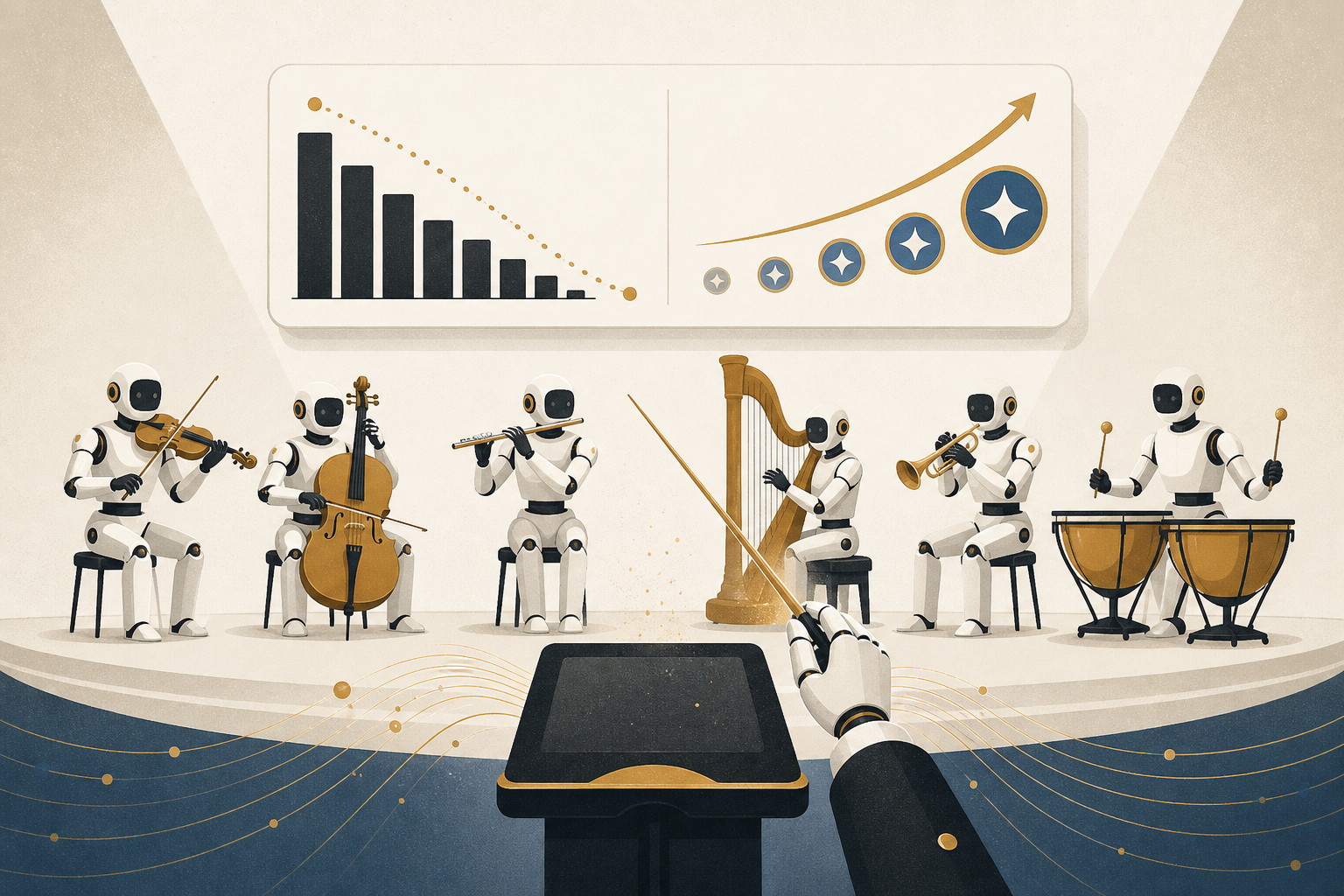
Can an AI Orchestrator Get Better Without Human Feedback?
A new approach called OrchRM lets multi-agent orchestrators improve themselves by learning from intermediate outputs — reducing token costs by up to 10x while lifting accuracy by around 8%. Here is what that means for enterprise back-office automation.

2026 / 06 / 14
Can AI Express How Angry It Sounds? Fine-Grained Emotion Intensity Control in TTS
Controlling the intensity of emotion — not just the presence of emotion — has been a stubborn challenge in LLM-based text-to-speech. Emo-LiPO reframes emotion intensity as a ranking problem and applies Listwise Preference Optimization to directly optimize the alignment between emotional prompts and audio output. The results outperform existing baselines across all emotion categories, with the most pronounced gains at high intensity levels.

2026 / 06 / 14
Why AI Contract Review Fails Across Borders ── 14,727 Clause Pairs Quantify the Gap
LAUKIN, a new dataset of 14,727 clause pairs extracted from 204 commercial contracts across Australia, the UK, and India, benchmarks how well AI models handle cross-jurisdictional legal equivalence. The best of 12 evaluated models reached an F1 of 65.11%. The findings spell out the limits of single-jurisdiction AI in global legal workflows — and where it can still add value today.

2026 / 06 / 14
Automating KPI Extraction from Annual Reports — What LEDGER Tells IR and Finance Teams
LEDGER is a large-scale benchmark of approximately 5,000 corporate annual reports, annotated with 31 KPIs linked to market reactions at earnings disclosure. It reveals where LLMs fall short on dense financial documents — and provides a precise map for designing workflows where human review fills the gaps.

2026 / 06 / 14
Automate CRF Entry Without Sending Hospital Data Anywhere ── How Local LLMs Enable Privacy-Preserving Clinical Trial Support
A fully local two-stage LLM pipeline using MedGemma-27B achieved second place (macro F1 = 0.55) on an English clinical CRF-filling benchmark — zero external API calls, zero fine-tuning. If local on-premise deployment can reach competitive performance on this task, pharmaceutical companies, CROs, and hospitals have a concrete path to privacy-compliant AI-assisted data entry.

2026 / 06 / 14
Can an E-Commerce AI Grow Its Own Skills? ── What SkillChain Demonstrates in Production
SkillChain is a closed-loop system that automatically bootstraps, optimizes, and continuously refines the 'skills' of an image-based e-commerce AI assistant — without human intervention at each cycle. Deployed on a production EC platform, it demonstrated statistically significant improvements in user engagement and retention. Here's what the architecture means for teams building or managing AI in retail, e-commerce, and product.

2026 / 06 / 13
Medical Imaging AI Hallucinations: How to Manage Them Well Enough to Pass FDA Review
A new paper systematically categorizes AI hallucinations across five medical imaging modalities and proposes detection and mitigation strategies aligned with FDA's Total Product Lifecycle framework. Here is what radiology AI vendors and medical device makers need to take from it for regulatory submissions.