Column
You Only See Your Doctor for 1 Hour a Year. The Other 8,759 Hours Are Where Health Is Made
A new architecture called Personal Care Utility reimagines health management as everyday infrastructure — the kind that reaches you like electricity or running water, not just when you visit a clinic. Here's what HR teams, PHR developers, and chronic disease SaaS builders can take away from it.
Hi, I’m Keito Inoshita from Affectosphere Group.
Here’s a scene that comes up a lot when talking to HR professionals.
“We run annual health checkups. But the day after results come in, everyone’s back to the same habits.”
Employee health data accumulates as isolated data points. But it never connects to daily behavior. So nothing changes.
There’s a structural reason for this — and a research team has put a number on it.
3 Points for Today
- The core problem: people spend roughly one hour per year with a clinician. The other 8,759 hours of daily life are where health outcomes are actually determined.
- The PCU concept: a research architecture that reframes health management as infrastructure — constant, personalized, and woven into everyday life like power or water.
- What teams can try now: concrete use cases, department mappings, and KPI candidates for HR wellness programs, PHR services, and chronic disease SaaS.
The 1-Hour vs. 8,759-Hour Asymmetry
A study published on arXiv (Mahyar Abbasian, Elahe Khatibi, Saba A. Farahani, Nitish Nagesh, Arshia Ilaty, Hooman Sajjadi, Amir Rahmani, Ramesh Jain) puts this gap in stark terms.
The time a person spends with a clinician in any given year amounts to roughly one hour. The remaining 8,759 hours of daily life — the habits, the meals, the sleep, the stress — are what actually determine long-term health outcomes.
Most people would nod along to this. But almost all healthcare services are designed around that one-hour side of the equation. Diagnosis, prescription, clinic visit. The rest of the time is left to the patient.
The paper’s response to this asymmetry is a framework called Personal Care Utility, or PCU.
Delivering Health Like Electricity
The framing PCU proposes is striking.
“Health management should be as universally accessible as electricity or running water.”
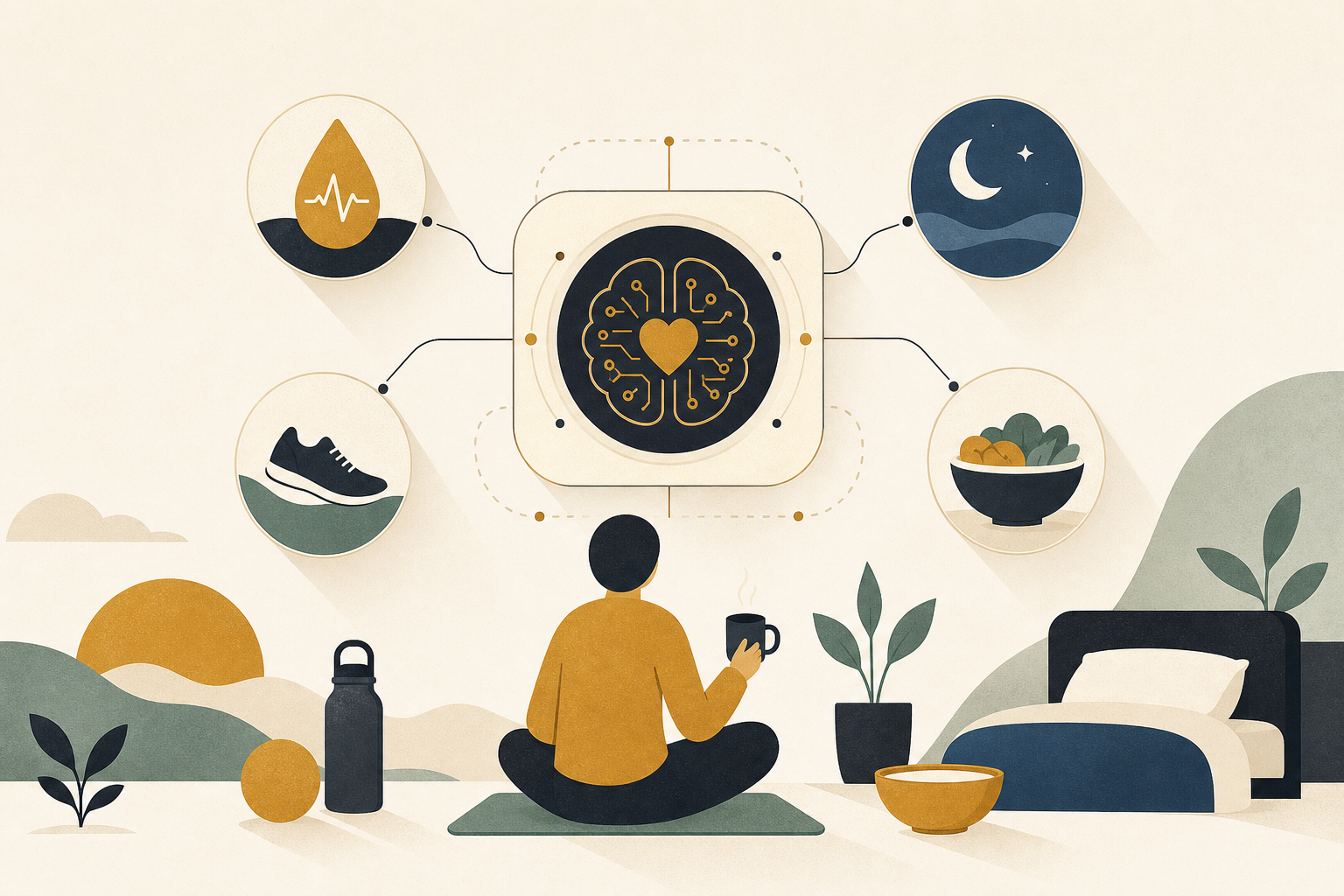
Electricity and water reach you without conscious effort. They’re available when you need them. They scale to individual circumstances. PCU applies this logic to health: an architecture that continuously converts personal data into meaningful life events and delivers context-adaptive guidance around the clock.
The data it integrates includes:
- Continuous glucose monitoring (CGM)
- Meal logs
- Activity data (steps, exercise intensity, etc.)
- Medication records
- Sleep data
- Stress indicators
These are combined to estimate individualized health states and deliver interventions across three layers.
Real-time alerts (notifications when immediate attention is needed, such as a post-meal glucose spike). Weekly summaries (trends and improvement points from the past week). Evidence-based interventions (diet, exercise, and lifestyle recommendations grounded in clinical evidence).
The paper uses type 2 diabetes management as a concrete case study, demonstrating that all three intervention layers can function together.
The Clinical Safety Question
Any system like this immediately raises a necessary question: who is responsible when AI gives someone the wrong advice?
PCU addresses this by framing all guidance explicitly as non-prescriptive — it’s guidance, not diagnosis or treatment. The paper states that clinical safety is maintained throughout the architecture. That said, for teams looking to implement something similar, we’d recommend reading the original paper directly for specifics, and designing clear lines of responsibility alongside medical professionals from the start.
Launching a system like this without explicit physician partnership and liability structure would carry significant risk, in our view.
A Concrete Use Case for HR and PHR Teams
Here’s how PCU’s framing might translate to a real implementation.
Use case: continuous support program for employees managing chronic conditions.
Departments involved: HR, employee benefits, and occupational health working together.
Current gap: employees flagged as “at-risk” in annual health screenings are largely left to self-manage until their numbers deteriorate enough to trigger an occupational physician consultation.
What a PCU-inspired approach could look like: collect continuous data on blood glucose, activity, and sleep; deliver weekly personalized feedback to each employee; identify individual tendencies (e.g., post-lunch glucose spikes) and send specific, actionable nudges (e.g., “try a 10-minute walk after lunch”).
KPI candidates:
- Rate of “at-risk → improved” transitions in annual health screenings
- Lifestyle change scores among program participants (step counts, meal-logging retention, etc.)
- Change in self-reported wellbeing scores
For health insurers: ongoing correlation monitoring between enrollee CGM data and medical costs, with cost-effectiveness measurement of preventive interventions.
For chronic disease SaaS builders: PCU’s three-layer intervention structure (real-time, weekly, evidence-based) could serve as a product architecture skeleton.
What “Infrastructure” Actually Means Here
PCU’s choice of the word “infrastructure” isn’t rhetorical decoration.
Electricity and water became infrastructure because individual effort at acquiring them hit a wall. Health is similar. A world where only highly motivated people maintain healthy lifestyles is not sustainable. The argument is that technology needs to blend into everyday life — so that healthy behaviors accumulate without requiring constant conscious effort.
For anyone designing health and wellness programs, this framing carries a direct challenge: moving from “running health events” to “laying health infrastructure.”
The research presents an architectural framework, not a finished product. But the direction it points in speaks directly to what practitioners in this space are grappling with.
That’s all for today!
References
- Mahyar Abbasian, Elahe Khatibi, Saba A. Farahani, Nitish Nagesh, Arshia Ilaty, Hooman Sajjadi, Amir Rahmani, Ramesh Jain (2026). Personal Care Utility: Health as Everyday Infrastructure. arXiv preprint.
* This article was written in part with AI assistance and may contain inaccuracies.