> "In an age when emotion envelops society like an atmosphere, we ask what to measure, what to preserve, and what we will never yield."
The Affectosphere Group, directed by Keito Inoshita, looks beyond affective computing toward the arrival of the "Affectosphere." The Affectosphere is a sphere in which emotion exists ubiquitously like the atmosphere of society, becomes computable, and is observed by AI every day. Our lab reconceives that sphere as an object of computation, and re-examines — from both technological and philosophical sides — what AI that handles emotion means for people and for society.
VISION — Version (2026)
Since the twentieth century, the study of emotion has treated emotion as a phenomenon closed within the human interior. Psychology has described emotion as subjective experience, philosophy as normative experience, and neuroscience as the expression of neural physiology — yet the object has always been closed "within the individual."
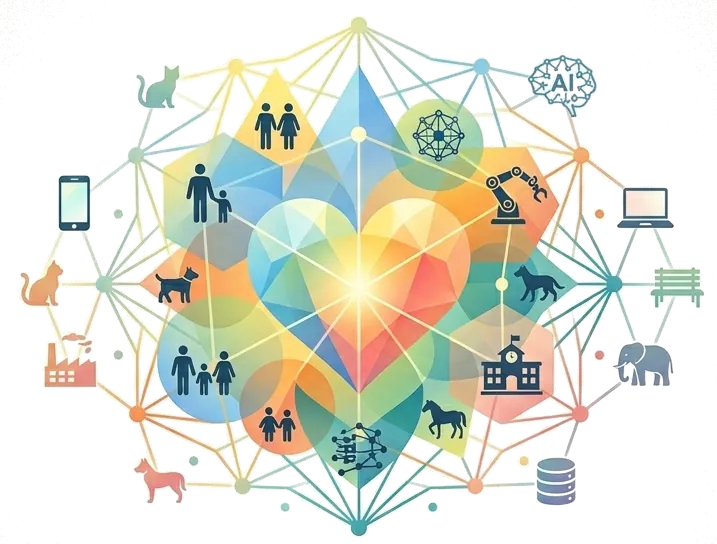
The rise of affective AI, however, is quietly but fundamentally rewriting this premise. Text, facial expression, voice, physiological signals, the rhythm of dialogue, the lighting of a store, the air of a social network, the silence of an organization — across every site of society, emotion is already being generated, propagated, and shaping relations. Emotion is no longer confined inside the individual; it is becoming an atmosphere-like presence woven into the very structure of society. We call this sphere the Affectosphere.
The Affectosphere is a domain with a doubled horizon: it is computable and observable, and yet, for the individual, it persists as personal experience. Over the next decade, dialogue-capable AI will become ubiquitous in cars, home appliances, furniture, and urban infrastructure. The ubiquity of AI has two stages. The first stage is the ubiquity of AI that "understands when you speak" (the expansion of active dialogue); the second is the ubiquity of AI that "understands without your speaking" (passive inference of the environment). The latter is the apex of convenience and, at the same time, a world in which one's emotions are continually read without one's awareness.
In such a world, the question we pose is not "whether to give AI emotion." It is the question of how to design AI that has already begun to possess functional emotion. As Anthropic's research has shown, LLMs already harbor functional emotions internally, and these causally influence their behavior. The question has already moved to the stage of design.
At the core of that design, we place the principle of Affective Sovereignty. No matter how precisely AI comes to measure emotion, the one who ultimately determines its meaning is the user themselves. This is a natural extension of the right to self-determination in medicine and in personal information, and it is positioned as a new human-rights concept for an age in which technologies that handle emotion become widespread.
Our paper Bridging the Silos in Affective AI (2026) sets out affective AI research as a six-layered socio-technical system (theory, data, model, dialogue, social applications, ethics) and diagnoses the structural fractures that recur between those layers as "silo bridges." Working from the five design criteria it derives — making emotion theory explicit, designing the boundary between inference and intervention, longitudinal evaluation of interaction, accountability tailored to deployment context, and the preservation of affective sovereignty — we aim to prepare the soil in which affective AI can grow soundly.
The Affectosphere is not a phenomenon that suddenly appears in the future. It already exists, and a new layer is formed each time AI is implemented as a technology that reads emotion. What we aim for is a future in which AI endowed with an EQ that surpasses humans is realized not as a being that dominates people but as a "being that exists alongside us."
To that end, we build technology, polish concepts, and continue to keep questions open. The Affectosphere is the sphere in which emotion envelops society like an atmosphere, and so that it may be preserved as a place where anyone can regain a margin of the heart, we design, we measure, and we keep asking.
A Gentler Explanation
AI that reads emotion has already entered our daily lives. Smartphones gauge their users' moods to adjust the timing of notifications; call-center AI detects dissatisfaction from the tone of a voice; social networks measure the emotion of posts to optimize advertising — without noticing, we have begun to live in a world in which our emotions are continually read.
From here on, AI will come to understand and stand close to our emotions even more. A refrigerator may sense its user's fatigue and operate with a gentle sound; a car may detect the driver's irritation and adjust the ambient sound; a robot may quietly speak to a child who is feeling low.
Yet this convenience carries a serious problem. In a world where AI unilaterally and continually interprets, "You are angry, aren't you," "You look sad," the most basic human right — how we ourselves understand our own emotions — is quietly eroded.
We call this kind of future the Affectosphere: a sphere in which emotion exists ubiquitously like the atmosphere of society and becomes computable. The Affectosphere Group is a lab that keeps asking, from the three directions of technology, philosophy, and society, how this sphere should be designed.
What we seek to protect is a simple principle: "the ultimate interpreter of your emotion is you yourself." No matter how well AI comes to measure emotion, the one who ultimately determines its meaning remains the person themselves — this principle we call Affective Sovereignty.
To realize AI that handles emotion not as a being that dominates people but as a being that exists alongside us. To leverage the fact that Japanese is, by global standards, a language extraordinarily rich in emotional expression, and to present from Japan to the world an affective AI that preserves culture while extending it. That is the vision of the Affectosphere Group.
updated 2026.05.30