
Column
How DoorDash Uses MARL to Autonomously Balance a Three-Sided Tradeoff
DoorDash deployed a multi-agent reinforcement learning system in production that dynamically adjusts the balance between delivery speed, courier efficiency, and restaurant load. The architecture offers a replicable blueprint for logistics, last-mile delivery, and sharing economy operators worldwide.
Hello. This is Keito Inoshita from Affectosphere Group.
One of the hardest problems in running a food delivery platform is managing the three-sided tradeoff.
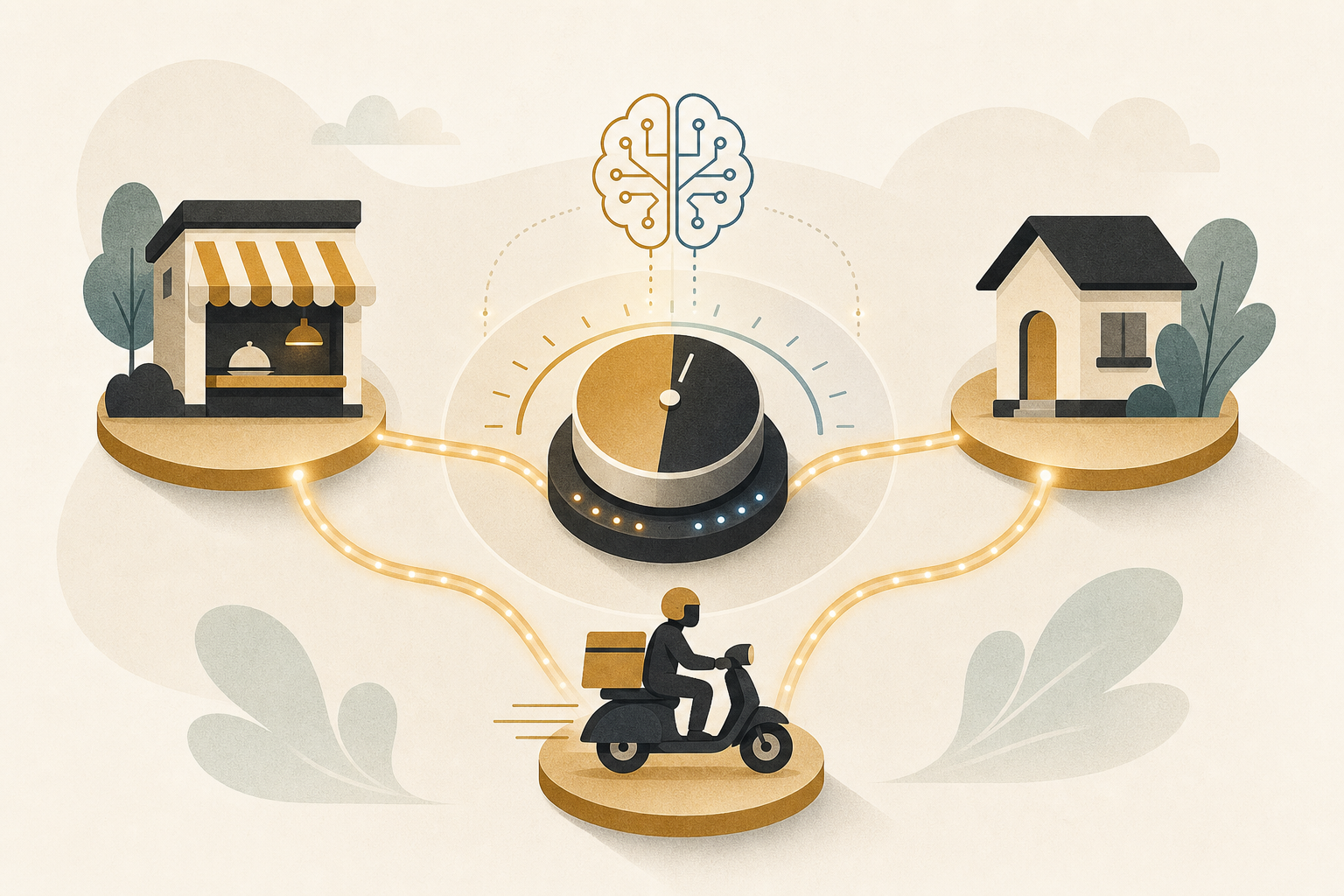
Customers want their orders fast. Couriers want to maximize their earnings per hour. Restaurants want orders to arrive at a pace they can handle without sacrificing quality. These three interests frequently conflict.
Try to optimize delivery speed → concentrate couriers in high-demand areas → overwhelm specific restaurants with orders → quality drops → delivery time goes up anyway. The feedback loops are real.
DoorDash’s engineering team tackled this problem directly. A study published on arXiv in June 2026 (Haochen Wu, Yi Hou, Shiguang Xie; arXiv:2606.13604) describes a multi-agent reinforcement learning (MARL) system deployed in production that autonomously adjusts this three-sided tradeoff in real time.
For logistics, e-commerce delivery, and food delivery companies, this is a case worth studying carefully.
Three takeaways for today
- DoorDash built and deployed a production MARL system that dynamically adjusts the balance between delivery speed, courier utilization, and restaurant congestion in real time.
- The technical core of this work is solving the delayed feedback problem — which is why rule-based operations optimization has fundamental limits.
- The architecture translates to food delivery, last-mile logistics, ride-sharing, and other multi-stakeholder dispatch problems — with concrete KPIs to track.
① What the three-sided tradeoff actually looks like
In a food delivery marketplace like DoorDash, three types of players interact.
Consumers want fast delivery. Shorter delivery times improve satisfaction and drive retention.
Dashers (couriers) want efficient earnings. Less dead mileage, smoother transitions between assignments — each translates to higher hourly income.
Restaurants want orders arriving at a manageable pace. Too many simultaneous orders hurt quality. Too few leave capacity idle.
These interests conflict structurally.
If you optimize for consumer delivery speed by concentrating couriers near high-demand restaurants, you overwhelm those restaurants. Food preparation slows down. The extra wait time at pickup cancels the routing efficiency gain. Consumer delivery time ends up longer than before.
Rule-based systems try to handle this by encoding business logic manually: “during lunch peak, cap restaurant order rate at X per minute.” But these rules need constant tuning, do not generalize across contexts, and cannot react to conditions that designers did not anticipate.
DoorDash chose a different approach: let reinforcement learning handle the adaptation.
② The delayed feedback problem
The technical centerpiece of this research is solving the delayed feedback problem in a real-time dispatch setting.
Reinforcement learning works through a cycle: take an action, observe the result, update the policy. The quality of learning depends on how clear and timely the feedback signal is.
In food delivery dispatch, the action (assigning a courier to a restaurant for a specific order) and the meaningful result (did the customer get their food on time? was the restaurant overwhelmed?) are separated by a time gap. The delivery result only becomes observable after the order completes — potentially 30–60 minutes later.
This time gap between action and feedback is the delayed feedback problem. When the delay is large, the learning signal is noisy: many other actions were taken during the interval, making it hard to attribute outcomes to specific decisions.
The research team designed a learning architecture that handles this delay — using marketplace feedback signals that arrive late while still enabling reliable updates to the objective weights governing the three-sided tradeoff.
③ What autonomous adjustment actually means
“Dynamically adjusting objective weights” is worth unpacking concretely.
In a conventional system, the optimization weights might be set as fixed parameters: “weight delivery speed at 50%, courier utilization at 30%, restaurant load at 20%.” These weights are tuned by engineers and updated periodically.
But the right balance changes constantly. Lunch peak and 3am look different. Rainy days change courier behavior. A stadium event creates a localized demand spike. An engineering team cannot manually update weights fast enough to track these variations.
The MARL system learns to adjust these weights in real time based on what it observes in the marketplace. When conditions shift, the system recalibrates the balance between consumer speed, courier efficiency, and restaurant load without a human deciding to intervene.
The multi-agent structure also matters. Different agents handle different aspects of the problem — courier routing, order assignment, restaurant load management — and coordinate toward overall system health. This allows parallelism in optimization that a single monolithic model cannot easily achieve.
④ Application to your business
Starting from the DoorDash case, let’s think about implications for food delivery, logistics, and sharing economy operators.
For food delivery platforms, the application is direct.
Operators running similar marketplace structures face the same three-sided tradeoff. The MARL architecture described here is technically deployable in any platform that has the data infrastructure to collect marketplace feedback signals.
One Japan-specific angle: restaurant overload tends to have a particularly direct impact on quality in the Japanese food service market. Restaurant operators are often unwilling to compromise on quality standards even under pressure. An MARL system that actively manages restaurant order cadence could reduce the tension between growth volume and quality maintenance. KPIs to track: peak-hour restaurant wait time and courier idle rate, optimized simultaneously.
For e-commerce last-mile delivery, the structural analogy holds.
Amazon, Rakuten, and major parcel carriers deal with a distribution center–courier–recipient tradeoff. Delivery efficiency, redelivery rate, and courier labor load all need to be balanced. Japan’s notoriously high redelivery rate — a persistent industry problem — could be addressed by a system that learns to predict recipient availability patterns and adjusts delivery scheduling accordingly. Relevant KPIs: first-attempt delivery success rate and deliveries per courier per day.
For ride-sharing and taxi dispatch, the mapping is straightforward.
Passenger wait time, driver utilization, and platform cost per trip form a three-sided structure. The delayed feedback problem (knowing whether a dispatch decision was good only after the trip completes) is identical. DoorDash’s architecture is directly applicable to demand prediction–driven dispatch optimization in ride-sharing.
⑤ What you need before implementing MARL
Implementing MARL for operations optimization has real prerequisites.
The first is a feedback collection infrastructure. DoorDash’s system works because the platform captures structured action-to-outcome data — assignment decisions, pickup times, delivery completions, customer ratings. Before any MARL system can learn, you need that data pipeline. The first question to ask: does your platform log dispatch actions and downstream outcomes in a way that makes the feedback delay measurable?
The second is explicit optimization target definition. For the three-sided tradeoff to be manageable, you need to define what “good” means in numerical terms for each stakeholder. What metric represents courier satisfaction? What threshold for restaurant load is acceptable? These definitions need to be made before training, not discovered after deployment.
The third is a staged rollout design. MARL systems can exhibit unexpected behaviors in production, particularly in edge-case conditions. Starting with a limited geography, time window, or route category and running A/B tests against the existing rule-based system is a practical path to validating the approach before full deployment.
From “someone loses” to “everyone gains”
The structural challenge in delivery and logistics has long been that optimizing for one stakeholder shifts costs onto another.
What DoorDash demonstrated is a shift in approach: instead of resolving the tradeoff through fixed rules that need manual tuning, let an adaptive system continuously realign the balance as conditions change.
This is not a food delivery–specific insight. Any service with multiple stakeholders holding different objectives — shared mobility, healthcare scheduling, supply chain management — faces the same structural problem.
MARL is not an exotic research curiosity anymore. DoorDash has put it into production at scale. For organizations with the data infrastructure and clearly defined optimization targets, the case for trying it is stronger than ever.
That’s it for today!
Reference
- Haochen Wu, Yi Hou, Shiguang Xie (2026). Multi-Agent Reinforcement Learning from Delayed Marketplace Feedback for Objective-Weight Adaptation in Three-Sided Dispatch. arXiv preprint arXiv:2606.13604.
* This article was written in part with AI assistance and may contain inaccuracies.