
Column
Medical Imaging AI Hallucinations: How to Manage Them Well Enough to Pass FDA Review
A new paper systematically categorizes AI hallucinations across five medical imaging modalities and proposes detection and mitigation strategies aligned with FDA's Total Product Lifecycle framework. Here is what radiology AI vendors and medical device makers need to take from it for regulatory submissions.
Hello. This is Keito Inoshita from Affectosphere Group.
The term “hallucination” has become familiar in discussions of text-generating AI. In medical imaging AI, the stakes are different.
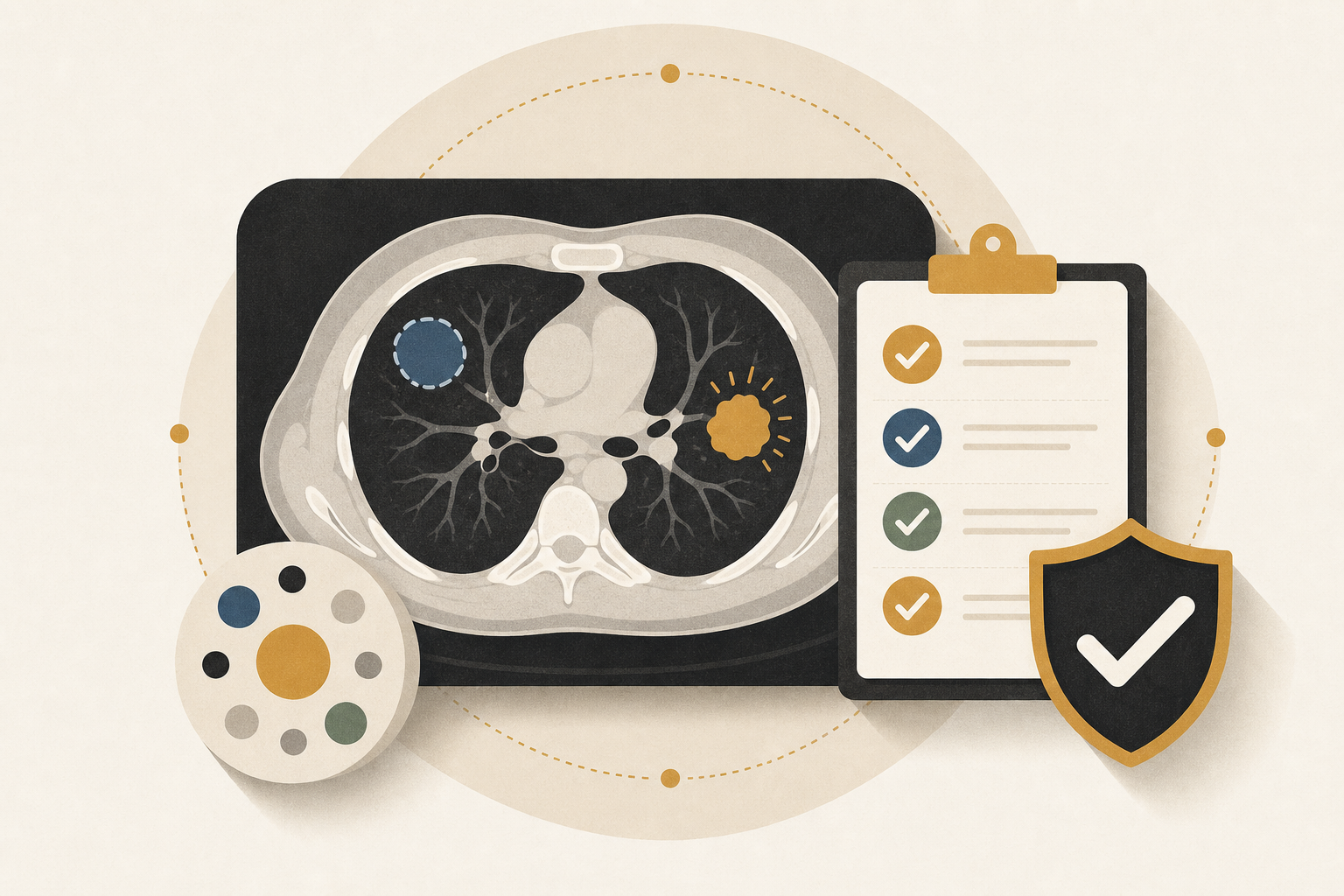
A phantom lesion appearing on a CT reconstruction, a cell structure that does not exist showing up in a pathology slide — when outputs like these enter clinical decision-making, the consequences are immediate and concrete.
But the challenge is not just about the danger itself. It is about defining what hallucinations are, detecting them, mitigating them, and then explaining all of that to regulators in terms they accept. That is a structural problem spanning the entire product development lifecycle.
A paper published on arXiv in June 2026 (Omar Alshahrani, Muzammil Behzad; arXiv:2606.13211) addresses this directly. It presents a cross-modality analytical framework covering five medical imaging modalities — an integrated taxonomy of hallucination types, root causes, detection methods, and mitigation strategies positioned explicitly within the regulatory context of FDA’s Total Product Lifecycle framework.
Three takeaways for today
- Having a formal hallucination taxonomy is what makes systematic accountability possible in FDA submissions.
- General-purpose foundation models appear to hallucinate less than specialized medical models — a counterintuitive finding with product strategy implications.
- Hallucination management must be designed as a continuous obligation across the product lifecycle, not a one-time pre-market checkpoint.
① Why a hallucination taxonomy matters for regulatory submissions
The foundation of this paper is a systematic classification of medical AI hallucinations across modalities.
X-ray, CT, MRI, pathology slides, ultrasound — hallucinations look different across these five modalities, and their root causes differ too. CT systems are prone to generating phantom lesions that resemble artifacts; pathology AI can produce non-existent cellular patterns. The paper maps these differences into a structured taxonomy: hallucination type, root cause, and which modalities are most affected.
This connects directly to regulatory submissions.
Under FDA’s Total Product Lifecycle (TPLC) framework, manufacturers must explain what kinds of errors their AI can produce, how those errors are detected, and how they are controlled. A vague statement that hallucinations may occur is not what reviewers are looking for. The question is whether the manufacturer can demonstrate a systematic understanding of the hallucination risk — what kinds, under what conditions, with what mitigation.
The taxonomy in this paper provides a shared vocabulary for exactly that kind of explanation. Radiology AI vendors and medical device makers drafting 510(k) submissions or De Novo requests can use this classification as the structural basis for their hallucination risk characterization, making it less likely that reviewers find gaps or inconsistencies.
The same logic applies in Japan. PMDA’s SaMD review process (Software as a Medical Device) draws on the same TPLC philosophy. Documentation of hallucination risk classification and mitigation is directly applicable to Japanese regulatory submissions as well.
② The paradox of specialized versus general-purpose models
One finding in the paper is worth pausing on.
The analysis suggests that general-purpose foundation models — large multimodal models not specifically trained for medical imaging — tend to avoid hallucinations more effectively than models specialized for medical use.
That runs against intuition. The assumption is usually that a model trained specifically on medical images should be more reliable in that domain.
The paper suggests that the diverse training data of general-purpose foundation models may reduce the risk of overfitting to the distribution of the training set. Specialized models fine-tuned on medical imaging datasets can end up generating plausible-looking outputs for inputs outside their training distribution — which is precisely where hallucinations emerge.
For product development, the implication is that specialization does not automatically mean safety. When building AI for rare diseases, unusual imaging conditions, or edge-case presentations where labeled training data is scarce, the hallucination risk of a fine-tuned specialized model may actually exceed that of a general-purpose baseline.
That should factor into decisions about when and how to specialize: not just whether the specialized model performs better on in-distribution test sets, but how it behaves on out-of-distribution inputs where hallucinations are most dangerous.
③ Hallucination management as a continuous obligation
The most important regulatory insight in the paper is that hallucination management cannot be treated as a pre-market task.
FDA’s TPLC framework explicitly requires manufacturers to maintain safety assurance across the entire product lifecycle — not just before launch, but continuously after the product is in use. This means monitoring for hallucinations in deployed systems, responding when problems are detected, and maintaining records that support post-market surveillance reporting.
The paper proposes several approaches aligned with this requirement: physics-informed constraints that force AI outputs to conform to anatomically and physically plausible structures; Chain-of-Thought prompting to make reasoning traceable and reduce the space where hallucinations can enter; and human-in-the-loop oversight integrated into the clinical workflow.
What this looks like in practice for a product roadmap:
One concrete design approach is building hallucination monitoring KPIs into the quality assurance framework. This means tracking how frequently the deployed system produces outputs that are flagged, corrected, or rejected by clinical reviewers. Collecting that data systematically over time creates the evidence base for FDA post-market reporting and for any subsequent modification submissions.
Equally important is documenting the monitoring mechanism itself in the original submission. Explaining “this is how our system detects hallucinations and this is how we respond” is substantive evidence of TPLC alignment, not just a compliance checkbox.
From chasing regulations to designing for them
The regulatory environment for medical AI is becoming more demanding, not less. Both FDA and PMDA are asking for more detailed safety explanations from AI medical device manufacturers.
Hallucinations are often treated as an unavoidable risk to be disclosed. The approach in this paper is different: classify hallucinations precisely, design detection and mitigation into the system architecture, and build continuous monitoring into the product lifecycle. That turns hallucinations from an unavoidable liability into a manageable risk.
Three things to act on: adopt a hallucination taxonomy, understand the risks specific to your model type and specialization approach, and design continuous monitoring into the product from the start. These three moves will meaningfully improve both the speed and quality of regulatory submissions.
That’s it for today!
Reference
- Omar Alshahrani, Muzammil Behzad (2026). Hallucination in Medical Imaging AI: A Cross-Modality Analytical Framework for Taxonomy, Detection, and Mitigation under Regulatory Constraints. arXiv preprint.
* This article was written in part with AI assistance and may contain inaccuracies.