
Column
Can Your AI Agent Explain Why It Took That Action? The AGO Framework Says It Should
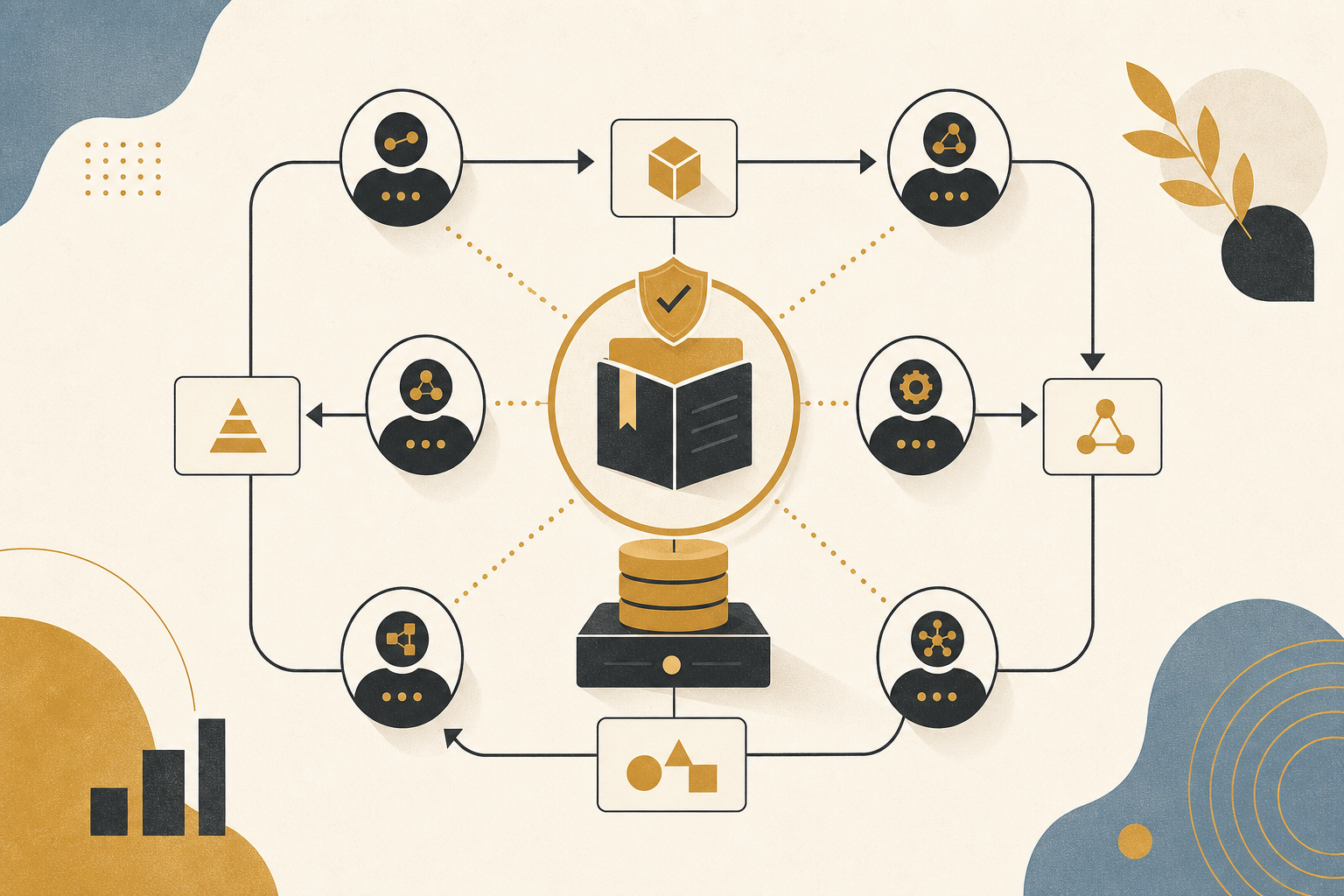
The AGO framework formalizes business processes around three axes — Agents, Goals, and Objects — and constructs a Business Process Knowledge Base that supports structured queries, incremental updates, and workflow generation. A governance-ready foundation for organizations deploying AI agents at scale.
Hello. This is Keito Inoshita from Affectosphere Group.
A question is becoming more common among organizations that have started deploying AI agents in their operations.
“When an auditor asks what this agent is doing, what exactly do we tell them?”
Automating email classification, supporting internal approval workflows, handling data entry — the efficiency gains are real. But when an AI agent becomes part of a business process, the organization needs to be able to explain not just what the agent does, but why it does it. Without that, change management, compliance, and accountability all become murky.
A study published on arXiv in June 2026 (Mohammad Azarijafari, Luisa Mich, Michele Missikoff; arXiv:2606.15291) proposes a framework designed to address this gap. The AGO framework describes business processes along three axes — Agents, Goals, and Objects — and constructs a formal Business Process Knowledge Base (BPKB) on a mathematical foundation. The goal is to bring agentic AI into business process management (BPM) with logical rigor and practical implementability.
Three takeaways for today
- The AGO framework uses three axes — who acts (Agents), why they act (Goals), and what they handle (Objects) — to describe business processes formally, with guaranteed logical soundness and completeness.
- The resulting Business Process Knowledge Base (BPKB) supports structured queries, incremental updates, and automatic workflow generation, designed for real BPM implementation rather than abstract theory.
- For large organizations expanding AI agent deployment, AGO provides a direct foundation for building an AI agent business register — enabling governance, compliance documentation, and change management traceability.
① What AGO addresses that BPMN does not
Traditional business process management describes what tasks are performed and in what sequence, typically through notation systems such as BPMN. This works well when human workers are the primary actors: the process flow corresponds to observable actions that people take.
When AI agents enter the picture, a gap opens. Agents are not passive executors of predefined steps. They pursue goals, select among possible actions, and adapt to context. The question of why the agent chose a particular action — which is central to accountability — is not captured in a flow diagram.
The AGO framework introduces a third layer to process description.
Agents refers to the actors carrying out process tasks, whether AI agents or human participants. Goals refers to the purpose or intent behind each action — the “why” layer that traditional BPM notation does not represent. Objects refers to the data, documents, and artifacts that the process creates or transforms.
Combining these three axes on a mathematical foundation allows business processes to be described in a formally rigorous way. The framework guarantees logical soundness — that descriptions are internally consistent and do not contain contradictions — and completeness — that descriptions do not omit information required for correct process interpretation. This is not just a notational improvement. It means that any description written in the AGO language can be mechanically verified to be well-formed.
② A knowledge base that queries, updates, and generates
The implementation-oriented contribution of this research is the construction of the AGO framework as a Business Process Knowledge Base — BPKB.
A BPKB is not a static document. It supports three operational capabilities.
The first is structured querying. Questions such as “what tasks is this agent responsible for?” or “which objects are involved in achieving this goal?” can be expressed as formal queries against the knowledge base and answered systematically. In an audit or compliance context, this means the organization can immediately produce accurate, complete answers about what any agent in the system is doing and why.
The second is incremental update. When a business process changes, the relevant portion of the BPKB can be updated without requiring a full rebuild. The framework formally guarantees that incremental updates preserve the consistency of the knowledge base as a whole — so a change to one part of the process description cannot silently invalidate another part.
The third is automatic workflow generation. From the Agents, Goals, and Objects defined in the BPKB, executable workflows can be generated automatically. This reduces the manual effort required to keep process documentation in sync with implementation, while maintaining formal correctness guarantees.
The researchers present this as a practical framework for BPM implementation, not purely a theoretical contribution.
③ Building an AI agent business register
The most direct enterprise application of this research is what might be called an AI agent business register.
As AI agent deployment scales within a large organization, tracking “which agent does what, for what purpose, and with what data” becomes a governance requirement. The AGO framework provides the description language for this register. Combined with existing BPM tools — BPMN, ERP workflow engines, RPA platforms — it adds the Goals layer that makes agent behavior explicitly purposeful and traceable.
The teams best positioned to benefit are business process management and operations reform teams, as well as SI and ERP vendors integrating AI agents into existing enterprise workflows. For COOs and digital transformation leads, an AGO-based register is a foundation for responsible AI deployment at scale.
From a regulatory compliance standpoint, the value is concrete. AI regulation in multiple jurisdictions — including the EU AI Act — is moving toward requiring explanation and accountability for automated decision-making. Being able to document “why the agent took that action” through a formal Goals layer provides a structural basis for compliance filings and audit responses that ad hoc documentation cannot easily replicate.
A KPI worth tracking: time required to identify the impact scope of a change to an AI agent’s behavior. With a BPKB in place, a structured query can immediately return the set of business processes, objects, and goals affected by a proposed modification. Organizations can measure this as a change management cost reduction metric and benchmark it before and after AGO adoption.
Consulting firms designing AI integration for enterprise clients can also adopt the AGO framework as a documentation standard for agent accountability — reducing the audit cost that typically surfaces in later project phases.
Organizations that can explain “why” will have the advantage
As AI agents become more embedded in business operations, a silent accountability gap grows: automation that nobody can fully explain.
That gap looks like efficiency in the short term. It shows up as compliance, change management, and audit costs later.
The AGO framework offers a design language for building AI-driven process automation that is both efficient and explainable. For organizations currently deploying AI agents, incorporating Goals-level documentation into process design standards — alongside flow diagrams and technical specifications — is a practical step worth taking now.
That’s it for today!
Reference
- Mohammad Azarijafari, Luisa Mich, Michele Missikoff (2026). A Formal Framework for Declarative Agentic AI in Business Process Analysis. arXiv preprint.
* This article was written in part with AI assistance and may contain inaccuracies.