Column
AI That Measures “How the Workplace Feels” — Support and Surveillance Are Two Sides of the Same Coin
AI that visualizes employees' psychological states is quietly spreading through HR and organizational development. From three recent studies, here's a five-minute brief on “designs that do not feel like surveillance,” “connecting measurement to intervention,” and “measuring emotion without dehumanizing the person” — for HR and executive leadership.
This article is an English translation of the original Japanese column. Some phrasing has been adapted for English readers.
Hello — this is Inoshita from Affectosphere Group.
Recently an HR lead at a large manufacturer told me:
“One of our star employees just handed in a resignation letter, out of nowhere. In the last 1:1 they said ‘I’m fine.’”
Anyone working in HR will recognize this scenario.
Remote, hybrid, globally distributed — as ways of working diversified, managers can no longer keep tabs on team health just by being in the room. A 1:1 “how are things?” doesn’t get an honest answer. An annual engagement survey is far too slow. The signal that someone is about to leave gets missed, and your best people exit in silence.
That pain is what has pushed demand for workplace emotion AI up sharply.
But this is a domain to step into very carefully.
Visualizing workplace emotion is one design step away from surveillance. The moment employees perceive themselves as being constantly watched, psychological safety collapses, surveys become rituals, and the quality of data the AI can capture crashes. Instead of productivity gains, you get a boomerang of broken trust and faster attrition.
Today I’d like to translate three papers from 2025123 into the language of HR, organizational development, and the executive team.
Three-line takeaway
- Value: workplace emotion AI that detects burnout signals weeks to months in advance lifts the competitive bar for talent retention.
- Design: “who you disclose to and how” matters more than “what you measure.” A default that returns insights to the individual first is what prevents drift toward surveillance.
- Affective AI lens: measuring emotion sits one step from objectifying the person. Whether the executive team owns that question decides whether the deployment succeeds.
In order.
1. What workplace emotion AI can do (the value side)
Putting the three studies together, a picture comes into view.
Workplace emotion measurement isn’t enough on text alone. Multimodal emotion recognition — combining facial expression, voice, text, and physiological signals (heart rate, electrodermal activity) — is moving toward practical use in workplace settings.
Each signal has its specialty.
- Text — semantic richness
- Voice — prosody (pitch, pace, micro-tremor)
- Physiological — sub-conscious affective state
- Face — instantaneous reaction
Combine them, and you can pick up multi-faceted psychological states that no single modality can see.
Layer generative AI on top, and it contributes across the whole pipeline — augmentation, analysis, feedback.
The most important piece is that generative AI can bridge quantitative metrics and qualitative feedback.
The number “your team’s stress index is up this week” becomes the actionable line: “speaking turns dropped in the second half of last week’s meeting — try cutting the agenda in half next time.” That translation used to live in the tacit skill of experienced managers. Closing that gap meaningfully lifts the 1:1 quality of newer managers and the communication quality across cultural boundaries.
And the frontier of research has clearly moved from “measure” to “measure, then change what.” Team health dashboards, burnout prediction, 1:1 support systems — the bridge from emotion data to concrete HR interventions (assignment, leave, team composition) is now an active research area.
2. Risk: get the design wrong and it dies the moment you ship it
Here’s the design principle I most want to push.
The largest risk is drift toward surveillance.
The moment employees perceive workplace emotion AI as monitoring them, it’s dead. Honest speech disappears, surveys become rituals, and the data quality collapses. This is a textbook example of a technically precise system that self-destructs on bad operational design.
The fix is to design the default as employee-first.
Make “emotion-data feedback returns to the individual first” a principle. Anything that goes to a manager or executive is a summary the individual has consented to. Personal raw data must never feed performance review.
That single rule clarifies the surveillance-vs-support boundary dramatically.
The second risk is opacity of data capture. Cameras, microphones, keystroke logs, chat content — the surface area you could capture is wide. “It’s in the employee handbook” is no longer enough.
EU AI Act, GDPR, national labor law, Japan’s APPI — they all keep raising the bar for automated inference at work. For every data type collected, you need a consent process that spells out purpose, retention, who can access it, and how to opt out. That’s the modern floor.
The third risk is misinformed HR decisions. Using emotion-AI outputs as the direct basis for assignment, evaluation, or promotion is, right now, extremely dangerous. Model accuracy isn’t perfect, and individual and cultural variance is large. Letting someone’s career be moved by “the AI said so” isn’t justifiable.
Keep AI output at the level of an alert or hint, and require human, multi-perspective final judgment. Writing that operational rule down before deployment prevents an enormous amount of future trouble.
3. The part I most want to convey as an affective-AI lab
Here is what I most want to push from the lab.
The real difficulty of workplace emotion AI is philosophical, not technical.
“Measuring emotion” is, if you stop and think about it, a fairly intense act. You convert the inner life of a person into a number visible from outside. That number may then move assignment, evaluation, promotion.
I’ll say this honestly as someone who studies affective AI: it sits one step away from objectifying the person.
In the moment when a person can’t even put their own current feeling into words, the AI announces, “your stress index is 72.” Sometimes that’s right. Sometimes it’s wrong. But more than “right or wrong,” we don’t yet really understand the psychological load of being repeatedly confronted with a numerical version of yourself.
So whether to deploy workplace emotion AI isn’t a tech-selection question. It’s a philosophical decision the organization has to make about how it treats emotion.
Our lab’s stance is to treat emotion as ambiguous and many-sided. A person’s feeling can’t be averaged or voted away. “Stress index 72” captures one face of one moment, not the person.
If you deploy workplace emotion AI, you have to design the slack that prevents the person from being crushed by the number.
Concretely, carry these questions into the design.
- Will this number ever be used outside the purposes the person consented to?
- If the number is wrong, can the person say “no, that’s not right” and have it stick?
- Are areas where the person doesn’t want to be measured (private feelings, unprocessed feelings) protected from measurement by design?
“Measure because we can” is the single thing you most cannot do in affective AI.
So what do you do tomorrow?
Three concrete moves.
- Before deployment, hold an all-hands session disclosing fully “what we’re measuring, who can see what, for what purpose.” Skip this and you’re almost guaranteed to hit a problem within six months.
- Write down the rule that emotion-AI outputs will not be a direct basis for evaluation or promotion. Get exec, HR, legal, labor relations (and union if applicable) aligned before anything ships.
- Lock the disclosure order: “individual first, then manager.” Never let a manager see emotion data the person themselves hasn’t seen yet.
Lock these three down before any tech selection.
Closing
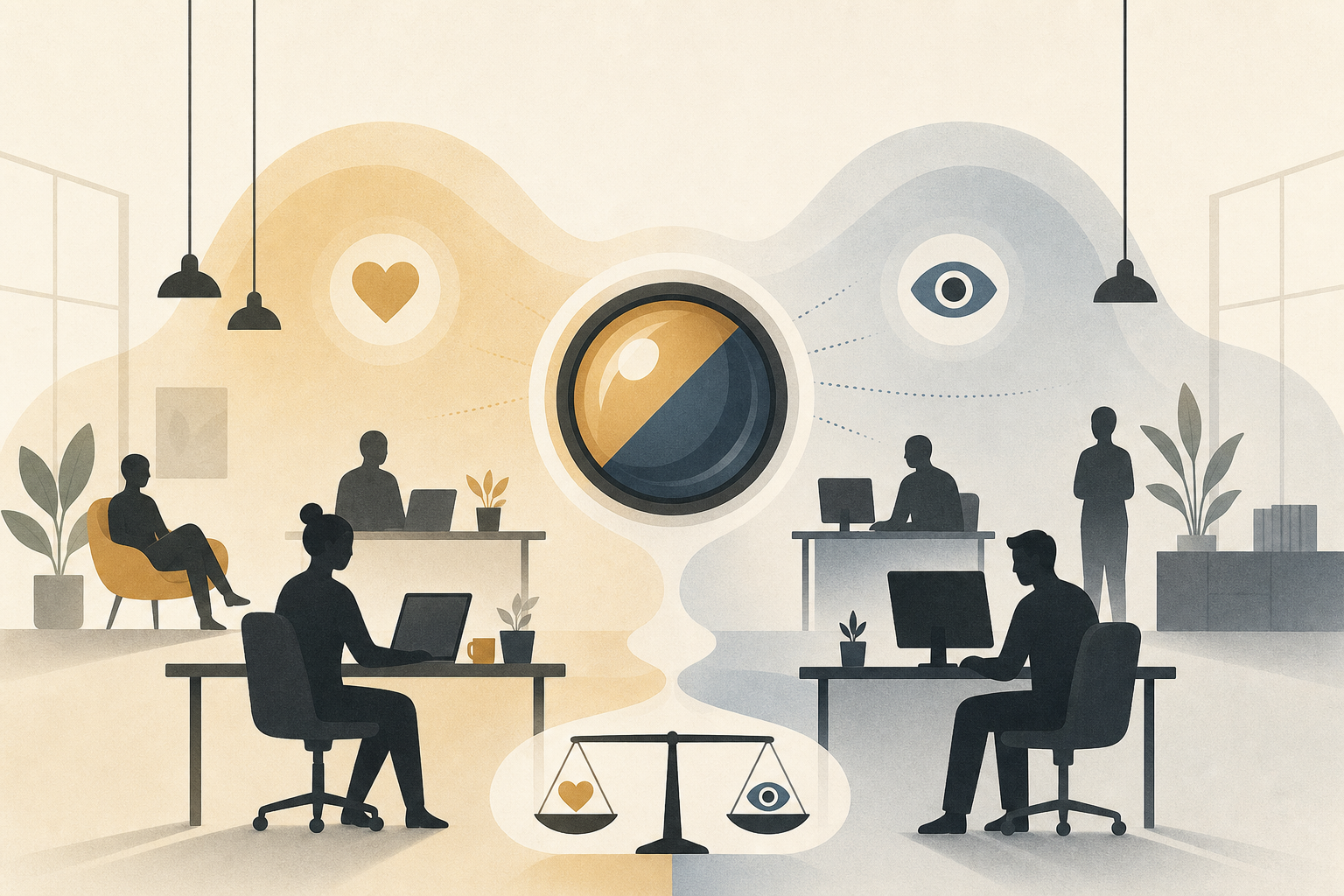
Workplace emotion AI is profoundly two-sided: with the right design it’s the strongest support tool; with the wrong design it’s the worst surveillance device.
Polishing technical accuracy doesn’t save bad operational design — it’ll still damage relationships. A so-so technical accuracy with excellent operational design can meaningfully lift organizational health.
“Multimodality,” “generative-AI assist,” “connecting well-being to HR action” — the technical front is real. But at the same time, the responsibility to actively draw the surveillance-vs-support line has landed in the executive team’s lap.
This isn’t a problem for the tech function alone. HR, exec, legal, labor relations, and the employees themselves all have to carry it.
If you ever wonder, “is our org development really fine as it is?” — start by debating those three points internally: explanation session, written operational rules, locked disclosure order.
That’s it for now.
References
- Keito Inoshita, Hironobu Ozaki (2025). Current state and outlook of multimodal emotion recognition in workplace environments (in Japanese). Journal of the Japan Society for Information and Knowledge, vol. 35, issue 2, pp. 151-156.
- Keito Inoshita (2025). Workplace emotion analysis and well-being improvement with generative AI (in Japanese). Earth, Space, and the Future, vol. 1, issue 2, pp. 109-114.
- Keito Inoshita (2025). Well-being and workplace environment in the generative AI era guided by emotion data (in Japanese). 25th Student Science and Technology Paper Contest.
* This article was written in part with AI assistance and may contain inaccuracies.
Footnotes
-
Keito Inoshita, Hironobu Ozaki, “Current state and outlook of multimodal emotion recognition in workplace environments” (in Japanese), Journal of the Japan Society for Information and Knowledge, vol. 35, issue 2, pp. 151-156, 2025. ↩
-
Keito Inoshita, “Workplace emotion analysis and well-being improvement with generative AI” (in Japanese), Earth, Space, and the Future, vol. 1, issue 2, pp. 109-114, 2025. ↩
-
Keito Inoshita, “Well-being and workplace environment in the generative AI era guided by emotion data” (in Japanese), 25th Student Science and Technology Paper Contest, 2025. ↩