
Column
What 1.3 Million Tweets Reveal About Depression in ADHD and ASD Communities
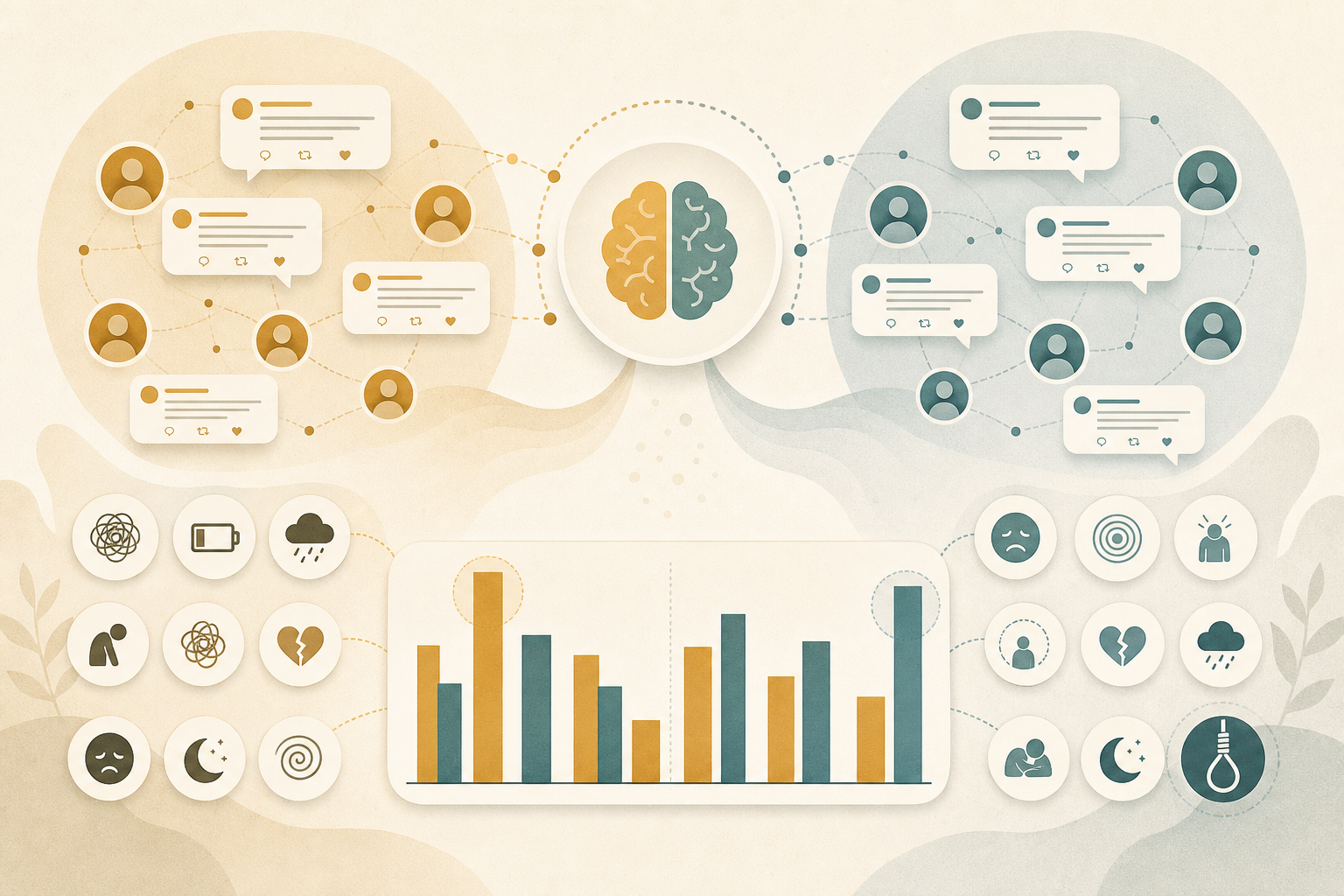
Researchers profiled DSM-5 depressive symptoms across 792 self-reported ADHD and ASD Twitter users using MentalRoBERTa fine-tuned on ReDSM5. Differences emerged between the two groups — with important caveats about what population-level data can and cannot tell us.
Hi, I’m Miura from Affectosphere Group.
When you work in affective AI research, a question keeps coming back: can we read the emotional and mental state of a population from the text they generate?
A single person’s diary tells you about one person. But what if you collected posts from hundreds of thousands of social media users? Could you surface population-level patterns in mental health — for communities with neurodevelopmental characteristics, for example?
That’s exactly the question a research team took on in a study published on arXiv (Rizwan, Nabergoj, & Demšar, arXiv:2607.05626).
The researchers collected over 1.3 million Twitter posts from 792 users who self-identified as having ADHD or ASD. They fine-tuned MentalRoBERTa — a BERT-based model pre-trained on mental health text — on a dataset called ReDSM5, then used the resulting classifier to assign each tweet to one of nine DSM-5 depressive symptom categories. The goal: a population-level symptom profile for each group.
This is affective AI doing something different from what it’s usually asked to do. Not recognizing one person’s emotion — mapping the emotional and mental landscape of an entire community.
Three takeaways
- Over 1.3 million tweets from 792 users were classified into nine DSM-5 depressive symptom categories using a fine-tuned MentalRoBERTa model.
- ADHD users showed higher frequencies of cognitive difficulty and fatigue; ASD users showed relatively more suicidal ideation-related language.
- The researchers explicitly note this is a population-level finding — it does not demonstrate phenomenological differences at the individual level.
① How do you turn 1.3 million tweets into a symptom profile?
The core of this study is MentalRoBERTa.
It is a BERT-based language model pre-trained on mental health corpora, then fine-tuned on ReDSM5 — a dataset annotated with labels corresponding to the nine diagnostic criteria for major depressive disorder in DSM-5. Those nine criteria cover areas like depressed mood, sleep disruption, changes in activity level, fatigue, difficulty concentrating, and suicidal ideation.
Each tweet gets assigned to one or more of these symptom categories. The researchers then aggregate those classifications at the user level and the group level to build symptom frequency profiles for the ADHD and ASD populations in their sample.
This is not the same as reading individual tweets and deciding whether someone might be depressed. The logic is closer to epidemiology: process a large corpus statistically and let population patterns emerge.
From an affective AI perspective, the design question of scaling from individual emotion inference to population-level pattern detection is genuinely interesting. What comes into focus at scale? What disappears? This study gives a practical answer.
② Do ADHD and ASD show different patterns of depression?
The study found differences in symptom profiles between the two groups.
The ADHD group showed higher frequencies of language associated with cognitive problems — difficulty concentrating, confused thinking — and fatigue. The ASD group showed relatively higher occurrence of suicidal ideation-related language.
This is worth sitting with. One interpretation is that ADHD’s characteristic load on executive function is visible in text. Another is that the social isolation associated with ASD shows up in the language of suicidal ideation. Both readings are speculative, but they’re grounded in what we already know about these conditions.
The researchers are careful here, though, and their care matters.
These are population-level statistical tendencies. They are not evidence of phenomenological differences at the individual level. The group “Twitter users who self-identify as ADHD” is not representative of everyone with ADHD — it skews toward people who are active online and willing to disclose publicly. Selection bias is real, and the authors say so.
Responsible reporting in sensitive domains looks like this: share what the data shows, and be explicit about what it doesn’t prove. That’s what’s happening here.
③ What does this mean for EAP and HR teams?
Let’s turn to practical application.
The NLP pipeline this study demonstrates — MentalRoBERTa fine-tuned on DSM-5 categories — is the kind of system that could be adapted for internal organizational data with appropriate privacy safeguards.
Imagine applying a similar pipeline to anonymized support chat logs or an internal social platform, aggregated at the team or department level. The output might look like: “Cognitive-load-related language has increased in this business unit over the past month” or “Fatigue-related expressions are running higher than the baseline for this group.”
EAP interventions tend to be more effective when they reach people before individual crises develop. Population-level profiling could help optimize the timing of those interventions — shifting from reactive to proactive.
There’s also a product design angle for neurodivergent employees specifically. If ADHD employees tend to express cognitive overload in recognizable language, and ASD employees show different patterns, a one-size-fits-all wellness program is probably missing the mark. Condition-specific program design needs condition-specific data, and population-level NLP profiling is one way to get it.
For insurers building wellness programs, or digital mental health SaaS products targeting the enterprise market, this kind of population-level signal layer is a meaningful addition to what’s currently available.
④ What to get right before deploying this in the workplace
The application potential is real, but so are the risks.
The first requirement is anonymization. Inferring individual mental health states from individual posts is a privacy violation. Any deployment needs to be designed around group-level aggregation, with no pathway back to individual identification.
Second, model limitations need to be built into the design. NLP classifiers are not perfectly accurate. Misclassified posts could translate into inappropriate interventions. Error rates and their downstream consequences belong in the product spec, not as an afterthought.
Third, purpose must be explicit. The difference between “monitoring employees” and “supporting employees” is not just semantic — it determines whether trust is built or destroyed. Governance design is not optional.
These are the same questions affective AI researchers navigate whenever a system moves from research to deployment. The answer isn’t to avoid the application. It’s to design the safeguards into the foundation.
Social media as a population-level emotional mirror
What this study demonstrates is that social media can function as a real-time mirror of population mental health — not at the individual level, but at the group level.
This is an exploratory study, and the researchers are clear about that. But the scale — 1.3 million posts, 792 users, nine DSM-5 categories — shows that this kind of profiling is technically feasible at meaningful size.
The finding that ADHD and ASD groups show different depressive symptom patterns creates a foundation for more targeted research into neurodevelopmental mental health. It also opens the door to data-driven conversations about how workplace wellbeing programs should be designed differently for different populations.
Affective AI has been moving from individual emotion recognition toward population-level emotional state mapping. This study sits squarely in that trajectory. I’ll be following where this line of work goes next.
That’s it for today!
References
- Rizwan, Muhammad, Nabergoj, David, & Demšar, Jure (2026). Population-Level Profiling of DSM-5 Depressive Symptoms Among Self-Reported ADHD and ASD Users on Twitter: An Exploratory Study Using Advanced NLP and Statistical Analysis. arXiv preprint. https://arxiv.org/abs/2607.05626
* This article was written in part with AI assistance and may contain inaccuracies.