
Column
It is not distracted driving but what lies ahead that shapes the takeover — rethinking driver monitoring design for semi-autonomous vehicles
We have long blamed takeover failures in semi-autonomous driving on distracted or drowsy drivers. But a simulator study finds that what drives takeover behavior most strongly is not the driver's secondary task load — it is the hazard context in front of them. That finding has direct implications for ADAS design, driver monitoring systems, and telematics insurance.
Hello. I am Miura from Affectosphere Group.
If you work in automotive safety, you may recognize this kind of conversation.
“Of course the driver fails to take over when they are looking away.” “Using a smartphone obviously scatters attention.” “Isn’t a driver monitoring system that catches drowsiness and eye deviation enough?”
That premise may deserve a second look.
A study published on arXiv (Azimi, Hakiminejad, Gomero, Pantesco, Kan, Izzetoglu & Tavakoli, arXiv:2607.10945) analyzed takeover readiness in semi-autonomous driving through multimodal physiological measurement. Its central finding: what shapes takeover behavior most strongly is not secondary-task load — distracted or not — but the hazard context in front of the driver.
Today I want to use this study as a starting point and think through what it means for ADAS development, DMS product design, and telematics insurance.
Three takeaways
- In semi-autonomous driving, drivers placed in prolonged passive monitoring experience reduced alertness — and when a sudden takeover request arrives, reaction is slow. This study set out to decompose that process through multimodal measurement.
- A within-subjects driving simulator experiment crossed two hazard types (dynamic pedestrian / static collision scene) with three secondary-task levels (none / conversation / working-memory load), measuring vehicle dynamics, subjective workload, autonomic nervous system signals (electrodermal activity, heart rate variability), and prefrontal cortex activity via fNIRS simultaneously.
- The dominant factor in takeover behavior turned out to be hazard context, not secondary task. Pedestrian events produced longer, less stable maneuvers; collision events produced faster, more stable responses. The secondary task’s effect on objective vehicle control was relatively small.
① What current DMS looks at — and where it falls short
Let me start by mapping the current situation.
Most driver monitoring systems on the market today aim to capture the driver’s own state through cameras and sensors. Where is the gaze directed? Are the eyelids closing? How is the head tilted?
This is effective for catching distraction and drowsiness. But as automation levels rise, a different problem surfaces.
In semi-autonomous driving, the driver is technically the system’s supervisor. Yet when minutes or tens of minutes pass with nothing to do but watch, human alertness naturally drifts downward. That is not a matter of willpower — it is a fundamental property of passive monitoring. And when the request to “take over now” suddenly arrives, the question is how quickly and how stably the driver can respond.
This study tried to reproduce that process precisely in a simulator and analyze it with physiological signals. Including autonomic nervous system indicators — electrodermal activity (EDA) and heart rate variability (HRV) — and prefrontal cortex activation patterns via fNIRS is the distinctive design choice, and it sits at an intersection with affective computing and physiological sensing research. Trying to read the driver’s internal state through physiological signals rather than just behavioral data is the same move that emotion AI makes.
② What the simulator study found: context dominates
Here is the skeleton of what the research team set up.
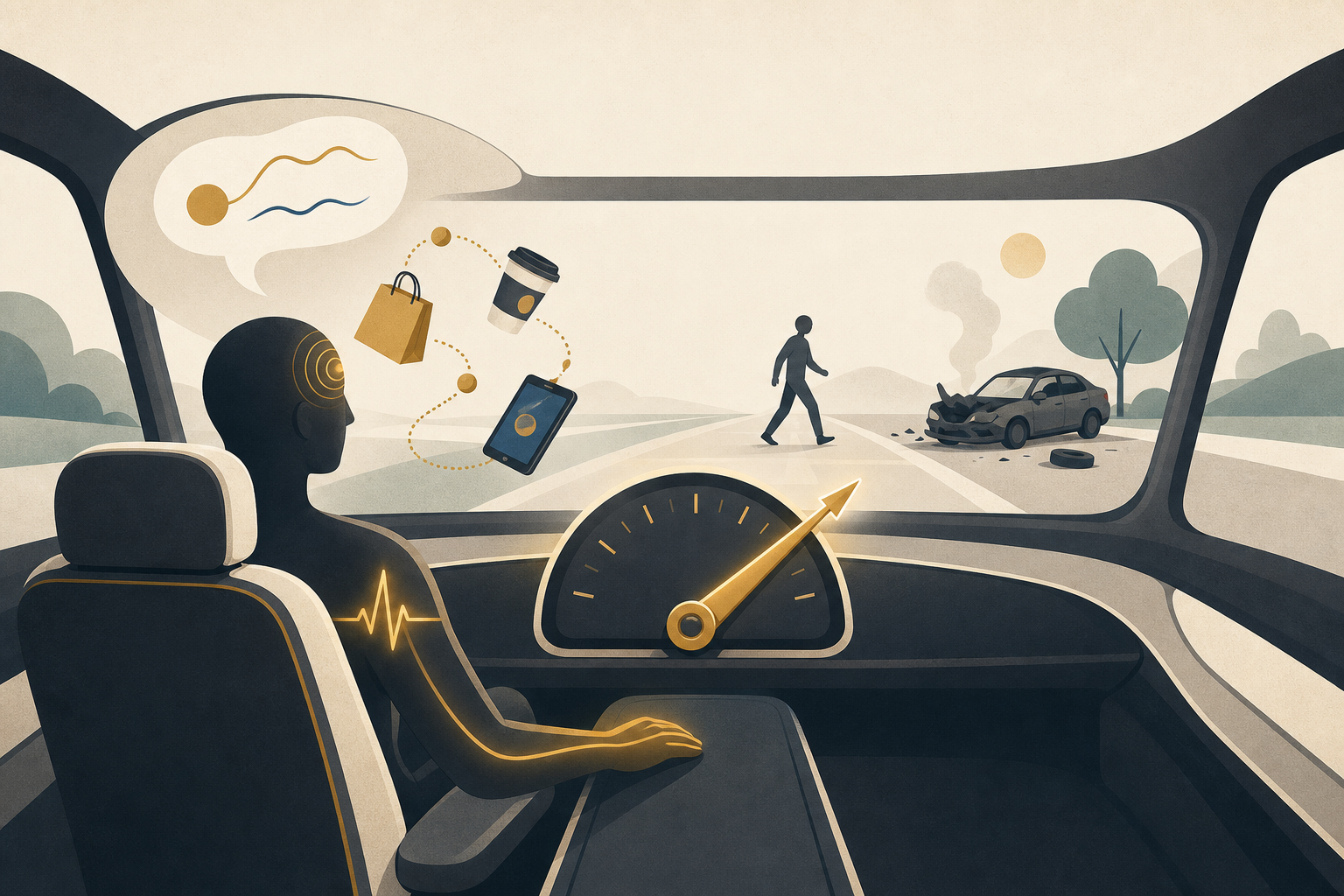
Two hazard types. A dynamic pedestrian — someone stepping into the road unexpectedly, involving unpredictable motion. And a static collision scene — a stationary vehicle or obstacle on the road, a situation that is somewhat more predictable.
These were crossed with secondary-task load at three levels: none (pure monitoring), a conversation task, and a working-memory task imposing higher cognitive demand. Because the design was within-subjects, each participant experienced multiple conditions.
Measurement was multimodal. Beyond vehicle control data, the study collected subjective workload ratings, autonomic indicators (EDA and HRV), and prefrontal cortex activity via fNIRS — all at once. The aim was to decompose takeover readiness from multiple angles simultaneously.
The result: what most strongly influenced takeover behavior was not the presence or absence of a secondary task but the type of hazard — the context.
Pedestrian events produced longer takeover maneuvers that were less stable. Collision-scene events produced faster, more stable responses. The secondary task’s effect on objective vehicle control was, relative to hazard context, smaller than one might expect.
This diverges from intuition. Given how firmly “distracted driving is dangerous” is embedded as a premise, many people would predict secondary task load to be the main driver of takeover quality. What the experiment pointed to instead was the external environment — what the driver encountered.
One important caveat: this is a simulator study, not a real-road study. Real driving environments are far more complex. Carrying these findings into vehicle design requires holding that gap between simulator and road in mind.
③ How to try it on the floor: departments and KPIs
So where and how could an organization try applying this? Here is my working scenario.
The core direction this study points toward is a shift from a driver-state model to a driver-state × environmental-hazard-context model. Current DMS looks at the driver. Adding external hazard context as an input alongside that — this is what I see as the design update implied by the findings. To be clear: this is my reading, not a conclusion the paper draws directly.
The departments I see as relevant are these.
First, ADAS and driver-assistance development teams. The finding that hazard type — pedestrian versus stationary obstacle — produces substantially different takeover behavior is a testable hypothesis for takeover-alert timing algorithms. Adding a contextual condition — “early alert during pedestrian detection, standard timing for stationary obstacles” — on top of the current “alert when drowsiness score exceeds threshold” design is a direction this study provides evidence for.
Second, DMS vendors. From a product-requirements standpoint, an architecture that integrates external scene recognition (object detection, road condition) with driver internal state (EDA, HRV, estimation of prefrontal cortex activation) could become a differentiating capability. This study provides the experimental framework that makes that case.
Third, insurance teams working on telematics products. Most telematics insurance today scores risk from behavioral signals: smartphone use, hard acceleration, hard braking. Adding a dimension of driving-environment hazard density — frequency of pedestrian-heavy intersections traversed, passages through high-accident-rate segments — as a scoring variable is a direction this research’s implications support, in my view.
Fourth, safety management in transport and logistics. Long-haul drivers and highway freight operations face exactly the “prolonged passive monitoring followed by sudden takeover demand” risk this study addresses. A route management system that maps hazard composition by segment and optimizes takeover-request timing to the environmental context is a plausible downstream application.
For KPIs to track, I propose the following.
First, takeover latency and maneuver stability — how lag and steering variance move when a context-aware alert system is introduced versus the current design. Second, driver subjective workload ratings — how perceived load shifts when alert timing changes under the same driving conditions. Third, telematics risk prediction accuracy — how the correlation with accident rates changes when environmental hazard variables are added to the scoring model. Fourth, incident count before and after — how near-miss events attributable to takeover failures trend after a context-adaptive design is implemented.
On sequencing, I would start with a simulator-based replication experiment. Set up conditions similar to this study, verify that the finding holds with your own participants and equipment, and establish the link to your product architecture. Move to real-road evaluation from there.
Beyond monitoring the driver alone
What I find compelling in this study is that its result — environmental context matters more than distraction — challenges what designers have treated as a natural starting point.
Monitoring the driver is the right idea. But monitoring the driver alone is not enough. Without capturing what is in front of them, you cannot fully characterize takeover readiness — that is what I take from this research.
From an affective computing angle, using autonomic physiological signals like EDA and HRV to estimate takeover readiness is a direction I expect to develop further. Research into sensor fusion that directly infers “is this driver primed to take over right now” sits at the boundary between the automotive industry and emotion AI, and I have a sense we will see more work there.
That is it for today!
References
- Azimi, Shiva, Hakiminejad, Yasaman, Gomero, Luis, Pantesco, Elizabeth, Kan, Irene P., Izzetoglu, Meltem, & Tavakoli, Arash (2026). When Context Dominates: Multimodal Signatures of Takeover Readiness Under Varying Hazard and Cognitive Load Conditions. arXiv preprint. https://arxiv.org/abs/2607.10945
* This article was written in part with AI assistance and may contain inaccuracies.