Column
Sub-1B Emotion AI That Rivals 10B Models — How Light-MER Reshapes On-Device Deployment
Large multimodal emotion models have been stuck behind a practical wall: too accurate to ignore, too heavy to ship on real devices. Light-MER uses knowledge distillation to break that wall, achieving 10B-class performance in under 1B parameters across nine benchmarks. Here is what it means for mobile, automotive DMS, and edge AI products.
Hello. This is Miura from Affectosphere Group.
When teams talk about embedding emotion AI into products, they tend to hit the same wall every time.
“Accurate models are too heavy to run on a smartphone.”
“Sending audio and video to the cloud creates privacy exposure.”
“Automotive chips are constrained — there is no room for a 10B model.”
Emotion recognition has long been stuck in a “works in the lab, can’t ship on the device” limbo. Large multimodal emotion language models deliver strong accuracy, but the compute cost of running them on real hardware has kept them out of consumer products.
A 2026 preprint from Kaiwen Zheng, Junchen Fu, Wenhao Deng, Hu Han, Joemon M. Jose, and Xuri Ge (arXiv:2607.12787) takes this problem head-on.
The team builds Light-MER, a lightweight emotion recognition model under 1 billion parameters, using knowledge distillation. Across nine benchmarks, Light-MER reportedly matches the performance of 10B-class models while staying small enough for resource-constrained deployment.
Today’s column unpacks what that means for business teams considering emotion AI in their products.
Three takeaways
- The value: a sub-1B model matching 10B-class accuracy makes on-device emotion recognition a realistic option for mobile, automotive, and wearable products.
- How Light-MER works: two technical choices — optimal transport loss with Sliced Wasserstein distance, and GRPO-based multi-reward optimization — move large-model knowledge into a small model efficiently.
- Business implementation: which teams act, and where — mobile apps, automotive DMS, HR Tech, and medical devices.
① The value chain that “small and accurate” unlocks
Start with why on-device matters so much.
There are two fundamental paths for deploying emotion recognition: cloud inference and on-device inference.
Cloud inference routes audio, video, or text to a server, gets emotion predictions back, and displays them. It is easy to set up and lets you run a large model without worrying about device specs.
The problem is data.
Sending facial video or voice recordings to a server requires careful handling under privacy regulations like the GDPR or Japan’s Act on Protection of Personal Information. Consent design, data retention policies, and security audits all add cost and timeline. In sensitive contexts — healthcare, education, caregiving — those requirements get significantly heavier.
On-device inference runs the model on the device itself. No data leaves the hardware, which eliminates a class of privacy risk at the architecture level rather than through policy.
The blocker has always been accuracy.
Small models lose accuracy. Accurate models need to be large. Large models don’t fit on devices.
Light-MER’s goal is to break that triangle.
According to the paper, sub-1B Light-MER matches 10B-class models across nine benchmarks. The exact margin varies by benchmark, and this is a preprint, so I’d treat the numbers as directional rather than final. Still, the direction — “small enough to deploy, accurate enough to be useful” — is a meaningful shift for product teams.
② Two technical choices behind Light-MER
You don’t need to implement these to benefit from them, but understanding the design logic is useful when evaluating whether this approach fits your use case.
Knowledge distillation, briefly
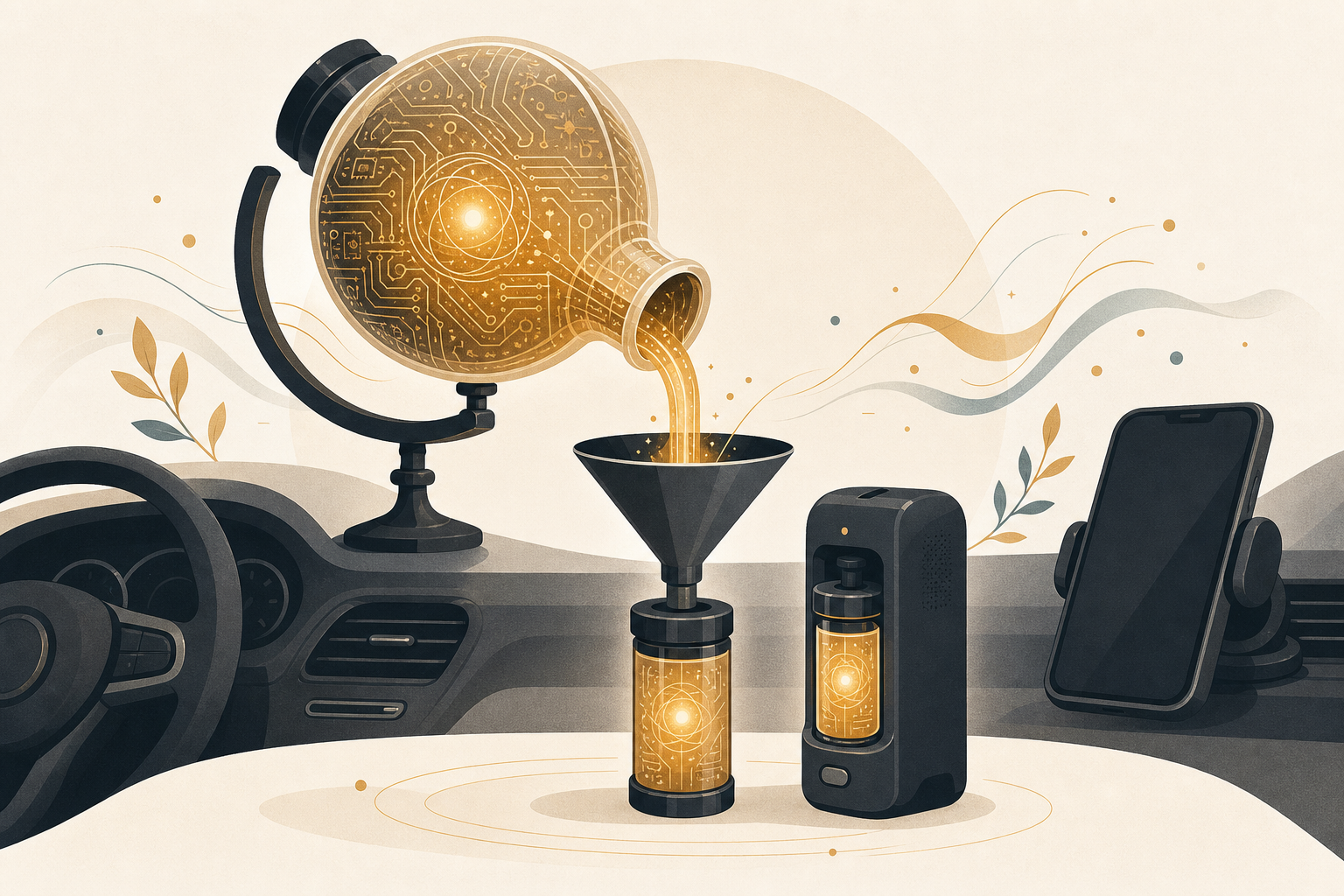
Light-MER is built via knowledge distillation. A large teacher model (10B-class) transfers its knowledge to a small student model (sub-1B). Rather than training the small model from scratch, the student learns to mimic the teacher’s outputs and internal representations.
Done well, this lets a small model punch above its weight. For a complex multimodal task like emotion recognition, two specific choices make the distillation work better.
Optimal transport loss with Sliced Wasserstein distance
The paper introduces a loss function based on Sliced Wasserstein distance combined with hidden-state alignment.
Roughly: the loss penalizes differences between the teacher’s internal representation distributions and the student’s, across modalities.
Multimodal emotion recognition fuses audio, video, and text signals. Misalignment between these modalities is a common source of accuracy loss, especially in smaller models. The optimal transport framing gives the distillation a principled way to minimize that misalignment.
GRPO-based multi-reward optimization
The second technique is multi-reward optimization based on GRPO (Group Relative Policy Optimization).
Instead of optimizing a single loss function, the training simultaneously optimizes across multiple reward signals. This helps the small model absorb the multidimensional competencies that emotion recognition requires, rather than collapsing onto a single narrow objective.
Together, these two choices appear to be what lets sub-1B Light-MER stay competitive with much larger models.
The team plans to release code and distilled weights, which would meaningfully lower the PoC cost for development teams.
③ Business implementation: who acts, and where
Here is where this becomes concrete for product and business teams.
Mobile apps / mental health
Real-time emotion recognition on a smartphone opens a different UX.
Mental health apps today rely heavily on self-reporting — “How are you feeling?” prompts that depend on user compliance. Inferring emotional state from voice tone or facial expression creates a more passive, continuous signal.
On-device processing means that voice and video never leave the phone, which changes the consent story significantly. “We analyze your emotions locally on your device” is a meaningfully different privacy posture than “your voice is processed on our servers.”
For product managers: simplified consent design, lower cloud inference costs, and offline functionality are the three benefits to evaluate first.
Automotive / Driver Monitoring Systems (DMS)
Automotive DMS is moving beyond eye-tracking and head-pose. Adding emotion recognition — detecting drowsiness, frustration, or distraction states through richer signals — is a natural next step.
The constraint is the in-vehicle chip. High-end GPUs are not cost-effective in automotive volume production, and the compute envelope is tight.
A sub-1B model that delivers competitive accuracy fits this constraint profile in a way that 10B models do not.
For OEM development teams: Light-MER’s size profile could lower the technical barrier to productizing emotion-aware DMS at volume. For Tier-1 suppliers: packaging a Light-MER-based inference stack optimized for automotive-grade chips is a plausible product direction.
HR Tech / Contact center quality management
Call center emotion monitoring and operator wellbeing tracking have been discussed for years. The persistent blocker: sending call audio to the cloud creates employee data exposure that legal and HR teams push back on.
Edge inference — running emotion recognition on premises or on-device — sidesteps this concern. A sub-1B model running on an on-premise edge node could enable real-time emotion quality scoring without routing sensitive employee audio to external servers.
This is a joint initiative between HR, legal, and IT infrastructure teams.
Medical devices / care robots
Continuous emotional state monitoring has clear applications in dementia care and psychiatric assessment contexts.
In these settings, patient data privacy is non-negotiable, and regulatory compliance shapes every architectural decision. On-device or on-premise processing fits that requirement in a way that cloud-dependent pipelines cannot easily match.
For care robot hardware designers, chip constraints are a real factor. Having a sub-1B model option in the evaluation pool expands the design space.
Summary
Light-MER challenges the assumption that emotion AI needs to be large to be useful.
By combining optimal transport distillation with multi-reward optimization, the research team shows that a sub-1B model can approach 10B-class performance across nine benchmarks.
This addresses three barriers simultaneously: device compute constraints, cloud infrastructure cost, and privacy exposure through off-device data transfer.
The results are from a preprint and should be treated accordingly, but the direction is clear. For teams in mobile, automotive DMS, HR Tech, and medical devices, this is a paper worth tracking.
If the code and weights release as planned, the PoC cost drops further.
See you next time!
References
- Kaiwen Zheng, Junchen Fu, Wenhao Deng, Hu Han, Joemon M. Jose, & Xuri Ge (2026). Do We Really Need Multimodal Emotion Language Models Larger Than 1B Parameters?. arXiv preprint. https://arxiv.org/abs/2607.12787
* This article was written in part with AI assistance and may contain inaccuracies.