Column
Label-Free User Profiling: What BUMP Means for LLM Personalization
No task labels, no manual annotation. A self-supervised framework that generates natural-language user profiles from behavior logs alone could make LLM personalization accessible at scales where it previously wasn't cost-effective.
Hello. This is Keito Inoshita from Affectosphere Group.
“How do we make the AI understand what this user actually wants?” — Whether you’re building an e-commerce platform, an internal chatbot, or any LLM-based service, this question comes up fast.
And the moment you try to answer it, the obstacles pile up. Annotating user preference data is labor-intensive. Relying on closed-source APIs raises data privacy concerns. Fine-tuning a separate model per user doesn’t scale economically.
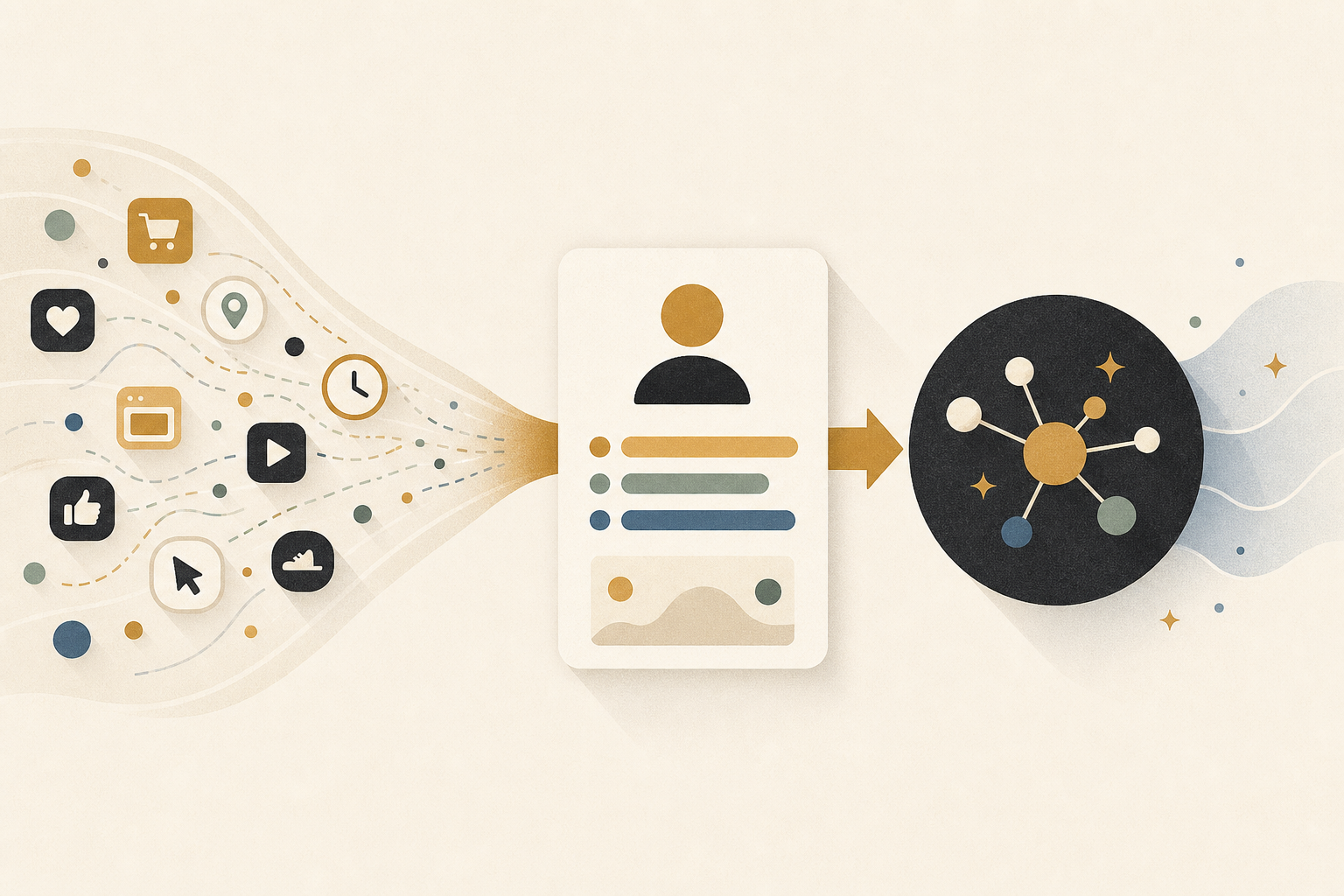
A study published on arXiv in June 2026 (Clark Mingxuan Ju, Yuwei Qiu, Tong Zhao, Neil Shah, Snap Inc., arXiv:2606.05336) attacks those obstacles directly. BUMP — Bidirectional User Modeling via Profiles — is a self-supervised framework that generates natural-language user profiles from behavior logs alone, requiring no task labels and no manual annotation.
Three takeaways for today
- Given only behavior logs, BUMP generates natural-language user profiles without any task labels.
- BUMP matches or outperforms closed-source API baselines on the LaMP personalization benchmark.
- The zero-annotation requirement makes it a viable entry point for mid-scale services where full recommendation infrastructure isn’t cost-effective.
① What “label-free” profile generation actually means
Personalization research has a long history, but the challenge in the LLM context is specific: how do you convey user preferences to a language model?
Two dominant approaches existed before this.
The first is retrieval augmentation: paste relevant items from the user’s history directly into the prompt. Simple, but performance depends on retrieval quality, and irrelevant history inflates the context window.
The second is parameter-level personalization: train a dedicated adapter per user. More precise, but storage and cost scale with user count. Tens of thousands of users means tens of thousands of adapters.
BUMP takes a different path. It generates a natural-language summary of each user — a “profile” — from their behavior history, and attaches that profile to prompts. The key is that this profile generation is self-supervised: no labeled ground truth is needed. The model learns to generate profiles whose predictions of user behavior outrank predictions based on other users’ histories.
② Bidirectional ranking and GRPO: the mechanism
A bit of technical context.
BUMP’s profile generator is trained using GRPO (Group Relative Policy Optimization), a reinforcement learning technique that learns from relative comparisons among multiple generated candidates rather than absolute rewards.
The evaluation criterion is bidirectional ranking:
- Forward: does the generated profile better predict this user’s future interactions than other users’ interactions?
- Backward: does it better predict this user’s past interactions than other users’ past interactions?
Evaluating both directions simultaneously ensures that the profile captures genuine user-specific characteristics rather than overfitting to a narrow slice of history.
Scoring uses a small LLM judge with multi-correct NDCG (Normalized Discounted Cumulative Gain). Critically, this is self-contained — no dependence on external closed-source APIs for evaluation. That matters for production deployment where data security is a constraint.
③ Where this applies in practice
Setting aside the technical details, where does BUMP actually fit in operational contexts?
E-commerce is the most immediate use case. Purchase histories, browsing logs, and ratings already exist. Generate profiles from those, attach them to LLM-powered chat interfaces or recommendation prompts, and responses become tailored to each user’s apparent preferences — without labeling a single data point.
Internal enterprise tools are another strong fit. Employee behavior logs — which features they use, what domains they work in, what questions they’ve asked — can generate profiles that allow an internal chatbot to respond in ways relevant to each person’s role and context. HR systems and knowledge management tools are natural entry points.
For mid-sized service businesses, this is potentially the most practical development. Large enterprises already have sophisticated recommendation infrastructure. But services with tens to a few hundred thousand users typically cannot justify the cost. BUMP-style approaches lower the entry threshold significantly.
In terms of KPIs to track: satisfaction scores for personalized LLM responses, in-session click rates, and chat completion rates are reasonable starting metrics for a pilot.
When the cost of understanding users drops, what changes?
Historically, achieving “responses adapted to individual users” required paying one of two costs: annotation labor or per-user model storage.
BUMP proposes a third path: use the behavior log data you already have, and let self-supervised learning generate the profiles.
No labeling, minimal external API dependency, storage that doesn’t scale with user count. When those conditions hold, projects that stalled at “we want personalization but the cost doesn’t make sense” become feasible again.
The LaMP benchmark results are promising, and the implementation architecture is realistic. This is still research, but the direction is one worth watching closely.
That’s it for today!
Reference
- Clark Mingxuan Ju, Yuwei Qiu, Tong Zhao, Neil Shah (2026). Self-supervised User Profile Generation for Personalization. arXiv preprint.
* This article was written in part with AI assistance and may contain inaccuracies.