Column
When AI Recommends, Humans Stop Reading: The Hidden Cost of Hiring Automation
A new study finds that when AI recommendations are present, recruiters spend up to 55.6% less time reviewing resumes — and that biased AI scores get quietly absorbed into final decisions, even by fairness-conscious evaluators.
Hi, I’m Keito from Affectosphere Group.
“Hiring AI will make our process more objective.” That’s often the pitch.
But what if introducing AI recommendations causes recruiters to read resumes less carefully — and ends up amplifying bias rather than removing it?
A preprint published on arXiv in June 2026 (arXiv:2606.22213) puts this question to an empirical test. Authors Kyra Wilson, Mattea Sim, Anna-Maria Gueorguieva, Soham Chatterjee, and Aylin Caliskan ran a controlled experiment examining how AI recommendations interact with human judgment in resume screening — combining behavioral logs with Implicit Association Tests.
Three takeaways for today
- Without AI recommendations, recruiters review resumes up to 55.6% longer.
- Biased AI scores transfer quietly into human decisions through automation bias.
- Even fairness-conscious evaluators struggle to serve as reliable AI monitors in high-stakes conditions.
① AI recommendations shorten how long humans actually read
The most striking finding in this study is about reading time.
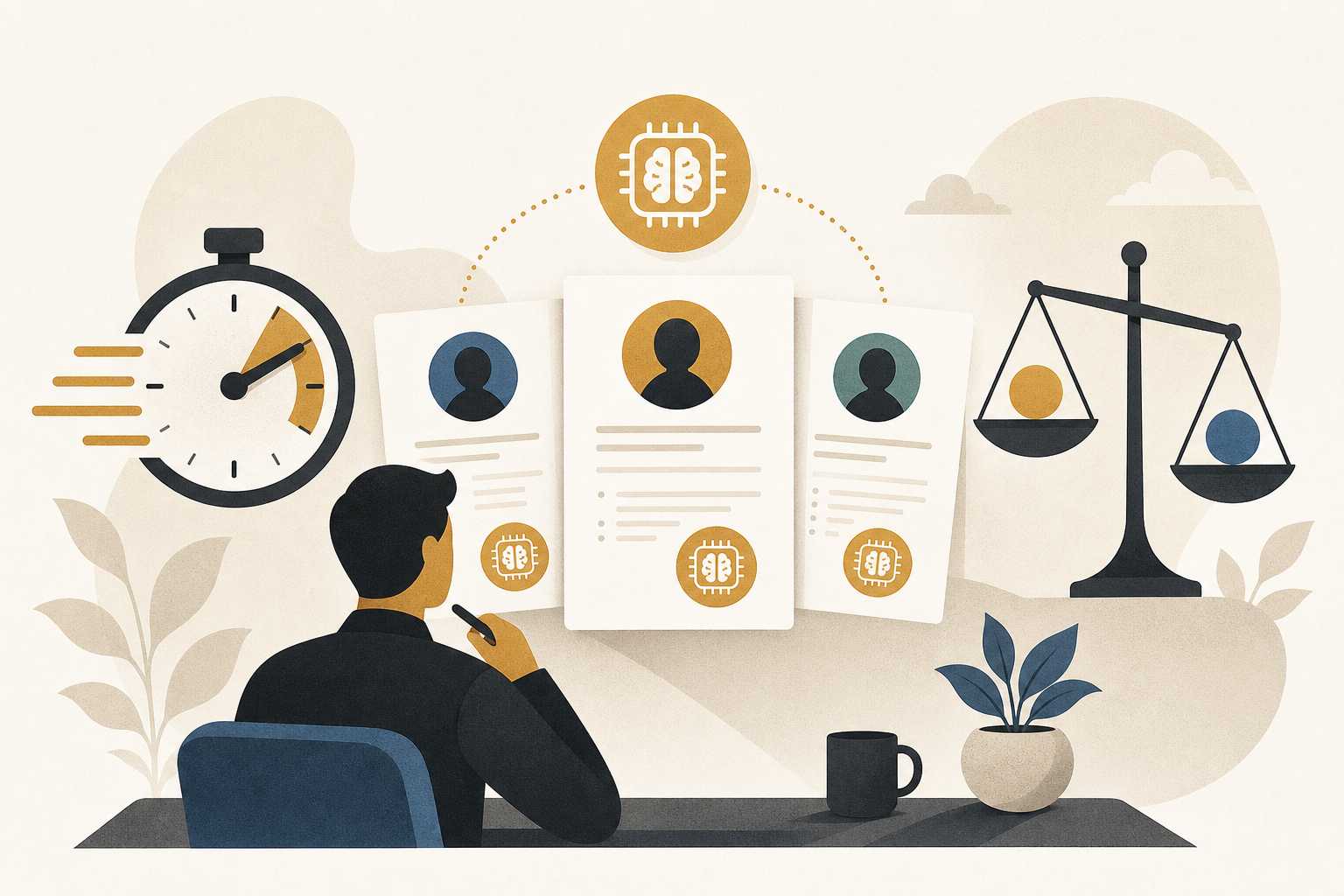
When AI recommendations were absent, participants spent up to 55.6% more time reviewing resumes compared to conditions where AI scores were displayed. This isn’t just an efficiency story — it’s a signal about depth of judgment.
On top of that, pass rates differed by 3–4 percentage points. Recruiters in the no-AI condition advanced more candidates to the next stage. So AI recommendations were simultaneously speeding up decisions and narrowing the funnel.
This isn’t AI correcting human error. It’s AI substituting for human deliberation — and that’s a different thing entirely.
② Bias flows from AI to human, quietly
The experiment included conditions where AI recommendations were intentionally biased — candidates with names associated with certain racial groups received lower scores. Then the researchers tracked whether that bias made its way into human decisions.
It did. When biased AI scores were present, evaluators were more likely to follow those scores without scrutinizing the underlying resumes closely. This is automation bias at work: the tendency to over-rely on automated outputs, especially under time pressure.
The uncomfortable part is that there’s no bad actor here. Recruiters weren’t being malicious. They were being efficient — and in doing so, they became conduits for the AI’s embedded inequity. Improving AI recommendation accuracy alone won’t fix this, because the problem is structural, not just technical.
③ Why do fairness-conscious evaluators still fall short?
The study used the Implicit Association Test (IAT) to measure each participant’s implicit racial bias. This allowed the researchers to separate out how people with stronger versus weaker fairness orientations behaved.
Here’s the nuance: participants who scored as more fairness-conscious on the IAT did allocate their review time more equitably across racial groups — but only when there were no AI recommendations. They were trying to be fair when acting on their own judgment.
When AI scores entered the picture, that equitable behavior weakened. Attention shifted toward the AI’s output, and their own fairness commitments became harder to act on.
The assumption that “a human in the loop will catch biased AI” may hold in low-stakes, low-time-pressure settings. But in high-volume screening — exactly where AI is most often deployed — the loop may not be functioning as intended.
④ What HR teams should build right now
This is the section that matters most for practitioners.
The study’s implication is not “don’t use hiring AI.” It’s that the design of how AI recommendations are used determines fairness outcomes — and most organizations haven’t made that design explicit.
Practical use case: Hiring AI fairness audit process design
Target teams: HR / Talent Acquisition, DEI and Compliance.
Three things to implement:
First, instrument review time by candidate attribute. Integrate review-time logging into your ATS (applicant tracking system) and segment average review duration by race, gender, and age. The key KPI: are candidates with high AI scores being reviewed significantly faster than others? A gap above 10% is a signal worth investigating.
Second, pilot a score-delayed UI. Instead of displaying AI recommendation scores immediately, require a minimum review period before the score appears. This nudges evaluators to form an initial impression independently before seeing the AI’s judgment.
Third, run regular bias amplification audits. Compare the demographic distribution of AI score top-quartile candidates against the demographic distribution of final hires. Divergence between these two distributions indicates where bias is entering or being filtered — and gives you a defensible paper trail for compliance purposes.
KPIs to track: average review time gap across demographic groups (target: within 10%), and the demographic disparity ratio between AI-recommended and final-selected pools.
Hiring AI isn’t a fairness tool by default — it can be a bias amplifier
Deploying AI in hiring makes recruiters faster. But this study suggests that speed comes at a cost: shallower reading, less independent judgment, and more susceptibility to whatever biases the model carries.
The numbers — 55.6% less reading time, 3–4% shift in pass rates — look modest. In high-volume hiring, they aren’t. Across hundreds or thousands of candidates, these effects compound.
Hiring AI doesn’t end responsibility. If anything, it demands more deliberate process design to ensure that human judgment remains genuinely in the loop — not just nominally.
That’s it for today!
References
- Kyra Wilson, Mattea Sim, Anna-Maria Gueorguieva, Soham Chatterjee, Aylin Caliskan (2026). Resume Screening, Fast and Slow: (Biased) AI Recommendations’ Influence on Human Decision Making. arXiv preprint.
* This article was written in part with AI assistance and may contain inaccuracies.