
Column
The AI That Gets Smarter Under Stress: ReflectiChain and the Future of Supply Chain Resilience
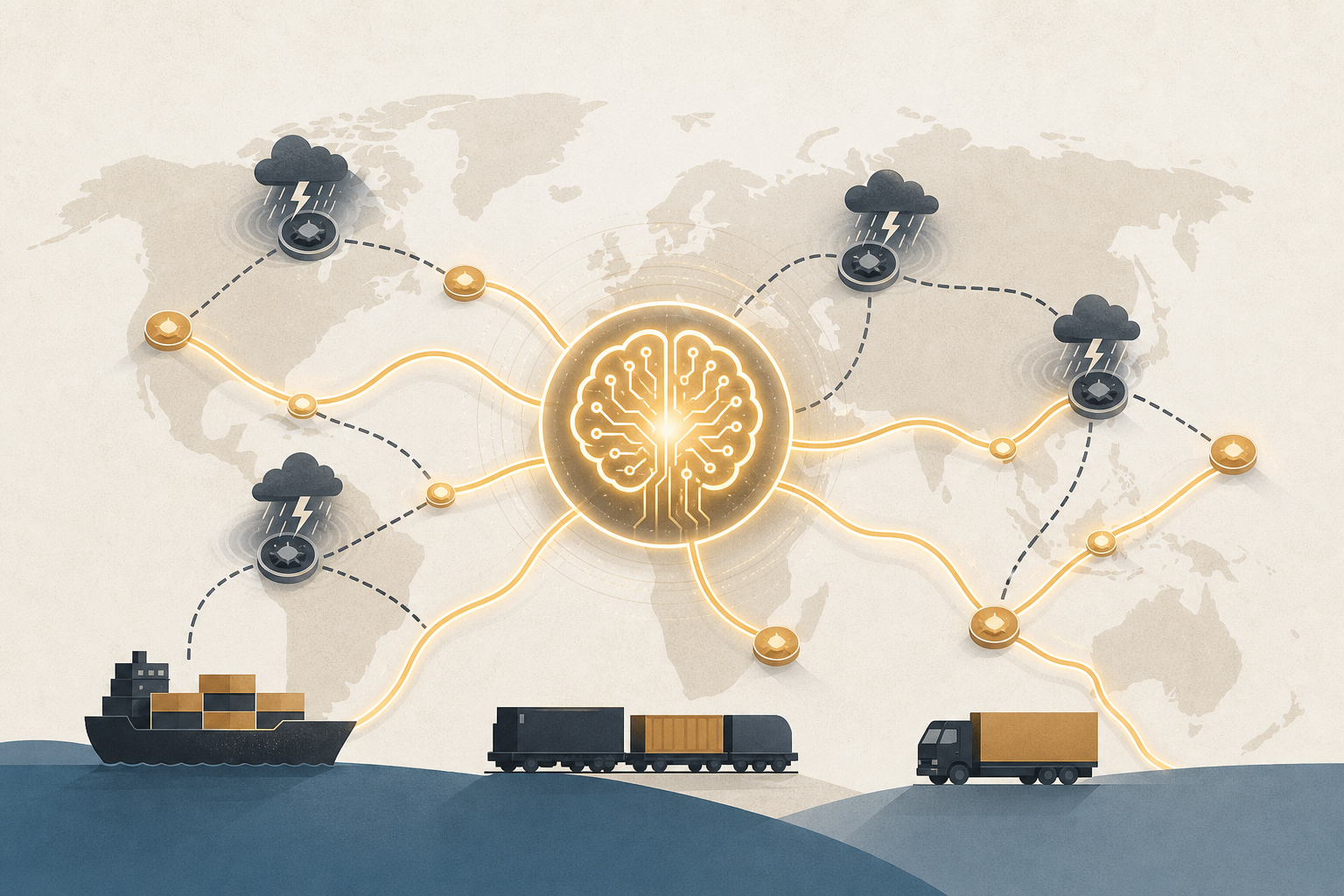
In an era of geopolitical shocks and natural disasters, what should power supply chain decision-making? A new study on ReflectiChain — combining LLMs and reinforcement learning — shows surprising antifragility in semiconductor SCM benchmarks.
Hello. I’m Inoshita from Affectosphere Group.
“Parts aren’t coming. And we don’t know when they will.”
If you’ve worked in manufacturing procurement, you know this feeling well. Since the pandemic, “not knowing” has become supply chain management’s biggest enemy.
Geopolitical risks, natural disasters, port strikes, semiconductor shortages. The variety and frequency of shocks has multiplied beyond recognition compared to a decade ago.
And yet, the “brain” of most companies’ SCM still runs on human experience, intuition, and glorified spreadsheets.
Today I want to introduce a study that might change this.
It’s a paper by Jia Luo on arXiv: “ReflectiChain” (2025).
Three things I want you to take away
- LLMs are good at “reading meaning,” reinforcement learning is good at “optimizing.” ReflectiChain resolves both weaknesses in a single architecture.
- In a semiconductor SCM benchmark, it maintained 82.3% operational rate under adversarial shocks, with 33% improvement in logical consistency.
- The most surprising finding: antifragility. Performance improved by 40.2% under moderate stress — an AI that gets stronger when challenged.
Let me walk through each.
① Why current SCM systems are fragile
Let’s start with the limitations of systems widely used today.
Conventional SCM systems are fundamentally built on “past patterns” and “pre-set rules.” They handle expected situations well, but struggle badly with surprises.
Recently, there’s been a push to integrate LLMs into SCM. LLMs are strong at “reading context.” They can receive news about suppliers, geopolitical signals, and demand fluctuation data as text, and make qualitative judgments like “this looks risky.”
But LLMs have a critical weakness.
They don’t have a felt sense of physical constraints.
Say an LLM suggests: “If the Taiwan factory stops, reroute through Korea.” The actual lead times, inventory levels, transportation costs, and physical capacity constraints of that route are things the LLM only “read as numbers.” It doesn’t know the gravity of the real world. That’s why its suggestions can become academic exercises disconnected from reality.
Reinforcement learning (RL), on the other hand, is great at optimizing within real-world constraints through trial and error. But it can’t articulate why it made a decision. Everything becomes a black box, and you can’t explain to procurement staff why a particular policy was chosen.
LLMs and RL each have their strengths and blind spots. ReflectiChain attempts to resolve this trade-off.
② How ReflectiChain works: 6-dimensional graphs and dual-loop learning
Let me get a bit technical here.
ReflectiChain has two key components.
The first is a 6-dimensional graph latent space.
Rather than representing supply chain state as a simple numeric vector, it encodes it as a graph structure with six dimensions — demand uncertainty, transportation constraints, supplier reliability, inventory state, and more. This lets both LLM-generated policies and physical constraints coexist in the same structured “space.”
The second is dual-loop learning.
The outer loop has the LLM updating its world model. The inner loop has the RL agent optimizing actions. The two coordinate so that the system can “optimize while understanding.”
The paper validates this on a semiconductor supply chain benchmark with 10 nodes and 6 types of external shocks.
Results:
- Logical consistency improved by 33%
- 82.3% operational rate maintained under adversarial shocks
- 40.2% performance improvement under moderate stress
That last number is the one I find most interesting.
③ “Antifragility” — a concept that works in executive conversations
There’s a concept called antifragility, developed by Nassim Taleb. It describes systems that get better, not just survive, under stress and volatility.
Glass is fragile. Steel is robust. But antifragile things improve from shocks. Muscles are a good example — load them, and they repair stronger.
ReflectiChain showed that under moderate external shocks — things like mid-level demand variability or sudden supplier delays — performance improved by 40.2%.
This is an AI that learns faster when stressed.
Think about what this means in practice.
Traditional SCM systems are designed around the assumption that shocks degrade performance, so the design goal is how quickly you can recover. ReflectiChain suggests a different possibility: shocks can make the system smarter.
This maps cleanly onto resilience-oriented management frameworks.
How to use this in practice: three use cases
Now for the business implementation side.
First, think of it as a geopolitical risk real-time simulator.
Taiwan Strait tensions, US-China trade escalation, critical mineral export controls — the LLM reads these from text and outputs “if this node goes down, here’s the optimal alternative, given physical constraints.” Work that currently takes specialist consultants weeks of scenario analysis could run in hours.
Second, it can serve as an automated recovery recommendation engine after natural disasters.
When a factory is damaged or a logistics hub goes offline, the system recommends which alternative suppliers to switch to and in what order, before human decision-makers have completed their assessment. It acts as a bridge.
Third, there’s an application in redesigning SCM KPIs around antifragility.
Traditional metrics focus on lead-time compliance, inventory turnover, and stockout rates. Adding “recovery speed after shock” and “prediction accuracy improvement after shock exposure” gives you a way to measure: “Is our SCM system getting tougher over time?” That’s a story that resonates in board-level conversations too.
Which teams should lead implementation?
In manufacturing, SCM transformation projects often stall because procurement, production planning, logistics, and IT all have their own turf. Cross-functional projects move slowly.
If a company wanted to implement something like ReflectiChain, who should lead?
Realistically, it’s probably a project team reporting directly to a Chief Supply Chain Officer or VP-level sponsor, or a joint ownership structure between a DX transformation office and the procurement division. IT alone can’t redesign the business workflow. Procurement alone can’t drive system implementation. You need both.
Short-term KPIs: time from shock occurrence to alternative proposal output, and adoption rate of proposals. Medium-term: improvement in stockout rate after shocks. Long-term: accuracy in responding to novel, unseen external shocks.
Closing
“An AI that gets smarter under stress” is a striking concept.
In SCM, shocks have traditionally been treated as things to avoid, or to recover from quickly. The antifragility design philosophy flips this: shocks become learning opportunities for the system.
This is still research-stage work, and applying it to real manufacturing environments will come with implementation challenges. But the architectural direction — LLM semantic understanding × RL optimization × graph structure for physical constraints — feels like a preview of what SCM AI could look like in the next decade.
In an era when geopolitical risk is the new normal, rethinking how we design supply chain intelligence feels increasingly urgent.
That’s all for today!
References
- Jia Luo (2025). ReflectiChain: Epistemic Grounding in LLM-Driven World Models for Supply Chain Resilience. arXiv preprint.
* This article was written in part with AI assistance and may contain inaccuracies.