
Column
Can AI Read the Tone of Your Voice? PRISM Brings Prosody into the Empathy Loop
AI that understands not just what you say, but how you say it. PRISM translates vocal prosody into language that LLMs can reason over, enabling a multi-agent spoken dialogue system that generates both semantically appropriate and emotionally resonant responses.
Hi, I’m Keito Inoshita from Affectosphere Group.
Think about calling a customer support line when you’re stressed. Your voice probably sounds tighter, a little slower. A skilled human agent picks up on that — not just from your words, but from the tone, pacing, and texture of your voice — and adjusts their response accordingly.
This is something AI voice systems have struggled to do for a long time.
Speech-to-text gives a transcript of what was said, but the prosodic layer — pitch, tempo, energy, the emotional fingerprint of how something was spoken — tends to get stripped out before it ever reaches the language model. The LLM reasons over words, not sound.
A paper published on arXiv in June 2026 (Wen Zhang, Xiaocui Yang, Zhuoyue Gao, Shi Feng, Daling Wang, Yifei Zhang, arXiv:2606.12902) proposes a framework called PRISM that tackles exactly this problem. Three agents — speech perception, response generation, and speech synthesis — cooperate through a shared prosodic signal, enabled by a mechanism the authors call prosody-to-language translation. Let’s look at how it works.
3 Points for Today
- The gap: Generating semantically correct responses and acoustically appropriate speech has been hard to do simultaneously in existing systems.
- PRISM’s core: A prosody-to-language translation mechanism converts acoustic features into text descriptions that LLMs can reason over natively, stabilizing inference.
- Results: Improvements across all evaluation dimensions — empathy, acoustic fit, and text quality — with code available publicly.
① Why Meaning and Emotional Acoustics Have Been Hard to Unify
Let me set the stage with a bit of background.
Voice dialogue AI has to do two things at once. First, generate a response that is semantically accurate and contextually appropriate. Second, deliver that response in a voice that matches the emotional register of the situation.
LLMs have gotten quite good at the first part. Generating coherent, contextually sensitive text is their home turf.
The second part has been harder. Text-to-speech synthesis has advanced rapidly, but deciding that this moment calls for a slower, softer tone — and letting that decision be informed by the model’s understanding of the conversation — has been difficult to wire up cleanly.
There is also a more fundamental problem: prosodic information from the user’s voice gets lost during transcription. The text “I’m fine” gives no indication of whether it was said with relief, exhaustion, or quiet resignation. That lost information degrades the LLM’s ability to reason about emotional state, which in turn degrades the empathy of the system’s response.
PRISM addresses both problems — prosody utilization and meaning-acoustic integration — through a three-agent architecture with a shared translational layer.
② PRISM’s Three-Component Architecture
PRISM is built around three cooperating agents.
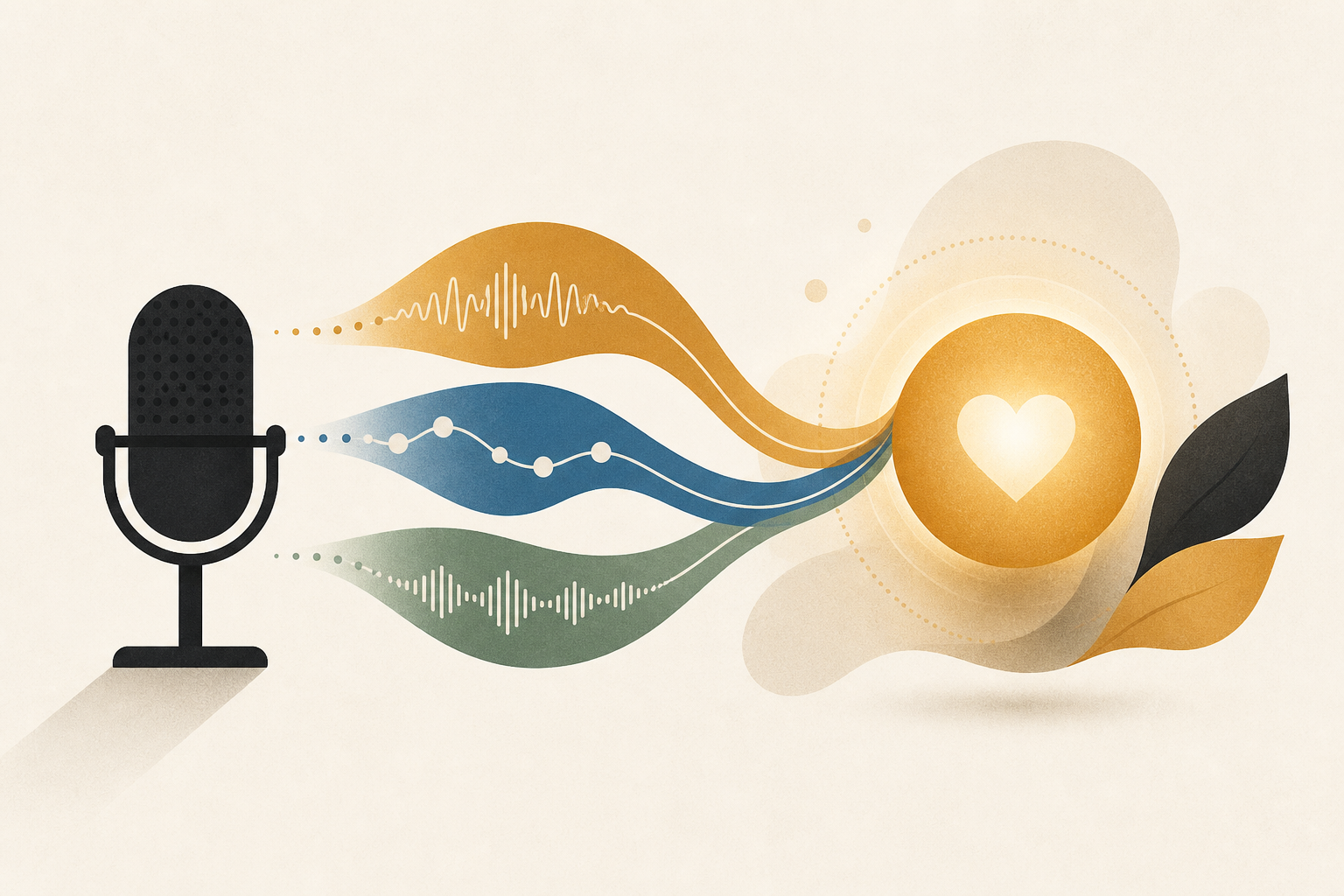
The speech perception agent receives the audio signal, performs transcription, and extracts prosodic features — pitch, tempo, energy, and related characteristics. Critically, rather than passing these as raw numerical vectors to the language model, this agent applies the prosody-to-language translation mechanism. Acoustic features get mapped to natural language descriptions: something like “slow speech rate with energy concentrated in lower frequencies” becomes “voice tone suggesting fatigue or anxiety.”
The response generation agent then receives a context that includes both the transcribed text and the prosodic description as language. An LLM reasons over this unified context and generates a response, with external knowledge tools available to enrich emotional understanding.
The speech synthesis agent takes the generated response text and renders it as speech, with acoustic parameters — speed, pitch, energy — calibrated to match the emotional context carried through from the earlier stages.
All three agents share prosodic information as a common signal. That’s the design principle that ties PRISM together.
③ Why Translating Prosody into Language Matters
The prosody-to-language translation is the part of PRISM I find most interesting from an architectural standpoint.
LLMs are trained on text. When you try to pass raw acoustic feature vectors directly into a language model, you run into what’s sometimes called a modality gap — the model’s contextual reasoning machinery doesn’t engage well with input that isn’t native to the text modality it learned over.
The prosody-to-language mechanism works around this by converting acoustic features into the format LLMs handle best: text. Instead of forcing the model to bridge modalities on its own, PRISM does the bridge-building upstream, in the perception agent, and delivers the signal to the reasoning agent in its native format.
This is a kind of deliberate modality routing — not wiring everything together directly, but converting to a shared language first. The empirical claim in the paper is that this detour stabilizes LLM inference, and the evaluation results support it.
As a design principle for multimodal AI systems more broadly, this approach has some interesting implications. When your reasoning model is trained primarily on text, keeping text as the integration layer — rather than trying to fuse all modalities at the vector level — may offer a practical path to more reliable behavior.
④ What the Evaluation Showed
PRISM’s evaluation covers multiple dimensions: empathy, acoustic fit, and text quality.
The empathy dimension measures how well the system’s responses reflect understanding of the user’s emotional state. Acoustic fit measures whether the generated speech’s acoustic characteristics match the emotional register of the moment. Text quality covers semantic and linguistic appropriateness of the response content.
According to the paper, PRISM improves across all three dimensions compared to prior methods. What’s particularly notable is that improvements in semantic quality and emotional acoustic fit occur together — rather than trading off against each other, which has been a common pattern in prior systems.
The code is publicly available, so if you want to dig into the implementation, the paper’s repository is the place to look.
Implications for Voice AI — Customer Support and Emotional Care
As research like PRISM moves toward deployment, the practical implications for voice AI applications become specific.
In contact center AI, the current dominant architecture is roughly “generate an appropriate text response, read it aloud.” Add prosody-awareness and you get something different: “read the emotional state from the caller’s voice, adjust the tone and pacing of the response accordingly.” The same informational content delivered with more warmth and attentiveness to emotional state changes the user experience substantially.
In mental health support lines, eldercare companion AI, and educational dialogue systems, the quality of emotional connection is not incidental — it is the core value. An AI that responds to how something was said, not just what was said, could meaningfully raise the ceiling on what these applications can offer.
That said, this is currently an arXiv preprint, and the path from controlled evaluation to real-world deployment involves challenges that the paper doesn’t fully address — cross-linguistic generalization, cultural variation in prosodic norms, robustness in noisy audio environments, and so on. The architectural ideas are valuable regardless, but field testing at scale is still ahead.
Emotion AI and the “Voice That Listens” Interface
Stepping back a bit, what PRISM represents is a step toward voice dialogue AI that participates in a full emotional loop — not just exchanging information, but reading and reflecting the emotional texture of a conversation.
In text-based chat, emotion is mostly carried in the words themselves. In voice, emotion is present in every syllable — in how something is said, not just in what is said. An AI that picks up on that signal and feeds it back into both its verbal content and its acoustic delivery is getting meaningfully closer to the way human conversation actually works.
As an affective AI researcher, this direction of travel is one I find genuinely significant. PRISM makes a concrete architectural contribution here: prosody translation plus multi-agent coordination as a practical path toward more empathetic spoken dialogue.
Worth following as the field develops.
That’s all for today!
References
- Wen Zhang, Xiaocui Yang, Zhuoyue Gao, Shi Feng, Daling Wang, Yifei Zhang (2026). PRISM: Prosody-Integrated Multi-Agent Reasoning Framework for Empathetic Spoken Dialogue. arXiv preprint.
* This article was written in part with AI assistance and may contain inaccuracies.