Column
One AI Per Employee: How HR Quietly Changes
From 'roll out the same HR tool to everyone' to 'each employee has a personal AI that talks with the org AI.' A 5-minute take on the two-layer design for next-generation HR — for HR leads, organization developers, and executives.
This article is an English translation of the original Japanese column. Some phrasing has been adapted for English readers.
Hello, this is Inoshita from Affectosphere Group.
The other day I was at lunch with someone running an HR-tech startup, and they said this.
“We run an employee engagement survey every six months. But the people who actually submit it — they’re not the ones who quit. The ones who quit just quietly disappear before the next survey lands.”
If you have ever worked in HR, this probably rings a bell.
Surveys are great as “tools to see the organization,” but they were never designed to pick up the daily wobble of an individual employee.
In a paper I wrote in 2024 1, I proposed flipping this structure on its head.
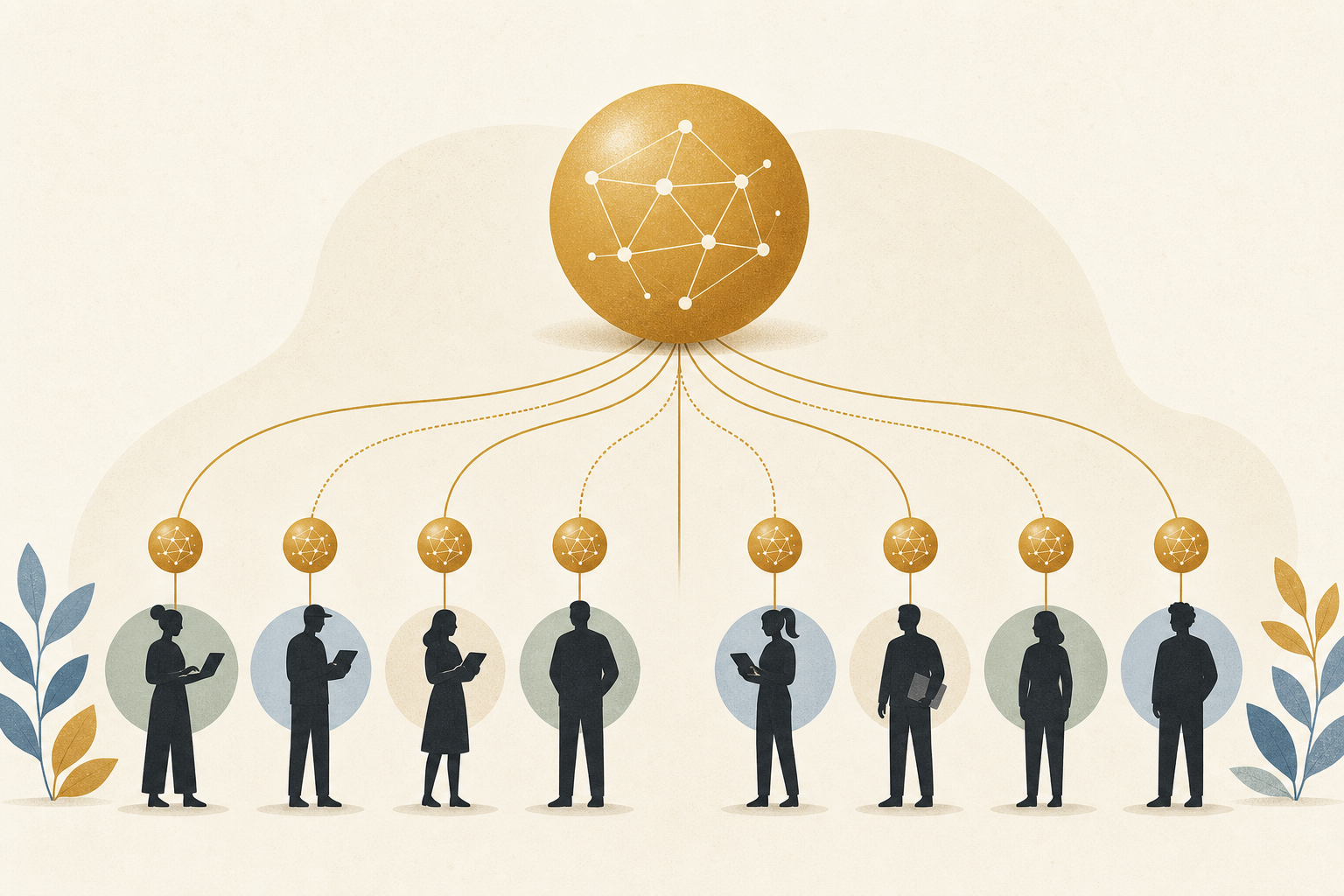
The idea: give each employee their own AI — a personal AI — and design it so that this personal AI talks with the organization’s AI.
Today I want to unpack that for HR, organization development, and executive readers.
Today’s takeaway in 3 lines
- Value: putting one AI next to each employee can catch “daily wobble” that no survey will ever pick up.
- Structure: the key is splitting AI into “personal AI” and “organization AI,” and letting them translate between each other. Data sovereignty stays with the individual.
- Trap: get the design wrong and this quietly turns into “surveillance AI.” The boundary is everything.
Let me go in order.
① First, what this generates for HR
Imagine you are the head of HR at a 500-person company.
Most HR systems today stand on the organization’s side. Assignment management, evaluation aggregation, surveys, people analytics. A row of “tools to see the organization.”
Now add one “personal AI” per employee. What changes?
- An employee has someone to vent to about their career — without going to the manager or HR
- A learning plan that runs at the pace of their actual life
- Something that notices “you might be a bit tired lately” before the person themselves does
On its own, that is “a smart 1-on-1 bot.” The interesting part starts after that.
The personal AI hands only information the employee allows over to the organization AI.
The organization AI, in turn, translates “company-side concerns” — strategy, budget — through the personal AI back into the employee’s own language.
In short — a translator is now sitting between the individual and the organization.
It is a structure where AI quietly carries the work that used to crush a single HR person trying to do it for hundreds of people.
② The “individual optimum vs. organization optimum” dilemma dissolves
The eternal dilemma of HR, I think, is: “stand up the individual and the organization collapses; stand up the organization and the individual wilts.”
Even a single transfer pits the person’s wishes against business needs head-on. Tweak an evaluation system and you end up with a system that is mildly uncomfortable for everyone.
What is interesting about the two-layer design is that it reframes this from a trade-off into “a problem of conversational resolution.”
For example, an employee’s personal AI knows: “this person actually wants to lean more toward marketing.” The organization AI knows: “next quarter we need someone to launch a new business at the overseas subsidiary.”
The AI detects in advance where these two interests intersect, and presents the option to both sides.
The final decision is still made through human conversation between the employee, the manager, and HR. The AI never elbows its way in as a judge — it just raises the resolution of the conversation.
Quiet, but it actually shifts the premises of how an organization runs.
③ The emotion-AI angle that you cannot afford to skip
Here is the part I most wanted to write, as Affectosphere Group.
The two-layer design of personal AI and organization AI can slide into “surveillance AI” embarrassingly easily.
Imagine the organization AI vacuuming up all of it — emotion logs, meeting comments, swipe-card times, Slack reactions — from above. What happens?
Employees stop expressing “natural emotion” in front of the AI.
Smile reactions become strategic. People stop saying real things in 1-on-1s. Even when talking to their personal AI, they think “this gets passed upward” and edit themselves.
The instant that happens, the data quality collapses.
Our lab’s core stance is to handle emotion “as ambiguous and polysemous as it actually is.” The reason is simple: human feelings do not survive being collapsed into averages or majority votes.
Emotion data also has a particular property: the moment people feel they are being observed, the data itself mutates.
So even in this personal-AI / organization-AI design, the principle to defend at the very end is just one:
“Data has meaning precisely because individual sovereignty is protected.”
Put the other way around — HR tech that fails to protect this might post good numbers in the short run, but in three years it will produce an organization where nobody says what they actually think.
And from that organization, you only get quantitative data. Attrition does not drop. Engagement does not rise. The place just somehow stagnates.
That, as an emotion-AI researcher, is the future I find scariest.
So what do you do starting tomorrow
It would be unfair to only fan the risk side, so here are three things you can act on at the field level.
- Inventory: look at whether your HR-tech investments are weighted toward “organization-side tools” or “individual-side partners.” It will almost certainly be the former.
- Visualize what gets shared: if you adopt anything personal-AI-shaped, bake in a UI from day one where the employee can review and refuse what gets passed to the organization. Bolting it on later does not work.
- Channel for appeal: for HR decisions touched by AI — assignments, evaluations, recommendations — provide a human path for employees to push back. This is both EU-AI-Act-aligned and practically essential.
The value is big. The risk is big. Look at both — that is the ask from someone who works on both HR and emotion AI.
Closing
The essence of HR, ultimately, is conversation between people. Assignment, evaluation, career — they all happen inside human relationships.
AI should not be technology that elbows in, but infrastructure that raises the resolution of those conversations.
The two-layer personal-AI / organization-AI design was an attempt to translate that principle into technical architecture.
Protect individual sovereignty. Pursue organizational rationality. Let the AI quietly translate and support the conversation between them.
And our lab’s interest as an emotion-AI group is probably converging on: “how to handle emotion data safely so that even when observed, it does not mutate.”
So — that is it for today.
If anyone thought “wait, is our HR tech tilted to the organization side?”, please take this chance to do that inventory.
References
- 井下敬翔 (2024). パーソナルAIと組織AIによる人事管理の革新と最適化. 人と仕事の未来研究所第1回懸賞論文.
* This article was written in part with AI assistance and may contain inaccuracies.
Footnotes
-
Keito Inoshita (2024). Innovation and Optimization of Human Resource Management with Personal AI and Organizational AI, 1st Essay Prize, Institute for the Future of People and Work. ↩