
Column
Can AI Think Like a Clinician? Mental-R1 Aligns LLM Reasoning for Mental Health
When AI assesses anxiety, depression, or suicide risk, getting the answer right isn't enough — the reasoning process matters too. Mental-R1 uses reinforcement learning to align how LLMs think with how clinicians think, improving weighted F1 by +10.4 points over prior RL methods across 8 mental health datasets. Here's what this means for HR, EAP, and workforce wellness teams.
Hi, I’m Keito Inoshita from Affectosphere Group.
When an HR manager senses that an employee isn’t quite themselves lately, what’s the right move?
Scheduling a one-on-one takes time. Industrial physicians can’t realistically screen every person in an organization of hundreds or thousands. EAP helplines are there, but the employees who most need support are often the least likely to reach out on their own.
This is the gap that AI-assisted mental health screening is positioned to fill. The interest is real — but so is a structural problem that has limited trust in this approach: LLMs tasked with assessing mental health often reach the right answer for the wrong reasons. The reasoning process doesn’t look like clinical thinking.
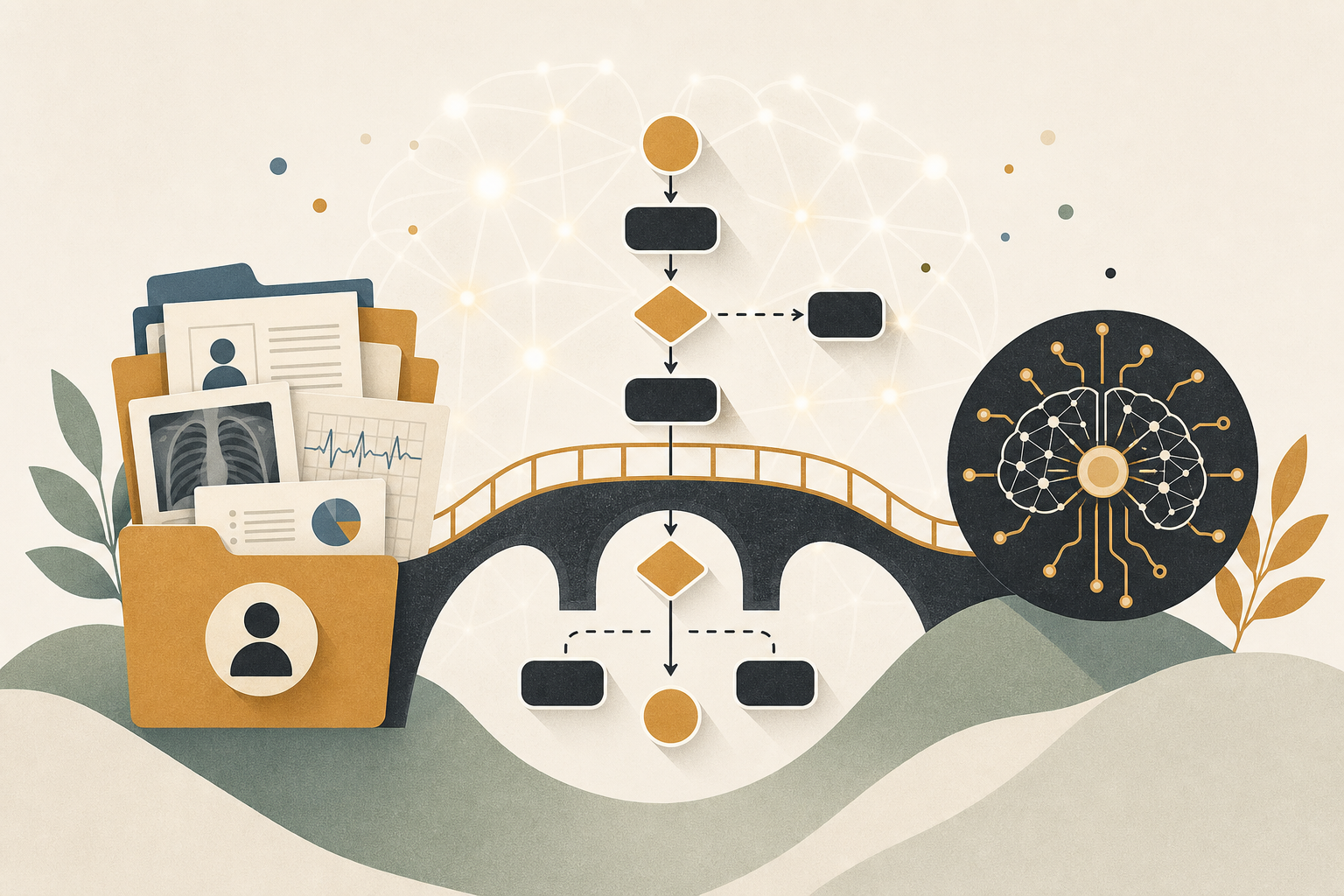
A paper published on arXiv in June 2026 (Xin Wang, Boyan Gao, Yibo Yang, David A. Clifton, arXiv:2606.13176) proposes Mental-R1, a framework designed to address exactly this. Rather than just training for accurate outputs, Mental-R1 uses reinforcement learning to shape how the model reasons — aligning the inference process with clinically grounded cognitive evaluation theory.
Let’s break down what that means, and what it could mean for organizations thinking about AI in workforce wellness.
3 Points for Today
- The core problem: LLMs in mental health assessment often produce correct-looking answers through reasoning that doesn’t match how clinicians think.
- CRPO’s design: Reinforcement learning that optimizes the reasoning steps themselves, with entropy-based phasing from exploratory early thinking to decisive late-stage judgment.
- Practical HR and EAP applications: Where AI-first screening plus human triage creates value — and what KPIs to track.
① The “Wrong Reasoning” Problem in Mental Health AI
Let’s make this concrete.
Suppose an LLM receives the text: “I haven’t been sleeping well lately. When I think about work, I feel anxious and have no motivation to do anything.”
The model outputs: “Possible mild anxiety disorder.”
Even if that assessment happens to be accurate, what was the reasoning path? If the model arrived there by keyword matching — “can’t sleep → anxiety,” “no motivation → depression” — without considering whether the sleep disturbance might have a physical cause, without tracing the timeline of symptoms, without weighing the person’s described situation and resources against the demands they’re facing, then the reasoning is fundamentally different from how a clinician would think.
Cognitive Appraisal Theory provides a framework for how clinicians do think about these situations. Mental state formation is mediated by a person’s appraisal of their situation: “How am I interpreting what’s happening to me?” and “Do my resources feel adequate to handle it?” This staged, contextual reasoning is at the core of clinical mental health evaluation.
Mental-R1’s starting premise is that LLMs don’t naturally reason this way — and that aligning the reasoning process, not just optimizing for correct outputs, is necessary for mental health AI to be trustworthy at the level of process, not just results.
② Mental-R1’s Core: CRPO (Cognitive Relative Policy Optimization)
CRPO is Mental-R1’s reinforcement learning framework, and it has two key design features.
The first is optimizing reasoning steps, not just outputs. Standard RL in language modeling rewards correct final answers. CRPO evaluates the quality of intermediate reasoning steps — specifically, whether the model’s reasoning process reflects the staged logic of cognitive appraisal theory. The reward signal attaches to process, not just result.
The second is entropy regularization across reasoning phases. In the early stages of reasoning, CRPO maintains high entropy — encouraging diverse, exploratory thinking across multiple interpretive possibilities. As reasoning progresses toward a judgment, entropy is gradually reduced, pushing the model toward decisive conclusions. This early-exploration, late-convergence structure mirrors the way clinicians actually think.
A clinician doesn’t start by deciding the answer. They gather information, form initial hypotheses, consider alternatives, and converge on a diagnosis through a staged process. CRPO’s design embeds this structure into the LLM’s inference loop rather than leaving it to chance.
③ Results Across 8 Mental Health Datasets
Mental-R1 is evaluated on 8 mental health datasets covering anxiety, depression, suicide risk, and related clinical tasks.
The reported improvement is +10.4 points in weighted F1 score compared to prior RL-based methods.
Weighted F1 is the right metric to care about for mental health data, which is almost always class-imbalanced — severe cases are rare, mild and normal cases are common. An improvement in weighted F1 signals better performance on the cases that matter most, not just the easy majority-class predictions.
What also matters is that the improvements appear across all 8 datasets, not just one or two. Generalization across clinical tasks and data sources is what makes this useful as a foundation for real-world deployment rather than a single-domain benchmark result.
④ How HR and EAP Teams Can Use This
Here’s the practical part.
What does a Mental-R1-style model look like, deployed inside a corporate wellness or EAP context?
The most realistic application is an AI-first screening plus human triage pipeline.
Consider a monthly anonymous employee survey or a regular pulse check-in. Text responses are passed through a Mental-R1-style model for first-pass evaluation. Anxiety, depression, and burnout risk scores are generated automatically. Cases above defined thresholds are flagged and routed to industrial physicians or EAP counselors for follow-up.
For HR teams, this shifts the workflow from “I have a vague sense someone might be struggling” to “I have structured information about which individuals have crossed which risk thresholds, and when.” That’s a meaningful operational change.
KPIs you could track in this model include: month-over-month change in high-risk flag rate by team or department; EAP utilization rate among flagged employees; lead time from screening flag to specialist contact; and trend correlation between flag rate and business performance metrics like absenteeism or turnover.
One design principle is non-negotiable: the AI’s output is not a clinical diagnosis, and it does not replace professional judgment. It’s a triage accuracy layer — helping the right cases reach the right professionals faster, and helping specialists focus their limited capacity on the highest-priority situations. Mental-R1’s emphasis on transparent, traceable reasoning is especially relevant here. An HR team or industrial physician who can see why a case was flagged, not just that it was flagged, is in a much better position to make a sound judgment about next steps.
⑤ EAP Platforms and Mental Health SaaS
At the product level, a Mental-R1-style reasoning framework is applicable across several formats.
For EAP platforms, the use case is real-time screening of incoming text from help-line entry points — chats, intake forms, initial written disclosures. Automatic priority scoring tells counselors which cases need immediate attention, reducing response time for the highest-risk situations. The “designing intervention flows by severity” problem — which is genuinely difficult to operationalize in human-staffed EAP systems — becomes tractable as a structured triage function.
For wellness apps and journaling tools, the application is longitudinal monitoring of user-generated text — daily check-ins, mood entries, reflective writing. Detecting changes in pattern over time and generating early-warning signals for the user or a connected clinician, without crossing into diagnostic territory, keeps the product within a defensible regulatory position. The framing is “change detection and bridge to professional care,” not “AI diagnosis.”
In both cases, the regulatory and ethical principle is the same: AI screens and routes, humans assess and treat. Mental-R1’s CRPO-based transparency in reasoning is an asset for building the trust between AI system, HR team, and clinical staff that makes this kind of pipeline work in practice.
The “Align Reasoning to Domain Knowledge” Direction
To close with something more research-adjacent:
Mental-R1 represents a different axis of improvement from “train on more data” or “use a bigger model.” It argues that for high-stakes domains where the reasoning process matters — not just the output — domain theory should be embedded into the optimization target itself.
This logic extends beyond mental health. Legal reasoning, educational assessment, medical diagnosis — any domain where “how you got there” carries weight alongside “what you concluded” — is a candidate for this approach. Combining domain-specific theory with reinforcement learning at the reasoning step level is a design pattern I expect to see more of.
For HR, EAP, and industrial medicine practitioners, the more immediate takeaway is simpler: Mental-R1 offers a principled answer to the question of how AI should be used in mental health contexts — not as a black box that outputs risk scores, but as a system whose reasoning can be understood, audited, and trusted as a first-pass filter before expert review.
That’s all for today!
References
- Xin Wang, Boyan Gao, Yibo Yang, David A. Clifton (2026). Mental-R1: Aligning LLM Reasoning for Mental Health Assessment. arXiv preprint.
* This article was written in part with AI assistance and may contain inaccuracies.