Column
MedRLM: A Multi-Agent Medical AI That Reasons Across EHRs, Images, and Sensor Data
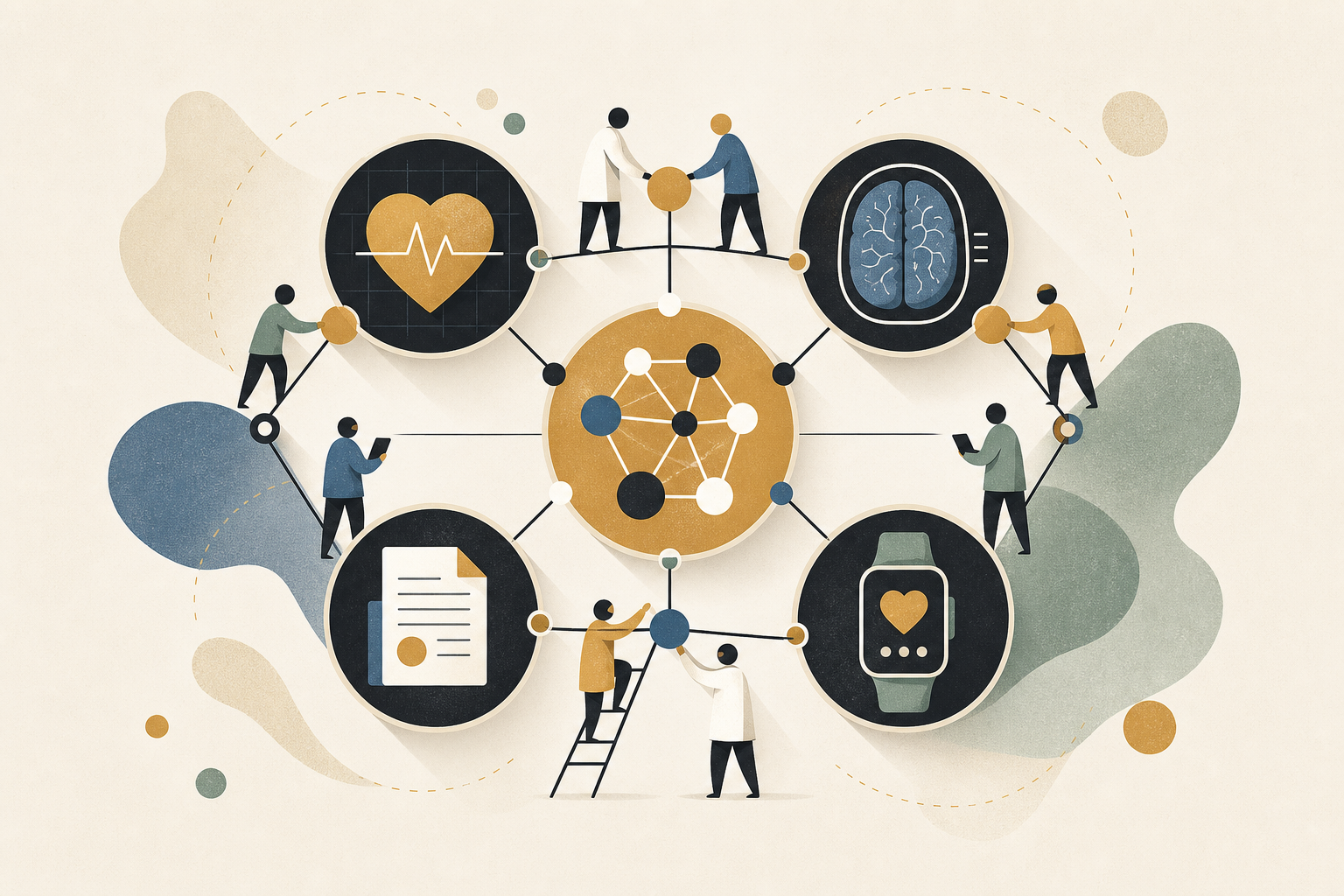
MedRLM proposes a framework where specialized AI agents collaboratively reason across electronic health records, medical images, ECG signals, and ICU time-series data. Its 'Clinical Evidence Graph Memory' enables longitudinal reasoning, while uncertainty-aware escalation optimizes community-to-tertiary referral flows.
Hello. This is Keito Inoshita from Affectosphere Group.
Medical AI typically focuses on single modalities: image diagnosis or text summarization. But clinical decision-making is far more complex — reasoning across EHR notes, imaging findings, ECG waveforms, and ICU vital trends, all along a temporal axis.
MedRLM (Aueawatthanaphisut, arXiv:2606.20164), published June 2026, tackles this through coordinated multi-agent reasoning over heterogeneous longitudinal patient data.
Today’s 3 Points
- A “Clinical Evidence Graph Memory” structures patient data across modalities and time, enabling longitudinal reasoning.
- Sensor anomaly detection automatically triggers deeper analysis agents — no human initiation required.
- An uncertainty management mechanism flags cases requiring clinician review, optimizing community-to-tertiary referral flows.
① Clinical Evidence Graph Memory
MedRLM’s core: patient data structured as a graph where nodes represent observations (test results, imaging findings, vital signs) at specific time points, and edges represent temporal or causal relationships.
New data extends the graph, making the full patient trajectory available as reasoning context. This enables conclusions like “ECG was normal 3 months ago, but combined with today’s imaging findings, matches a progression pattern.”
Most medical AI operates snapshot-style: one input, one output. MedRLM maintains the entire temporal context — a fundamentally different design philosophy.
② Sensor-Triggered Auto-Escalation
When continuous ICU monitoring detects an anomalous heart rhythm pattern, it automatically activates an ECG analysis agent that cross-references against the patient’s historical data for risk assessment.
This detect → analyze → assess chain executes without human intervention. Combined with home-care wearables, it could automate early detection and appropriate referral matching for high-risk patients.
The safety valve: uncertainty management ensures the system knows when it doesn’t know.
③ Uncertainty Management and Referral Optimization
When confidence is low, MedRLM flags “clinician review required” automatically.
For community-to-tertiary referral flows, this has direct value: supporting “should this patient be referred now?” decisions based on accumulated primary care logs, while explicitly flagging uncertain cases.
Late referrals increase patient risk. Unnecessary referrals waste tertiary resources. AI-assisted referral timing optimization carries both clinical and economic value.
Healthcare DX Implementation
For hospital groups and health IT vendors: consider adding a “graph memory layer” to existing EHR systems, starting with specific high-risk conditions (heart failure, diabetic complications).
Build pipelines integrating continuous wearable data as referral-decision inputs — moving from “collect and store” to “collect and trigger reasoning.”
KPI: referral appropriateness rate (percentage of referrals resulting in actual treatment intervention at the receiving facility).
AI That Knows When It Doesn’t Know
The essential challenge for medical AI isn’t just diagnostic accuracy — it’s appropriate uncertainty recognition and knowing when to defer to humans.
MedRLM’s uncertainty management mechanism addresses exactly this: not pursuing perfect automation, but issuing “a human should look at this” at the right moment.
That balance is the hardest and most important challenge in medical AI deployment.
Reference
- Aueawatthanaphisut, A. (2026). MedRLM: Recursive Multimodal Health Intelligence for Long-Context Clinical Reasoning, Sensor-Guided Screening, Evidence-Grounded Decision Support, and Community-to-Tertiary Referral Optimization. arXiv preprint.
Note: This article was partially written with AI assistance and may contain inaccuracies.