
Column
Where Does ChatGPT Get Its Brand Opinions? The Case for GEO Audits
As users shift from search engines to AI assistants, what LLMs say about your brand depends on what third-party sources they have seen. A new study shows this varies by language and market — and that proactive content management is the new reputation playbook.
Hello. This is Inoshita from Affectosphere Group.
Here is a question most marketing and communications teams have not yet answered.
“What does ChatGPT say about your brand — and do you know where that answer comes from?”
The SEO era taught us to optimize for search engine algorithms. But the consumer journey is changing. More users now open ChatGPT, Gemini, or Claude and simply ask: “What should I know about Brand X?” or “Is this company trustworthy?”
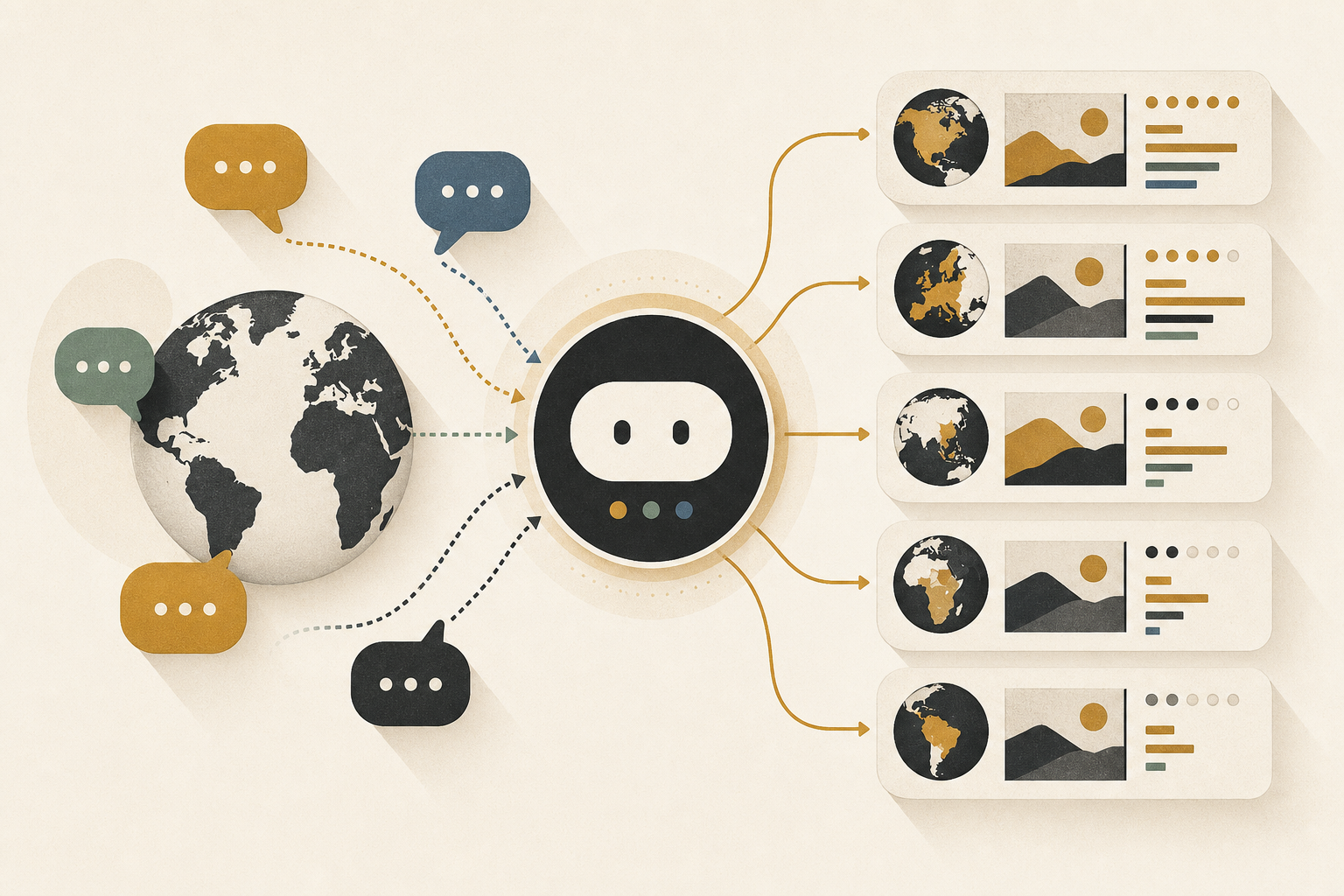
When an LLM responds, it is not returning a list of links. It is synthesizing a narrative from patterns in its training data — Wikipedia articles, news coverage, review platform content, research databases. The quality of that narrative depends on what was in the training corpus, and that varies considerably across languages and markets.
A paper published on arXiv in June 2026 by Dmitrij Zatuchin (arXiv:2606.25787) examines exactly this: how LLMs source brand reputation across different languages and markets, and what the patterns reveal about where brands stand in AI-generated knowledge.
Three takeaways for today
- LLMs do not treat all languages and markets equally — the quality and depth of brand knowledge an LLM can generate depends heavily on the source content available in each language.
- English-language markets tend to have richer LLM brand representations, while non-English markets may be systematically underrepresented.
- GEO — Generative Engine Optimization — the practice of managing the third-party sources LLMs reference, is emerging as the core AI-era reputation management discipline.
① The shift from search to AI conversation
The behavior of consumers researching brands has shifted in a way that matters for reputation management.
In the search era, a brand’s digital presence was measured by where it appeared in results pages. A user typed a query, scanned a list of links, visited multiple sites, and formed their own view.
In the AI era, a user asks a question and receives a synthesized answer. That answer comes entirely from what the LLM has internalized. The user often does not see the underlying sources, may not know to question the response, and makes decisions based on it.
This changes what “brand presence” means. It is no longer primarily about which links rank where. It is about whether accurate, rich, authoritative content about your brand is present in the data LLMs draw from.
Zatuchin’s research provides a systematic look at what that data actually looks like — and how much it varies across languages and markets.
② The language and market gap
A key finding direction in this research is the disparity between English-language and non-English-language market representations in LLMs.
The underlying reason is not hard to trace. LLM training data is heavily skewed toward English-language content. Wikipedia in English is far larger and more detailed than Wikipedia in many other languages. English-language news, press coverage, and review platforms dominate the web.
This means a brand’s English-language digital footprint — its English Wikipedia entry, its coverage in English-language media, its presence on English-language review platforms — has an outsized influence on what LLMs know and say about it.
A company may have excellent brand equity in Japan or Germany or Brazil, with strong local press coverage and review presence. But if its English-language third-party content is thin or outdated, LLMs queried by English-speaking users (or any user whose query is processed through English-heavy training data) may produce weak, incomplete, or inaccurate representations.
The reverse is also true. A brand that invests carefully in its English-language content ecosystem may outperform locally stronger competitors in LLM-generated reputation — simply by having better-sourced content in the language LLMs know best.
③ What GEO is — and why it differs from SEO
The research centers on a concept called GEO: Generative Engine Optimization.
SEO is the practice of making your content rank higher in search engine results by aligning with the algorithm’s ranking signals. GEO is the practice of ensuring that the third-party content LLMs are likely to reference — about your brand — is accurate, rich, and favorable.
The distinction matters. SEO optimizes your own website’s properties. GEO focuses on what others say about you in places LLMs can see.
The relevant content types for GEO include:
- Wikipedia entries in major languages (not just your home language)
- Coverage in authoritative news and trade publications
- Profile entries in industry databases, analyst reports, and research directories
- Reviews on platforms that AI systems are likely to have indexed (Trustpilot, G2, Glassdoor, and equivalents)
- Press releases published through widely-indexed wire services
The insight is that these sources function as the “ground truth” from which LLMs construct brand narratives. If the ground truth is incomplete or outdated, the AI narrative is too — regardless of how strong your own website is.
Practical GEO audit: what marketing and communications teams can do
The target audience here is brand marketing, corporate communications, and digital strategy teams.
The first step is a brand experience audit across AI platforms. Ask ChatGPT, Gemini, and Claude the following types of questions about your brand, in both your primary market language and in English:
- “What are [Brand X]‘s main products and what are they known for?”
- “How is [Brand X] regarded in terms of quality and trustworthiness?”
- “What has [Brand X] been in the news for recently?”
Record the responses verbatim. Note what is accurate, what is outdated, what is missing, and what is incorrect. Repeat this in at least two languages if your brand operates in multiple markets.
The second step is source identification. When you identify inaccurate or thin AI-generated brand content, trace it to its likely source. Is the Wikipedia entry outdated? Is there a negative news cycle from two years ago that LLMs are over-indexing on? Is your brand absent from certain authoritative databases?
A practical KPI to track is an LLM Brand Accuracy Score: a monthly audit of AI-generated responses about your brand, scored on accuracy, completeness, and sentiment, tracked against competitors. This gives you a quantitative baseline and shows improvement over time.
Specific improvement actions that follow naturally from this audit:
- Expand and maintain your English-language Wikipedia entry with properly sourced, up-to-date information
- Distribute press releases through high-authority wire services that tend to be indexed by training data pipelines
- Build a multilingual press room with key brand information in your major market languages
- Monitor and respond to review platform content on services that AI systems are likely to reference
The competition for AI-generated reputation has already started
We are still early in the GEO era, but the dynamics are already in motion. Brands that understand how LLMs source information — and that proactively manage that source landscape — will have a compounding advantage as AI-mediated information consumption grows.
The brands that will be well-positioned are not necessarily those with the largest budgets or the best PR agencies. They are the ones that understand this mechanism and act on it systematically.
The first step is simple. Ask an LLM what it knows about your brand today. What it tells you is the starting point for your GEO strategy.
Reference
- Dmitrij Zatuchin (2026). How Large Language Models Source Brand Reputation Across Languages and Markets. arXiv preprint.
* This article was written in part with AI assistance and may contain inaccuracies.