Column
Can How Older Adults Talk Reveal Early Signs of Dementia?
A new study proposes language-based digital twins — AI models that replicate an individual's conversational style — as a tool for non-invasive, continuous cognitive health monitoring. The implications for healthtech, eldercare, and insurance are significant.
Hi, I’m Keito from Affectosphere Group.
“Grandpa’s been talking a bit differently lately.” That’s the kind of observation families make before anyone else notices something is wrong.
The problem is that tracking language change over time — rigorously, continuously, outside a clinical setting — has been nearly impossible. Until recently.
A preprint published on arXiv in June 2026 (arXiv:2606.27334), by Mohammad Mehdi Hosseini, Mohammad H. Mahoor, and Hiroko H. Dodge, proposes a potentially practical answer: language-based digital twins of older adults, built from their natural conversational patterns, that can monitor cognitive health over time.
Three takeaways for today
- Language-based digital twins — LLM models that replicate an individual’s conversational style — are a new approach to cognitive monitoring.
- Natural conversation logs (calls, AI speakers, chat) may carry detectable cognitive signals without clinical tests.
- Healthtech, eldercare, and insurance companies have concrete entry points for piloting this kind of approach.
① What is a language-based digital twin?
In manufacturing and infrastructure, digital twins are virtual replicas of physical systems. This research applies the same concept to human language.
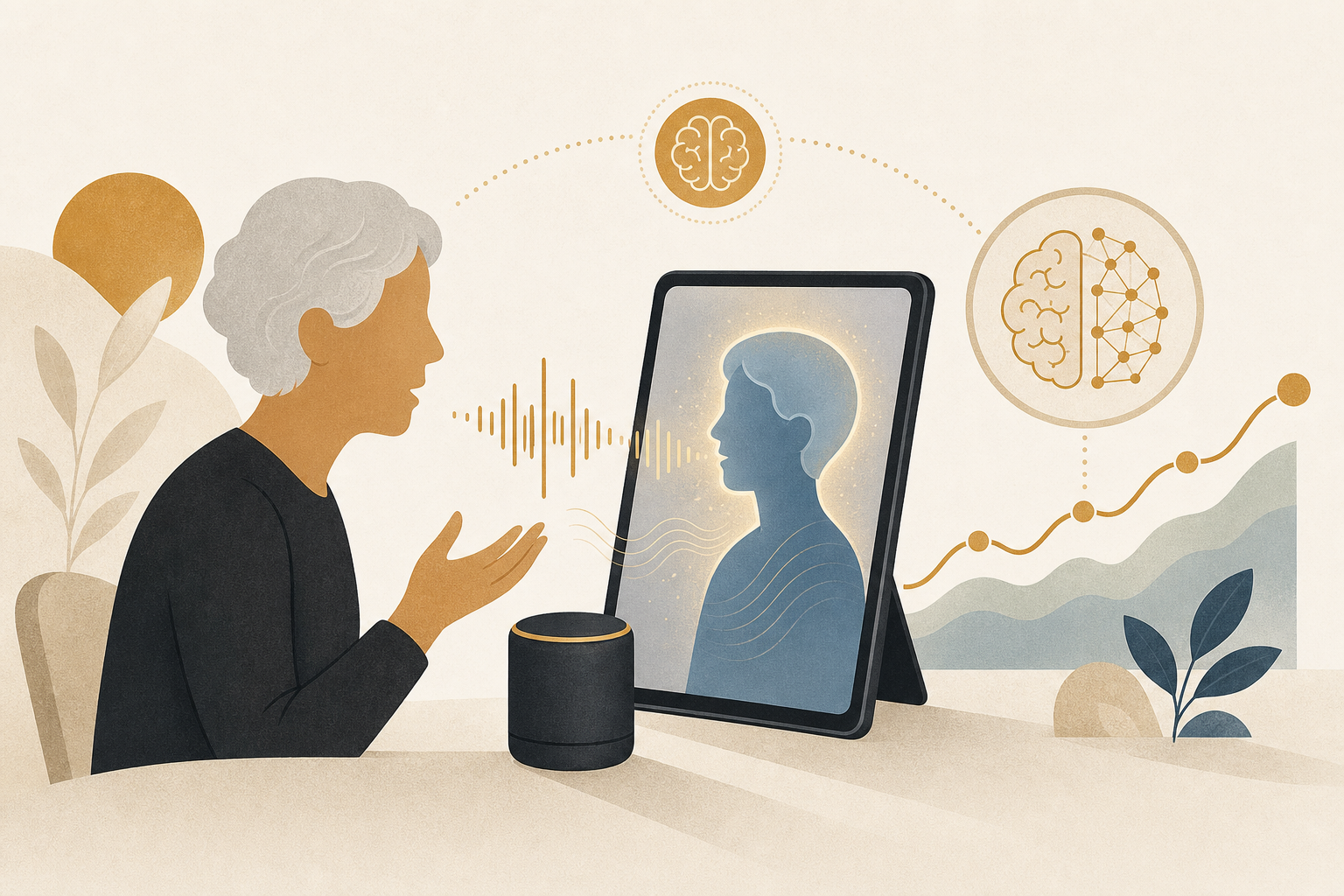
The idea: capture enough of how a specific person talks — their vocabulary choices, sentence rhythm, topic transitions, expressive range — and train a model to simulate that style. The resulting model is a language digital twin. It functions as a personalized baseline: this is how this person normally communicates.
The study used the I-CONNECT dataset, which contains structured video call conversations between older adults and researchers, paired with cognitive assessment scores. The team developed a neural architecture that combines stylistic cues with contextual metadata, and reports achieving performance comparable to real conversation data in predicting cognitive assessment outcomes.
The goal isn’t to reproduce conversations verbatim. It’s to ask: can a model of how someone talks predict how their cognition is doing — and detect when that model starts to drift?
② Why continuous, non-invasive monitoring matters
Early detection of cognitive decline is clinically important. But today’s cognitive assessments are largely clinic-based — MMSE scores, neuropsychological tests, physician observation — and happen at discrete intervals.
The problem is that cognitive change doesn’t wait for appointments. Someone might score fine at a six-month check-up and show noticeable decline two months later. The gap between assessments is where early signals get lost.
A system that continuously analyzes everyday conversation logs — phone calls, smart speaker interactions, text-based chat — could close this gap. The digital twin establishes a personal baseline during a period of normal function, then flags when conversational patterns diverge from that baseline over time.
No clinic visit required. The monitoring happens in the background of daily life.
This is still research-stage work and would require substantial medical validation before clinical use. But the research direction is meaningful: the authors report their architecture achieves performance on par with actual conversation data for predicting cognitive assessment scores in their dataset, which is an encouraging early result.
③ Business applications: who can use this and how
This is the section that matters most if you’re thinking about building in this space.
Healthtech and silver tech companies
The most direct application is layering language analysis onto existing eldercare interaction platforms. Smart speakers, care companion robots, AI telephone check-in services — all of these generate conversation logs as a byproduct.
Adding a cognitive monitoring layer means moving from “is this person alive today?” to “is this person communicating differently than they were three months ago?” The natural business model here is B2B2C: platform → family or care coordinator → older adult. Alerts go to a family member or primary care physician, not to the user themselves as a diagnostic conclusion.
Eldercare facilities and home care operators
Nursing homes and home care agencies have daily interaction with residents and clients. Frontline staff often sense when something has shifted — “she just seems off this week” — but that observation rarely gets systematically recorded.
Language monitoring could turn these informal signals into structured data: a weekly linguistic deviation score per resident, flagging cases that warrant further clinical attention. The key precondition is transparent consent from residents and families, and clear framing that this is a monitoring aid, not a diagnostic tool.
Insurance and health management platforms
For long-term care insurers, earlier detection of MCI enables earlier intervention, which can delay progression to severe stages — potentially reducing the cost and duration of high-intensity care. This is a plausible value hypothesis, though the magnitude would need validation in longitudinal studies.
Health plan operators or wellness platforms could explore incorporating conversational cognitive assessments as part of regular check-ins with older adult members. The critical design constraint: any data collected for wellness purposes should not be used for insurance underwriting or coverage decisions. That boundary needs to be contractually and technically enforced.
HR and employee health programs
As workforce demographics shift and retirement ages rise, cognitive health support for older employees is becoming an HR issue in some sectors. Text-based workplace communication could, in principle, be analyzed for longitudinal change — but this application faces the highest ethical and social friction of any use case here.
Workplace surveillance concerns are real and serious. If explored at all, this would require deep labor consultation, full opt-in design, and strict isolation of data from any performance management process.
④ First steps for teams considering a pilot
If you’re in R&D at a healthtech company or an eldercare platform, here’s a practical way to think about where to start.
The first priority isn’t the model — it’s the data design. The I-CONNECT dataset used in this study was purpose-built with structured conversations and co-collected cognitive scores. Building a real-world version of this requires answering the consent and privacy design questions first: what do you collect, from whom, with what disclosures, and what safeguards prevent mission creep?
The second priority is baseline architecture. A language digital twin only works if you have enough baseline data from a period of normal cognitive function. That means designing for longitudinal collection from the start — ideally monthly or quarterly touchpoints rather than one-time interaction.
KPIs worth tracking in a pilot:
- Linguistic deviation score from personal baseline (monthly)
- Time from system alert to physician or care coordinator contact
- Rate of alerts confirmed as clinically relevant by follow-up assessment
The last metric is especially important for calibrating alert thresholds. Over-alerting erodes trust; under-alerting defeats the purpose.
What to watch for: risks and limits
A few things to keep front of mind as this technology develops.
This is preprint research. The findings are promising but have not yet undergone full peer review or regulatory scrutiny. Positioning these results as a clinical tool without further validation would be premature and, in most jurisdictions, unlicensed.
Conversation data is among the most sensitive forms of personal information. A continuous log of how someone speaks, across months and years, is an intimate dataset. The ethical obligation to protect it is high — and the potential for harm from misuse (insurance discrimination, family conflict over competency) is real.
Finally, the timeline for value creation is long. This is not a feature that ships in six months. Building a useful language digital twin requires sustained data collection over time. Teams entering this space should plan on multi-year data programs, not quick wins.
The way we speak carries a record of our minds
What this research points toward is a future where cognitive health monitoring doesn’t begin with a doctor’s referral — it runs quietly in the background of everyday communication, and surfaces signals long before anyone notices something is wrong.
Whether that future arrives depends on whether the technology matures, whether the regulatory path gets clearer, and whether users trust the services enough to participate. None of those are guaranteed.
But as a research direction, it’s one worth watching closely — especially for anyone building in the eldercare, healthtech, or digital health insurance space.
That’s it for today!
References
- Mohammad Mehdi Hosseini, Mohammad H. Mahoor, Hiroko H. Dodge (2026). Language-Based Digital Twins for Elderly Cognitive Assistance. arXiv preprint.
* This article was written in part with AI assistance and may contain inaccuracies.