
Column
Is Cloud Really Expensive? 28-Day Operational Data on Enterprise Coding Agents Reveals When the Math Flips
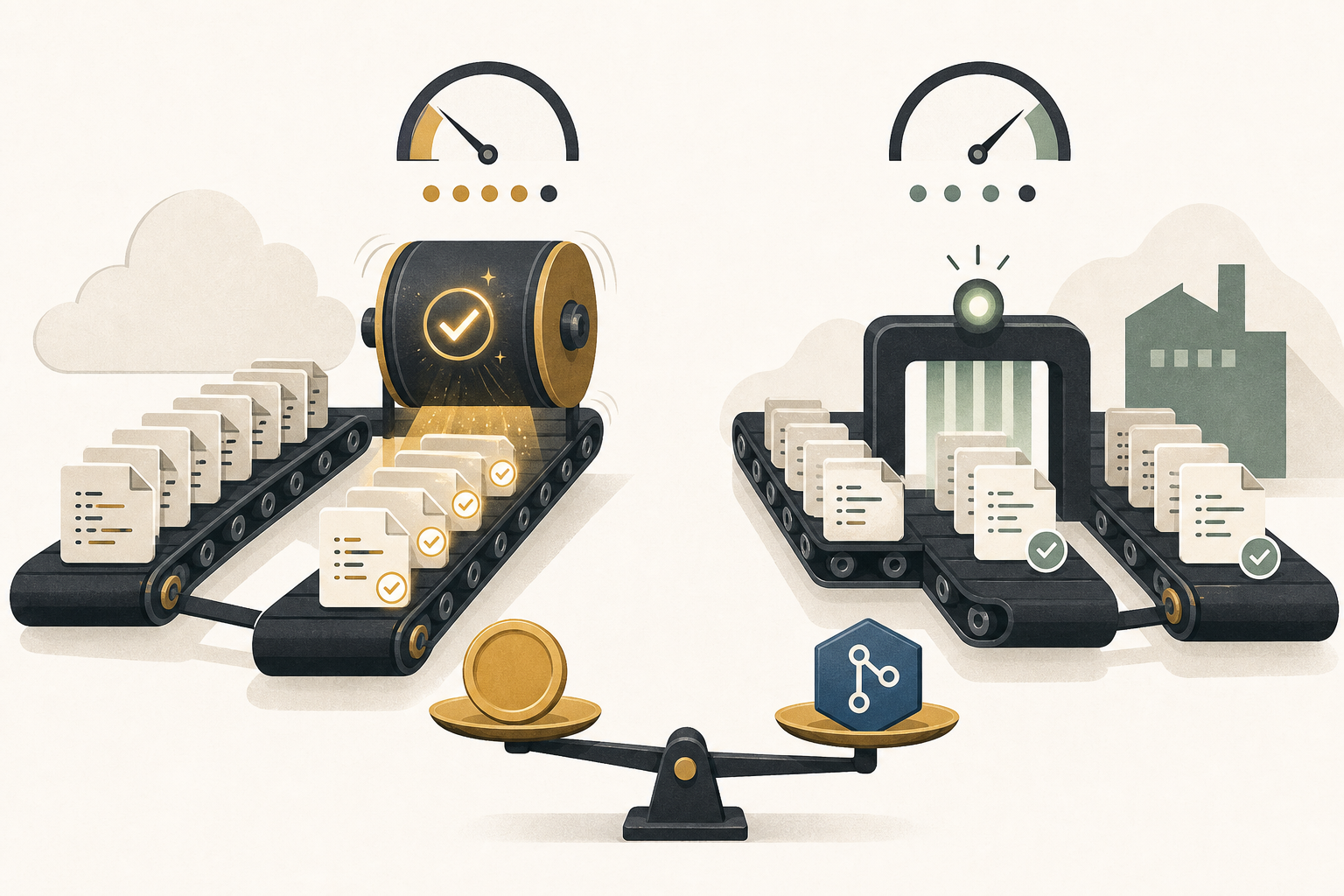
A head-to-head comparison of cloud API (Claude Opus) and on-premise quantized OSS (GLM-5.1/5.2) using 28 days of real operational logs shows that a 99.3% prompt cache hit rate brings cloud API cost below on-premise at $0.57 vs $2.83 per million tokens. But Fix Commit Ratio tells a different story for quality. Here is a three-axis framework for making the decision.
Hello. This is Miura from Affectosphere Group.
“We want to scale up our AI usage, but cloud API costs are unpredictable. Should we move to on-premise?” This question comes up constantly in technology planning discussions and executive meetings.
New empirical data suggests that this conventional wisdom can flip — depending entirely on how you use the system.
A study published on arXiv in July 2026 by Sheng-Wei Peng, Yi-Hsun Lin, and Yi-Pei Lee (arXiv:2607.13080) compares cloud API and on-premise deployments of enterprise coding agents using 28 days of real operational logs from each. This is not a synthetic benchmark — it is actual usage data from engineers doing real work. That makes the numbers directly relevant to business decision-making.
Three takeaways for today
- With cache optimization, cloud API cost can fall below on-premise. For workloads with high prompt repetition, cache design determines TCO more than the cloud-vs-on-premise choice itself.
- Code quality (Fix Commit Ratio) is 2.6–4.9x higher on-premise. Even when costs flip, the quality gap persists — requiring evaluation across three axes: cost, quality, and DevEx.
- Fix Commit Ratio can be repurposed as an internal AI quality KPI. “What fraction of AI-suggested changes actually got committed?” is a practical, business-grounded way to measure LLM value delivery.
① When “cloud is expensive” reverses
Start with the cost story.
The conventional assumption is that cloud API spending grows linearly with usage while on-premise hardware is a fixed capital cost that amortizes over time. Many organizations have made build-vs-buy decisions based on this framing alone.
This research challenges that assumption.
Over 28 days of operating Claude Opus as a cloud API coding agent, the prompt cache hit rate reached 99.3%. The resulting effective cost was $0.57 per million tokens.
The on-premise comparison — quantized open-source models (GLM-5.1 and GLM-5.2) — came to $2.83 per million tokens after accounting for GPU depreciation.
That means the cloud API was cheaper.
The mechanism is prompt caching. In coding agent workloads, a large portion of each request — system prompt, codebase context, coding standards — is nearly identical across calls. When caching captures that repeated content, the marginal cost per request drops sharply. A 99.3% hit rate means caching was working on almost every single request.
The flip side: in workloads where prompts vary substantially from call to call — open-ended reasoning tasks, diverse document processing — caching will not deliver this effect and the economics may look different.
Before any cloud-vs-on-premise cost comparison, ask: how repetitive is our prompt structure? The answer shapes whether caching can work in your favor.
One important caveat from the paper: DevEx costs — the internal labor involved in managing, updating, and monitoring on-premise model infrastructure — are not included in the TCO calculation. The on-premise numbers may look more expensive once those costs are counted. Treat the raw figures as a starting point, not a final answer.
② Quality does not follow the cost reversal
The cost story and the quality story point in different directions.
The research uses a metric called Fix Commit Ratio (FCR): the fraction of AI-suggested code fixes that engineers actually committed. This is a practical measure of whether an AI coding tool is delivering real value in production, as opposed to generating suggestions that get reviewed and discarded.
The results: on-premise achieved 74.9%; cloud API achieved 45.9%.
On-premise was 2.6 to 4.9 times higher.
Even in scenarios where cloud API is cheaper per token, if more than half of its suggestions are rejected by engineers, the actual productivity contribution is lower than the per-token cost comparison implies.
The paper does not fully explain the source of this quality gap — capability differences, caching effects on output quality, or other factors remain open questions. But the empirical gap is real and large enough to matter for ROI calculations.
This is the core problem with single-axis cost comparisons: a lower per-token cost does not automatically translate into better ROI if quality-adjusted output is also lower.
The research also examines TCO more broadly. Under some configurations, shared GPU on-premise deployments showed cost reductions of around 40.1%. But again, this figure excludes DevEx costs. The picture is more complex than “cloud won” or “on-premise won.”
Evaluating across three axes — cost, output quality, and DevEx overhead — is the only way to get a complete picture.
③ Bringing Fix Commit Ratio into your organization
The concept of Fix Commit Ratio is worth taking seriously as a general-purpose KPI design idea.
It answers a question that most AI evaluation frameworks struggle with: did the AI output actually get used? Not “was the output generated successfully?” or “did it score well on a benchmark?” but “did a professional who reviewed it trust it enough to commit it into production?”
That question applies far beyond coding agents.
In tool selection phases, you can run candidate LLMs or AI assistants on the same tasks with the same codebase and compare FCR across models. The model with the higher FCR is the one your engineers are likely to find useful. This gives you a selection criterion grounded in actual work behavior rather than benchmark scores.
For post-deployment monitoring, tracking FCR over time tells you whether adoption is deepening or stalling. A declining FCR might indicate model drift, a mismatch with evolving task requirements, or shifting team practices. It surfaces problems before they show up as productivity losses.
For model upgrade evaluations, comparing FCR before and after a version change gives you a direct, operationally relevant quality signal.
One important limitation to keep in mind: a low FCR can reflect poor model quality, but it can also reflect organizational factors — how the tool is integrated into the workflow, whether engineers trust it yet, whether task types are a good fit. Quantitative signals like FCR need to be interpreted alongside qualitative feedback from the team.
The research also examined hybrid routing — dynamically switching between cloud and on-premise based on task type — and found no clear advantage. Simply combining both approaches does not automatically outperform either alone. The quality of the routing logic matters.
Three questions to take back to your organization
Distilling this research into actionable decision-making prompts:
First, how repetitive is your prompt structure? For workloads like coding agents or internal Q&A systems where a large portion of each prompt is reused across requests, caching is likely to work well and cloud API economics may be more favorable than you assume.
Second, are you measuring the quality of your AI tools at the output level? Moving from “it feels like engineers are using it” to “X% of suggestions are actually being accepted and committed” turns a vague impression into a number you can track, compare, and improve.
Third, are you including DevEx costs in your total cost comparison? Model management, version updates, infrastructure monitoring, and internal engineering overhead add up. Excluding them systematically underestimates the true cost of on-premise.
“Cloud or on-premise” is not a binary question with a universal answer. It is a multi-axis evaluation problem, and the right answer depends on your specific workload, team structure, and quality requirements. This research is a useful starting framework for structuring that evaluation.
See you next time!
References
- Sheng-Wei Peng, Yi-Hsun Lin, Yi-Pei Lee (2026). Inference Economics of Enterprise Coding Agents: A Case Study of Cloud vs. On-Premise LLMs. arXiv preprint. https://arxiv.org/abs/2607.13080
* This article was written in part with AI assistance and may contain inaccuracies.