Column
When AI Reads Your Video Interview: Personality Prediction Accuracy Up 19% with Frozen Multimodal Embeddings
Asynchronous video interviews already run at most HR departments. A new study shows that combining frozen CLIP, Whisper, and RoBERTa models can automatically assess Big Five personality traits and cognitive ability — no fine-tuning required — beating the official baseline by 19.1%.
This article is an English translation of the original Japanese column. Some phrasing has been adapted for English readers.
Hello — this is Inoshita from Affectosphere Group.
“The interview went really well. Great vibe. But after they joined, the culture fit just wasn’t there.”
If you work in talent acquisition, that sentence is painfully familiar.
Interviews measure how a candidate performs in a specific moment — how nervous they get, their communication habits, how they’re feeling that particular day. What you actually want to know — personality traits and cognitive ability — is hard to assess accurately with a standard interview design. That mismatch is one of the structural causes of mis-hires.
At the same time, many HR departments already have asynchronous video interview infrastructure in place. Since COVID, on-demand recorded video interviews have spread rapidly. But most of that video data stops at “a human watches it and moves on” — it’s never structured or quantified.
A 2025 arXiv preprint by Kuo-En Hung, Hung-Yue Suen, Shih-Ching Yeh, and Hsiang-Wen Wang (arXiv:2606.11930) built a system that automatically estimates Big Five personality traits and cognitive ability from that “watch-and-done” video data — and beat the official dataset baseline by 19.1%.
Today I’d like to translate that research into the language of HR talent acquisition and HRtech development teams.
Three-line takeaway
- Value: AI that combines video, audio, and transcript from recorded interviews can potentially deliver more reproducible personality and ability assessments than impression-based interviewer judgment.
- Implementation: “Frozen” models mean no fine-tuning on proprietary data is needed. Off-the-shelf CLIP, Whisper, and RoBERTa, combined with a purpose-built integration layer, are enough to produce meaningful results — a realistic option for mid-sized HR teams.
- Risk: using personality inference in hiring decisions carries real fairness, bias, and transparency risks. Chasing technical accuracy alone will backfire.
In order.
1. What is actually new here
Combining three modalities without retraining
The conceptual contribution of this research is the word “frozen.”
Normally, applying an AI model to a new task requires retraining on task-specific data — fine-tuning. That costs time and money, and above all demands large volumes of labeled data for that exact task.
This paper turns that assumption on its head.
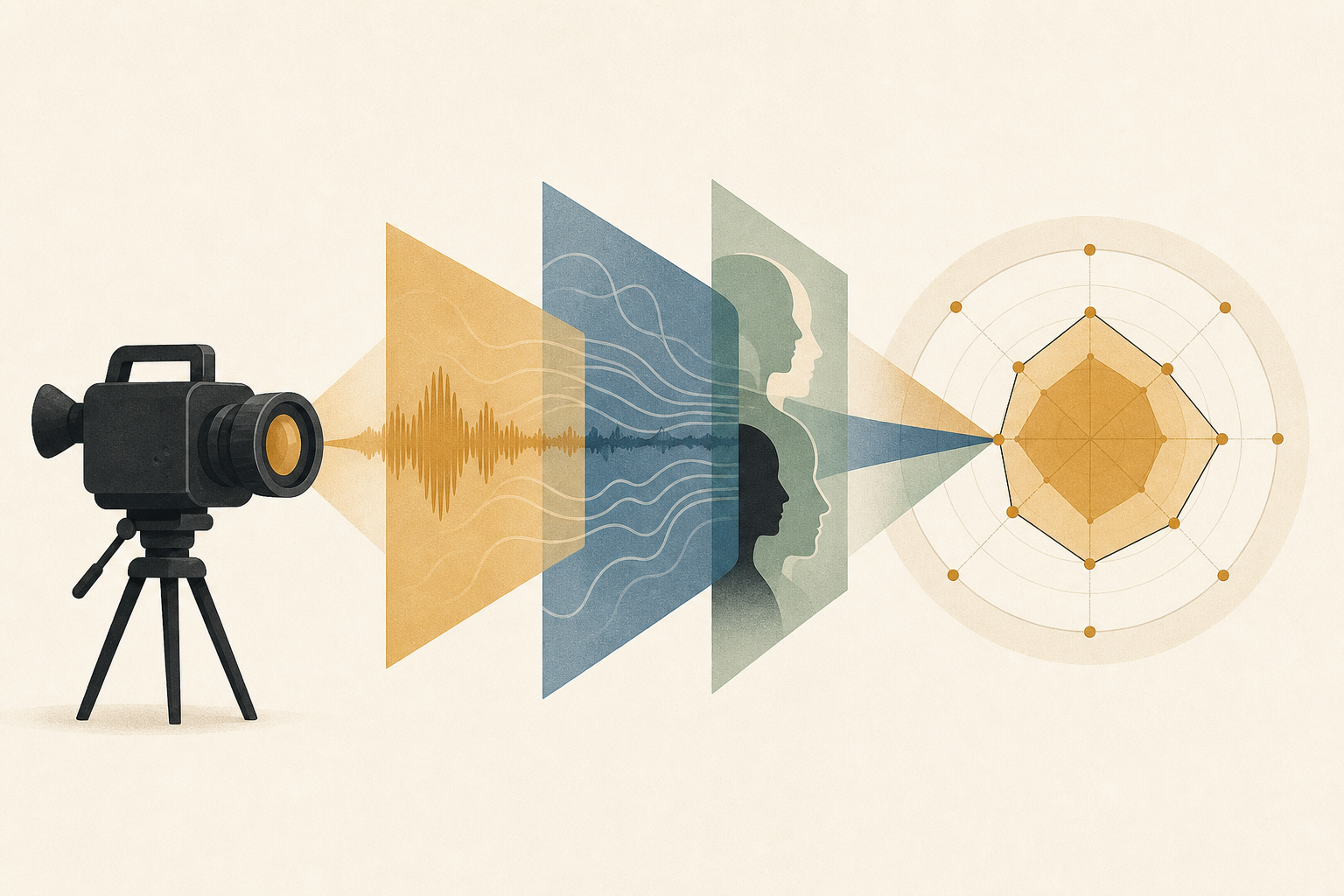
CLIP (visual/facial analysis), Whisper (audio/speech analysis), and RoBERTa (text/language analysis) — three large pretrained models — are combined without any additional training (that is, frozen) and applied to personality estimation.
Each carries a different specialty.
- CLIP: extracts facial and physical features from video frames
- Whisper: analyzes speech patterns from audio — prosody, pace, voice quality
- RoBERTa: analyzes linguistic features from speech transcripts
An integration architecture fuses these three outputs to estimate Big Five personality traits (Openness, Conscientiousness, Extraversion, Agreeableness, Neuroticism) and a cognitive ability score.
What 19.1% means
The system improves personality prediction accuracy by an average of 19.1% over the official baseline.
The “official baseline” is the standard benchmark provided by the dataset creators — a reference point designed for research comparison. Beating it by nearly 20% is a substantial result.
2. What this looks like in practice
Here are three concrete ways an HR team or HRtech builder could use this.
Use case 1: First-pass screening in graduate recruitment
High-volume graduate hiring with large numbers of recorded interviews is the best-fit scenario.
If you have 1,000 recorded interviews a year, having every one reviewed by a human interviewer consumes serious resources. AI screening — surfacing candidates whose Big Five profile matches what a role typically needs, and prioritizing those for human review — can dramatically cut evaluation time.
Example KPIs:
- One-year retention rate of screened-in candidates (proxy for mis-hire rate)
- Interviewer review time per screened candidate (cost metric)
- Correlation between AI score and post-hire performance review (predictive validity check)
Departments involved: talent acquisition, HR planning, IT/systems.
Use case 2: Manager-track assessment
Evaluating candidates for managerial promotion is higher stakes, but there is a clear path.
The key is designing the recorded interview format as a standardization tool. All candidates answer the same structured questions on video; their recordings are analyzed by AI. The output becomes one piece of evidence alongside 360-degree feedback, reference checks, and structured interviews — not a standalone verdict.
Use case 3: Building personality inference into HRtech products
For HRtech companies building applicant tracking systems or video interview platforms, this is direct product development input.
The “combine frozen models” design philosophy is achievable without in-house large models. A plausible architecture: call CLIP, Whisper, and RoBERTa via public APIs; design only the integration and inference layer in-house. That keeps the build lean while capturing most of the performance benefit.
3. Why Big Five matters here
The choice to use Big Five personality traits as the prediction target is important.
Big Five is one of the most extensively validated personality models in psychology. It describes personality along five dimensions: Openness, Conscientiousness, Extraversion, Agreeableness, and Neuroticism. The research base linking Big Five to job performance is substantial — Conscientiousness, in particular, has been repeatedly shown to correlate with work outcomes across many domains.
In other words, this study is not “measuring an arbitrary index with AI.” It is “automatically estimating a psychologically validated framework.” That distinction matters when you are making the internal case for adoption.
Risks and limitations: skip these and you will regret it
Technical possibility is only part of the story. The risks deserve equal honesty.
Fairness and algorithmic bias
Facial expression, voice patterns, and language use vary substantially across cultures, ethnicities, genders, and ages. A model trained predominantly on one demographic group may disadvantage others — sometimes in ways the accuracy numbers do not reveal.
“High accuracy” is not enough. “Fair to whom?” must enter the design conversation from the start.
The danger of treating personality scores as hiring evidence
Using AI personality scores as a direct basis for hire/no-hire decisions is currently dangerous.
No model is perfectly accurate, which means some candidates will be incorrectly scored. “The AI said so” does not satisfy any reasonable duty of explanation to a rejected applicant.
AI scores should be one additional information source, with final decisions made by multiple human reviewers. Write that rule down before anything ships.
Legal and ethical transparency
Under the EU AI Act, applying AI to “high-risk” areas such as hiring carries requirements for transparency and explainability. In Japan, developments around the Protection of Personal Information Act and equal employment opportunity regulations are worth monitoring closely.
At minimum, candidates should be clearly informed that AI-based personality inference is being used in their assessment — and their consent should be obtained.
Where to start if you want to experiment
Three realistic first steps.
- Audit your existing recorded interview data: how many recordings exist, in what format, where they are stored. AI analysis starts with having data you can actually use.
- Check API availability in your current toolstack: find out whether your ATS or video interview platform offers an API. CLIP, Whisper, and RoBERTa are all publicly available and callable via API.
- Design a retrospective validation pilot: run the AI scoring against recorded interviews of employees who are already on board, then check correlation with their actual performance scores. This is internal validity testing before you touch live hiring.
None of these steps mean “use this in hiring tomorrow.” They mean “understand what this technology can actually do, inside your own data.”
Closing
Recorded video interviews are infrastructure that most HR departments already have. Data that used to stop at “watch and move on” is becoming data that can be systematically measured.
What this study shows is that combining off-the-shelf pretrained models, without any fine-tuning, already produces meaningful personality assessment accuracy. That design — no proprietary training data required — makes the approach far more scalable for HRtech contexts than most people expect.
But technical accuracy and ethical legitimacy are not the same thing. Between “we can measure this” and “we are allowed to use this” sits a large space of questions about fairness, transparency, and accountability.
How your HR team uses this technology is not ultimately a tool-selection question. It is a question about what you believe matters in hiring decisions — and that is an organizational philosophy conversation, not a vendor evaluation.
That’s it for now.
References
- Kuo-En Hung, Hung-Yue Suen, Shih-Ching Yeh, Hsiang-Wen Wang (2025). Frozen Multimodal Embeddings for Personality and Cognitive Ability Assessment in Asynchronous Video Interviews. arXiv:2606.11930. https://arxiv.org/abs/2606.11930
* This article was written in part with AI assistance and may contain inaccuracies.