
Column
Can AI Replace a Personal Trainer? FitOne's Blueprint for Domain-Specific LLM Post-Training
FitOne — a fitness-specialized LLM built on Qwen3 with a three-stage post-training pipeline — outperforms baseline models by up to 12.73% on professional fitness certification exams, and offers a reusable architecture for scalable domain-specific AI.
Hello. This is Miura from Affectosphere Group.
“Give every employee a dedicated personal trainer.” That is the aspiration behind many fitness app products and corporate wellness programs. The reality is that it runs into cost and scalability walls almost immediately.
FitOne — a fitness-specialized LLM series introduced in a study published on arXiv in July 2026 (Zhao et al., arXiv:2607.02118) — is a technical answer to that constraint.
The research applies a three-stage post-training pipeline to Qwen3-based models at 8B and 32B parameters, achieving up to 12.73% improvement over baseline models on professional fitness certification exams.
The design philosophy has implications well beyond fitness: it addresses a persistent challenge in domain-specific AI development — how to build a specialized model without sacrificing general-purpose capability.
Today’s 3 Points
-
A three-stage post-training pipeline (continual pre-training → supervised fine-tuning → reinforcement learning) enabled FitOne to outperform baseline models by up to 12.73% on professional fitness certification benchmarks (ACSM-EP and NSCA-CSCS).
-
The training design preserves general-purpose capability while improving domain specialization — a balance that is difficult to achieve and directly relevant to any organization building domain-specific LLMs.
-
The pipeline architecture is highly transferable to other knowledge-intensive domains: healthcare, legal, HR, accounting — anywhere a general-purpose LLM alone is insufficient.
① Why the Three-Stage Pipeline Matters
The most common failure mode in building domain-specific LLMs is what you might call “specialization collapse.”
You pour domain knowledge into a model. It gets good at the specialized topic. But somewhere in the process, its general reasoning and conversational ability degrades. A fitness coaching AI that knows every exercise physiology term but cannot interpret a user’s casual question about soreness is not useful.
FitOne addresses this through a staged approach.
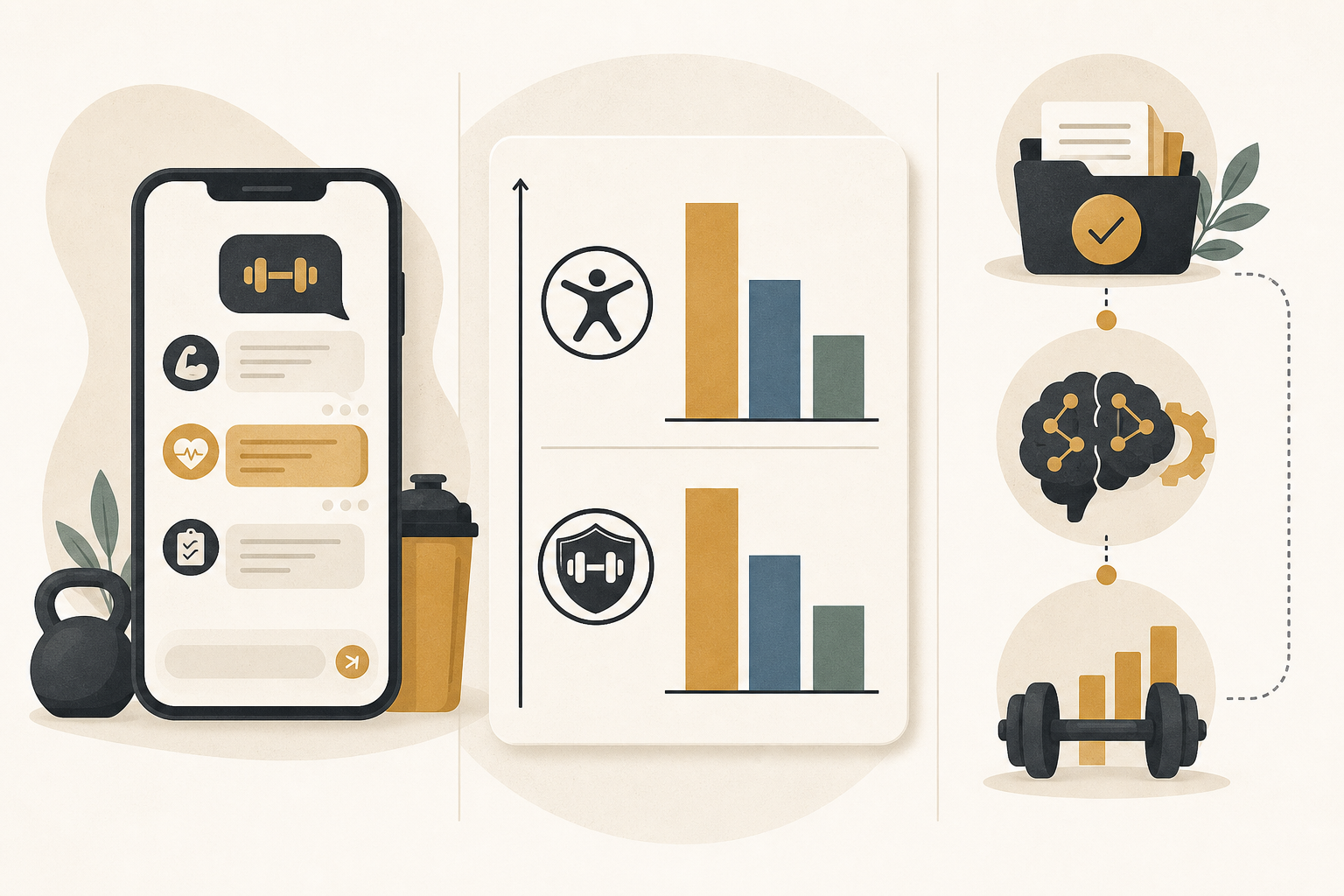
Stage one — continual pre-training — re-trains the base model on fitness and sports science corpora. This builds the domain knowledge foundation without discarding the base model’s linguistic capabilities.
Stage two — supervised fine-tuning — refines the model on coaching scenarios and domain-specific question-answer pairs. This aligns the model with how the knowledge is actually used in practice.
Stage three — reinforcement learning — further improves response quality through feedback signals.
Each stage does a specific job, and together they produce a model that is specialized without being brittle. That staged design is the core methodological contribution here.
② What ACSM-EP and NSCA-CSCS Results Mean
The evaluation benchmarks are actual professional certification exams.
ACSM-EP (American College of Sports Medicine — Exercise Physiologist) and NSCA-CSCS (National Strength and Conditioning Association — Certified Strength and Conditioning Specialist) are widely recognized credentials in the fitness industry. Using these as benchmarks is a reasonable proxy for domain-level knowledge depth.
Up to 12.73% improvement over the baseline model on these exams means FitOne demonstrably knows more about fitness science than the general model it was built on.
One important caveat: benchmark performance and real-world coaching quality are not the same thing. How well a model scores on a certification exam does not automatically translate to how useful it is as an interactive coaching tool. That gap depends on how the model is deployed, what user interactions look like, and how evaluation is designed in practice.
That said, 12.73% is a meaningful signal. It confirms that domain-specific post-training works, and gives a concrete performance reference for teams evaluating this type of approach.
What This Means for Fitness App Builders and Gym DX Teams
The most direct application is embedding AI coaching functionality into fitness products.
Most AI coaching features in fitness apps today amount to a general-purpose LLM with a system prompt. “I work out three times a week” goes in, a plausible-sounding workout plan comes out. But users have no way to evaluate whether the recommendation is actually grounded in exercise physiology — and in many cases, it is not.
A specialized model like FitOne can potentially explain its recommendations. “Here is why this rep range, here is the physiological rationale for this rest period.” That kind of grounded output is the difference between a chatbot that feels like a trainer and one that can actually function like one.
For gym chains and personal training services building digital coaching features, the value proposition is scalability. A FitOne-style model can deliver informed, personalized coaching interactions at any volume without proportional increases in trainer staffing. Members get 24/7 availability; the business gets a coaching layer that scales with subscriber growth.
Application to Corporate Wellness and Health Management
The second major application area is corporate health management programs.
Japanese organizations pursuing “health and productivity management” (健康経営) certifications and similar wellness initiatives increasingly face a common frustration: demonstrating ROI. “We launched a fitness program, but we cannot show what effect it had on healthcare costs or productivity.”
Integrating a FitOne-style model into a corporate wellness platform creates an AI coaching layer that can track individual exercise behavior, generate personalized recommendations, and log coaching interactions over time.
The KPIs become measurable. Not just physical metrics like BMI or step counts, but behavioral metrics: program completion rates, coaching session retention, engagement with recommended activities. Combined with health insurance claims data and occupational health records, you can model the intervention effect — AI-coached employees versus a control group — and express it in terms of health risk reduction.
This turns corporate wellness investment from a “we believe it works” category into a “here is the ROI evidence” category. For HR and benefits teams, that is the conversation that unlocks budget.
The Transferability Question: Beyond Fitness
The most important implication of this research may be what it says about domains other than fitness.
The three-stage post-training pipeline — continual pre-training, supervised fine-tuning, reinforcement learning — is not fitness-specific. It is a general methodology for taking a strong base model and making it deeply competent in a specialized domain without sacrificing its broader capabilities.
Any organization building domain-specific AI — whether for medical triage support, legal document review, HR policy Q&A, or financial compliance — is facing the same design challenge that FitOne addresses: how do you specialize without breaking the model?
FitOne gives a concrete, tested answer. The architecture is a reference design. Teams starting a domain-specific LLM project can use this pipeline structure as a starting point and adapt it to their domain and data.
What to Take Away
FitOne demonstrates that building a specialized LLM is an engineering problem with a clear methodology, not a mystery.
A three-stage pipeline, carefully designed to preserve general capability while deepening domain knowledge, produces models that outperform their general-purpose starting points on domain benchmarks.
For fitness app builders: explore whether FitOne’s architecture can be adapted using your proprietary coaching data and user interaction logs.
For corporate wellness teams: evaluate whether an AI coaching layer built on this kind of specialized model could close the measurement gap in your health investment ROI analysis.
For anyone building domain-specific AI in any knowledge-intensive field: the specialization-versus-generality trade-off is solvable, and this research is one of the clearest demonstrations of how.
References
- Xingtao Zhao, Tian Yang, Han Jiang (2026). Enhancing Fitness Intelligence through Domain-Specific LLM Post-Training. arXiv preprint.
* This article was written in part with AI assistance and may contain inaccuracies.