
Column
AI That Writes Its Own Research Papers: What FARS Means for Enterprise Research Automation
A multi-agent system called FARS autonomously generated 166 complete research papers across 67 AI/ML topics — no human supervision. Here's what this architecture means for consulting, finance, and pharma research teams.
Hello. This is Keito Inoshita from Affectosphere Group.
“AI that writes papers” has been a talking point for a while. But this one is different.
FARS — a Fully Automated Research System — doesn’t just write. It generates hypotheses, designs experiments, runs code, interprets results, and produces complete research papers, end-to-end, without human supervision.
Tang et al. (arXiv:2606.31651) report that FARS generated 166 complete research papers across 67 fine-grained AI/ML topics. That’s a system that actually scaled.
Today’s 3 Points
- FARS uses specialized agents collaborating through a shared workspace — proposals, code, logs, results, manuscripts — to handle the full research pipeline autonomously.
- 166 papers across 67 topics demonstrates scale, but the authors themselves acknowledge narrow experimental scope and methodological limitations; human oversight remains recommended.
- The architecture maps directly onto enterprise research workflows in consulting, finance, and pharma — “hypothesis → investigation → report” pipelines that absorb enormous analyst time today.
① The Architecture: Specialized Agents, Shared Workspace
The core insight of FARS is the combination of agent specialization and shared workspace design.
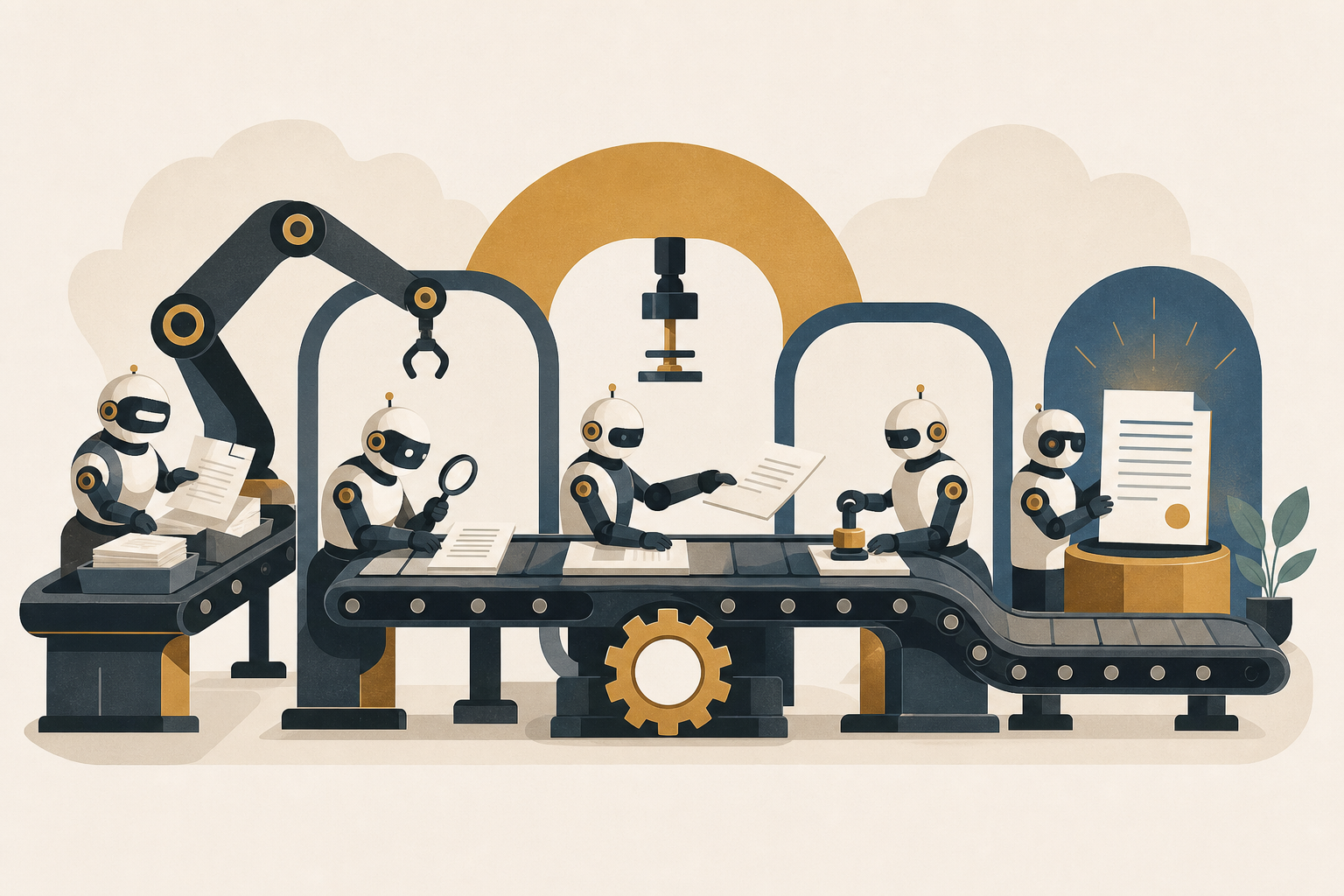
Multiple agents each handle what they do best: hypothesis generation, experiment planning, code execution, result analysis, manuscript writing. They don’t directly communicate with each other. Instead, they coordinate through five shared document types: proposals, code, logs, results, and manuscripts.
This is structurally identical to how high-functioning research teams operate. Individual contributors work in their lanes, but everyone reads from the same shared artifact layer to maintain coherence.
For enterprise applications, this “shared workspace” framing is the most transferable idea. More on that below.
② What 166 Papers Actually Means
The 166 papers across 67 topics isn’t just a scale number. It’s a statement about generalization.
67 fine-grained topics means the system didn’t just work for one narrow niche — it functioned across meaningful diversity within the AI/ML research space. The system was robust enough to handle varied problem structures.
That said, the authors are candid about limits. Narrow experimental scope, methodological constraints, and the recommendation for human supervision are all explicitly noted. Not every generated paper is high quality. This isn’t a flaw to dismiss — it’s an honest accounting of where research automation currently stands.
“Scales and works, but not yet fully reliable without human oversight” is a meaningful milestone.
③ The Enterprise Angle: Consulting, Finance, Pharma
The FARS framework translates directly to enterprise research contexts.
Consulting research teams produce initial industry analyses for new clients constantly — market sizing, competitive landscape, regulatory environment, technology trends. A senior analyst might spend three to five days on a single document. If a FARS-like system handles the first draft, analysts can redirect that time to interpretation and strategy.
Quantitative research teams in financial institutions run regular literature surveys on specific factors or anomalies. The “hypothesis → experiment → summary” pipeline, applied to financial data, could generate backtested research reports with far less manual effort.
Pharmaceutical research planning teams face literature surveys and hypothesis organization before any wet lab work begins. Automating this early phase with a FARS-style system could free researchers to focus on the creative judgment calls that actually require their expertise.
KPIs to track: reduction in initial document creation time, increase in cases handled per analyst, first-pass quality scores on automated drafts.
What to Borrow from FARS for Implementation
Direct deployment of FARS isn’t the point. The architecture is.
First, design the shared workspace explicitly. The FARS structure of proposals/code/logs/results/manuscripts maps to a business research equivalent: investigation hypotheses / data sources / collection logs / analysis outputs / final report. Defining what agents share at each stage is what determines multi-agent system quality.
Second, design human checkpoints deliberately. The authors recommend combining automation with human oversight. In practice, three checkpoints work well: hypothesis approval, final report review, and client delivery sign-off. These keep quality high without eliminating the efficiency gains.
Third, define scope boundaries. FARS’s acknowledged limitation — narrow experimental scope — appears in enterprise systems too. Explicitly defining what the system can and cannot investigate, and having humans cover the outside, prevents overconfidence failures.
Augmentation, Not Replacement
Reading the FARS paper, the clearest takeaway is that this is not a tool designed to make analysts redundant.
The same team that generated 166 autonomous papers also published honest limitations. The automation handles volume and breadth. Human judgment handles depth and consequence.
For enterprise research teams, this points to a clear implementation frame: automate “hypothesis → first-draft report,” then let analysts do what they do best — interpret, challenge, advise, and engage with clients.
The ROI of research automation isn’t replacing headcount. It’s getting more value from the headcount you have.
Reference
- Qiong Tang, Xiangkun Hu, Xiangyang Liu, Yiran Chen, Yunfan Shao (2026). FARS: A Fully Automated Research System Deployed at Scale. arXiv preprint.
* This article was written in part with AI assistance and may contain inaccuracies.