Column
Can AI Comfort Harassment Victims Better Than Humans?
An AI with empathic design outperforms human responders on key listening markers when supporting verbal harassment victims. What this means for HR, EAP providers, and the future of workplace support.
Hello. This is Keito Inoshita from Affectosphere Group.
If you have ever reported workplace harassment and found yourself facing a cold intake form or a days-long wait for a human meeting, you have experienced the gap this research is trying to close.
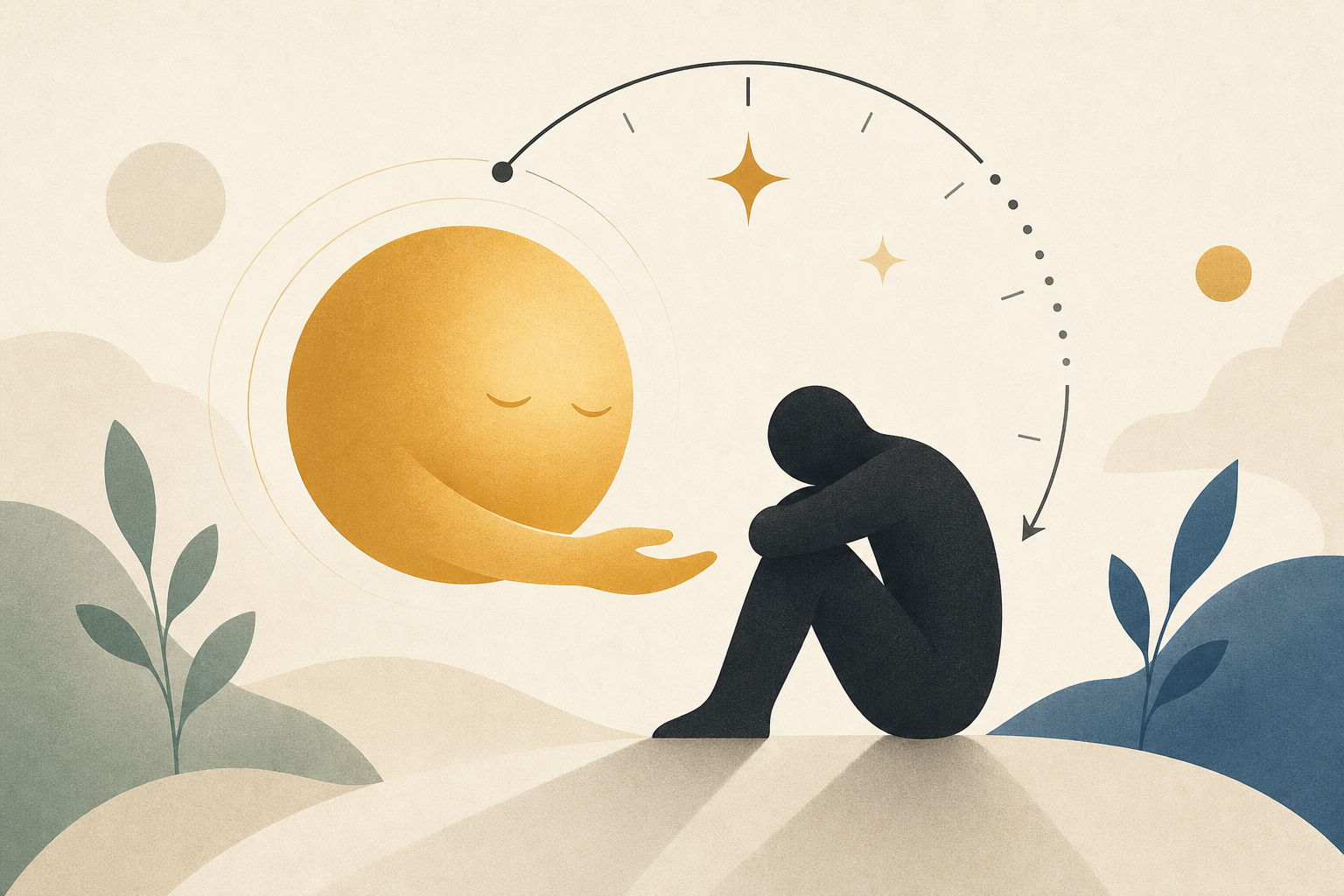
The moment right after disclosing harassment — when someone most needs to feel heard — is often exactly when appropriate support is hardest to reach. That is partly a resource problem, partly a scale problem.
A study published on arXiv in June 2026 (Anouk Bergner, Philipp Winder, Christian Hildebrand et al., arXiv:2606.05995) asks whether AI with empathic design can fill that gap. The answer was more encouraging than many might expect.
Three takeaways for today
- In supporting verbal harassment victims, LLM-generated responses consistently contained stronger empathic listening signals than human responders.
- Three empathic listening markers — perspective-taking, emotional validation, and action orientation — were confirmed to raise coping self-efficacy and the sense of being heard.
- A 24-hour AI triage model that bridges to human specialists is now practically within reach for HR and EAP providers.
① LLM empathy signals can exceed human responses
What makes this research interesting is not the claim that AI imitates human empathy. It is the finding that the volume of empathic signals in AI-generated responses outpaced that of human responders.
The researchers used 28 real verbal harassment scenarios and generated three types of responses for each: an empathically designed AI, a general-purpose AI, and a human support person.
The empathic AI consistently produced responses containing three distinct listening markers.
The first is perspective-taking — explicitly imagining and articulating the other person’s experience. Phrases like “I can see how difficult that situation must have been for you” represent this marker.
The second is emotional validation — communicating that what the person feels is not wrong. This means receiving and accepting emotions without judgment.
The third is action orientation — not just expressing empathy, but exploring together what can be done next.
Participants who received responses containing these three elements showed higher coping self-efficacy and a stronger sense of having been heard.
② Why AI responses carry more empathic signal
This does not mean human responders are unsympathetic.
Human responses are affected by individual variation, compassion fatigue, time pressure, and unconscious evaluative judgment — including the implicit question of whether something “really counts” as harassment. These factors can degrade response quality in ways that have nothing to do with intent.
AI follows its instructions consistently. Whether the disclosure comes at midnight or is the five-hundredth case that day, response quality does not drift.
The researchers are careful about scope, though. This study does not argue that AI can replace human support. It demonstrates that AI can function as an initial triage layer — providing immediate empathic response and bridging toward specialist human support when needed.
Using AI as a standalone substitute for serious ongoing counseling or complex case judgment is not what this research supports, and the researchers do not push it that way.
③ Implementation hints for HR and EAP
How does this translate to practice?
The clearest application is a 24-hour initial response window after a harassment report is filed. Currently, many organizations have a gap of several days between the initial report and the first human meeting. During that window, victims may experience isolation, anxiety, and the sense that no one is listening — all of which affect mental health outcomes and retention.
Placing an empathic AI as a triage layer in that window enables immediate response while preserving the human escalation path.
Useful KPIs here might include coping self-efficacy scores at initial contact, resignation intent rates within seven days of filing a report, and escalation conversion rates to specialist human meetings. A design where AI initial response is always followed by a scheduled human meeting also makes clear that the organization is not trying to automate away human support entirely.
For EAP providers, this represents a service extension opportunity: evening and weekend AI coverage that maintains emotional support quality while managing the cost of 24-hour human staffing.
Closing the silence after disclosure
The question this research asks is not whether AI can match human empathy. It is whether there is a scalable way to avoid leaving people alone in the window of silence after they have spoken up.
From an affective AI perspective, the methodological contribution here is the decomposition of empathy into measurable markers. Perspective-taking, emotional validation, and action orientation give researchers and designers a practical framework for evaluating and improving empathic AI response quality.
For HR and diversity practitioners thinking about how to deploy emotional AI responsibly in the workplace, this framework is a good starting point for design criteria.
That’s it for today!
Reference
- Anouk Bergner, Philipp Winder, Christian Hildebrand (2026). Empathy on Demand: How Empathic AI Can Scale Emotional Support for Verbal Harassment. arXiv preprint.
* This article was written in part with AI assistance and may contain inaccuracies.