
Column
Empathy You Don't Notice — How AI Coaching Changed Behavior Without Being Recognized
A 6-week within-subjects experiment (N=13) on WhatsApp compared three chatbots with different empathy levels. Participants couldn't reliably detect empathy — yet the high-empathy version drove greater step increases and faster improvement in behavioral intention. A look at the 'invisible' peripheral-route effect of empathy in health AI.
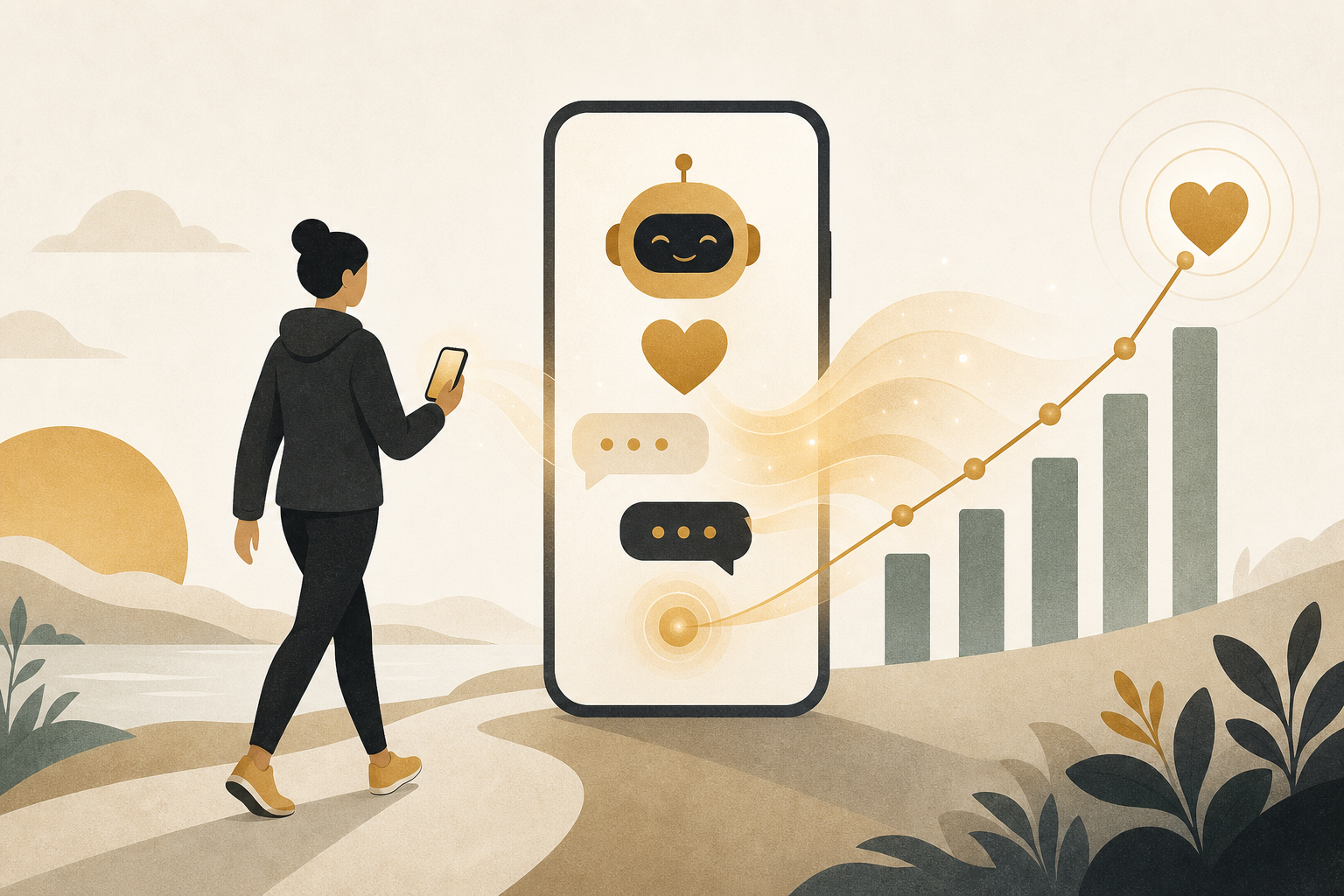
Hello. This is Keito Inoshita from Affectosphere Group.
Have you ever noticed a chatbot feeling “somehow warm”?
But how consciously do we actually pick up on empathy from AI? And if we don’t notice it — does it matter at all?
A June 2026 arXiv preprint (Li et al., arXiv:2606.26641) takes this question head-on. The study isolates the effect of empathy alone in an LLM-based physical activity coaching chatbot through a controlled experiment.
Today’s 3 Points
- Participants (N=13) could not reliably identify the empathy level of their chatbot — yet the high-empathy version produced greater step count increases and faster improvement in behavioral intention.
- Paradoxically, the non-empathy version tended to be rated as “more useful and engaging.”
- Empathy appears to work through the peripheral route of persuasion — a finding with direct implications for the design of next-generation health coaching AI.
① Why Isolating Empathy Is So Hard
Research on empathy in chatbots already exists, but most studies compare “empathetic chatbot vs. non-empathetic chatbot” as a whole package. The problem: empathetic chatbots typically differ in more ways than empathy — information density, response length, warmth of phrasing. You can’t untangle empathy’s specific contribution.
This study takes a more careful approach. The researchers built three WhatsApp coaching chatbots with only empathy level deliberately varied:
- High empathy: actively responds to emotional cues, uses empathetic language
- Low empathy: focuses on physical activity information, minimizes emotional exchange
- No empathy: purely task-oriented
The design is a 6-week within-subjects experiment — the same 13 participants experienced all three conditions. Small sample, but the care in isolating the single variable is notable.
② Undetected, Yet Effective
The most striking finding: participants could not reliably distinguish the empathy conditions.
When asked “how empathetic was that conversation?”, the scores across high, low, and no-empathy versions were statistically indistinguishable. People weren’t consciously aware of whether they were talking to an empathetic AI.
More surprising: the no-empathy version (the purely task-oriented one) tended to be rated as “more useful” and “more engaging.”
This sounds counterintuitive, but it makes sense on reflection. Empathetic language can sometimes feel like an interruption. When you want information, “that sounds really hard!” might feel beside the point.
But behavioral data told a different story.
In the high-empathy condition, participants showed larger increases in weekly step counts and faster improvement in behavioral intention (“I plan to keep walking next week”). Without consciously registering the empathy, they were actually moving more.
③ The Peripheral Route Explains It
The researchers frame this through the Elaboration Likelihood Model (ELM), a classic social psychology theory of persuasion.
ELM posits two routes to attitude change:
- Central route: deep processing of information content
- Peripheral route: emotional cues (warmth, likeability) influence attitudes without explicit processing
Empathy appears to work through the peripheral route. Participants didn’t consciously register “I’m being empathized with” — but the emotionally safe tone of the coaching influenced their motivation anyway.
For affective AI design, this is a significant insight. Whether users consciously recognize empathy and whether empathy actually contributes to behavioral change may be entirely different questions.
④ What This Means for Health Coaching AI
Several practical takeaways emerge.
First, relying solely on subjective user satisfaction as a KPI risks missing empathy’s actual effect. In this study, satisfaction favored the non-empathy version at times — but step counts favored the high-empathy version. The choice of evaluation axis is a design decision.
Second, how empathy is expressed matters. Direct empathy statements (“That sounds hard!”) may feel intrusive. Contextual empathy — acknowledging the situation rather than the emotion (“Last week’s weather must have made walking difficult”) — may land more naturally.
Third, N=13 is small. Generalization requires larger follow-up studies. That said, the finding that empathy’s effect is largely invisible to users seems worth taking seriously even at this scale.
A New Question for Affective AI
Affective AI has long aimed to recognize user emotions and respond to them.
This study surfaces a deeper question: if empathy works without being noticed, then the metric for success isn’t “did users feel empathized with?” — it’s “did behavior change?”
In health coaching: step counts. In learning: retention rates. In wellbeing: routine adherence.
How empathy is received behaviorally, not how it is rated subjectively — that may be the more fundamental question for both AI designers and users.
Reference
- Li, S., Liang, K.-H., Shahriar, S., Ye, Y., Goetsu, S., Du, W.-W., Yoshida, M., Ohwa, T., Xu, X., & Yu, Z. (2026). Invisible Impact of Empathy on Behavioral Change: Isolating the Effect of Empathy in Long-term Physical Activity Coaching Chatbot Interactions. arXiv preprint.
* This article was written in part with AI assistance and may contain inaccuracies.