
Column
Can AI Handle an Angry Customer? A New Benchmark for Emotional Intelligence
EIBench evaluates LLMs across four emotional dimensions — support, defense, repair, and rapport — using dynamic multi-turn simulations. A turn-credit reinforcement learning method substantially improved emotion management, pointing to new standards for customer support AI procurement.
Hello. This is Keito Inoshita from Affectosphere Group.
One of the most consistent complaints we hear from companies that have deployed customer support AI is this: the bot makes things worse when a customer is already upset.
The response might be grammatically correct and factually accurate. But the tone is off, the timing is wrong, and the customer ends up more frustrated than when they started.
This points to a gap in how we evaluate AI systems. Standard benchmarks measure whether a model generates a good response to a given input. They do not measure whether the model can navigate an emotionally dynamic conversation — one where the customer’s frustration is rising, and where the right move at turn three looks very different from the right move at turn seven.
A study published on arXiv in June 2026 (Rongzhi Zhu, Xiang Huang, et al.; arXiv:2606.15532) addresses this directly. The researchers propose EIBench, a simulator-based benchmark for evaluating emotional intelligence (EI) in LLMs across dynamic, multi-turn scenarios, along with a reinforcement learning method that substantially improves emotion management performance.
Three takeaways for today
- EIBench evaluates 15 models across four emotional dimensions — support, defense, repair, and rapport — using 2,222 dynamic scenarios where a simulator tracks user emotional state turn by turn.
- Centered Turn-Credit GRPO, a reinforcement learning extension, provides per-turn feedback on emotional impact, leading to substantial improvement in emotion management ability.
- Organizations procuring customer support AI can use this framework as a procurement evaluation standard and as an MLOps quality gate for model deployment.
① Why static benchmarks miss emotional intelligence
The standard approach to LLM evaluation gives a model a prompt and scores the response.
This works for factual accuracy, reasoning tasks, and code generation. It is not adequate for emotion management.
Emotional conversations are dynamic. A customer starts a support interaction mildly frustrated. Whether they become more agitated or begin to calm down depends heavily on how the AI responds — not just in content, but in tone, pacing, and acknowledgment. A model that produces a technically correct answer to an angry message may nonetheless escalate the situation if it fails to acknowledge the emotional state before moving to resolution.
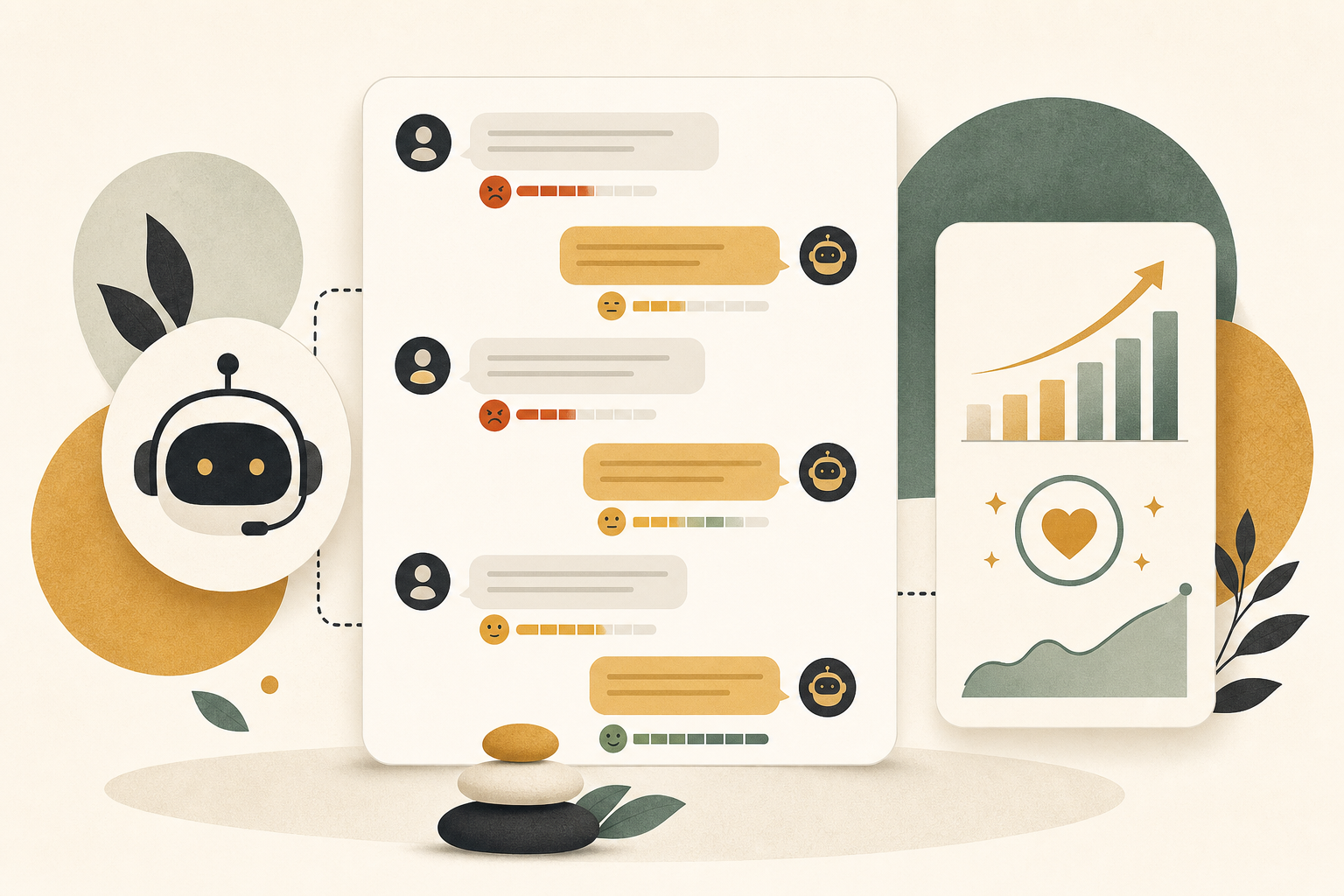
EIBench builds this dynamic into the evaluation. A simulator plays the user role and tracks the user’s emotional state at each turn of the conversation, updating it based on the model’s response. The model is then scored on how well it manages emotion across the entire conversation, not just on individual response quality.
The evaluation covers four dimensions. Support measures the ability to show empathy and provide emotional backing when a user is distressed. Defense measures the ability to maintain composure and protect the relationship when facing unreasonable anger or hostility. Repair measures the ability to restore a relationship after it has been damaged. Rapport measures the ability to build sustained trust over the course of a conversation.
Using 2,222 scenarios, the researchers evaluated 15 models and found that rankings shifted substantially compared to static evaluation results.
② Turn-level credit assignment improves emotion management
The second major contribution is a reinforcement learning approach called Centered Turn-Credit GRPO, an extension of group relative policy optimization.
The challenge with applying RL to multi-turn conversations is that a conversation-level reward makes it hard to identify which individual responses drove good or bad outcomes. If the model receives a single reward at the end of a ten-turn conversation, it has to infer — imprecisely — which of its turns contributed to success or failure.
Centered Turn-Credit GRPO addresses this by having the simulator track emotional state changes at each turn, enabling per-turn credit assignment. The model receives feedback such as: “Your response at turn three increased user distress. Your acknowledgment at turn five reduced it.” This granularity allows the model to learn from the local dynamics of the conversation rather than only from aggregate outcomes.
The result, according to the research, was substantial improvement in emotion management ability — with dynamic improvements that static evaluation could not detect.
③ Applying EIBench to procurement and MLOps quality gates
The practical applications of this framework for enterprise AI teams are direct.
The clearest use case is as a procurement evaluation standard for customer support AI.
When organizations compare AI vendors today, they typically look at response accuracy, latency, and cost. The ability to handle emotionally difficult customers — specifically, angry customers, upset customers, or customers in distress — is rarely measured with any rigor. EIBench’s four-dimensional framework makes it possible to compare models quantitatively on the dimensions that matter most for service quality: support and repair for handling frustrated customers, rapport for sustaining long-term trust.
The relevant teams are contact center AI automation teams and product managers responsible for AI procurement. KPIs to track alongside standard metrics: emotional escalation rate (the percentage of conversations where user sentiment degrades) and first-contact resolution rate specifically for emotionally charged interactions.
The second application is as an MLOps quality gate.
Before deploying an updated model to production, running it through EIBench-equivalent dynamic scenarios and requiring it to clear a minimum score adds a meaningful check that goes beyond traditional evaluation. It can catch emotional management regressions — cases where a newly fine-tuned model performs better on accuracy benchmarks but worse on dynamic empathy — before they reach customers.
This framework also has direct relevance for HRtech and LegalTech applications. Bots handling harassment complaint intake, mental health support, or legal consultation triage interact with users who are emotionally vulnerable. The repair and rapport dimensions of EIBench are especially important quality criteria for these use cases.
A new standard for emotionally capable AI
The evaluation standard for AI is shifting.
Moving from “does it answer correctly” to “can it navigate an emotionally dynamic conversation” represents a meaningful change in what we require from these systems.
EIBench provides a concrete framework for making that requirement measurable. Organizations deploying conversational AI — especially in customer-facing roles — now have a principled basis for adding emotional intelligence evaluation to their procurement and quality assurance processes.
That’s it for today!
Reference
- Rongzhi Zhu, Xiang Huang, Yuchuan Wu, Rui Wang, Zequn Sun, Tao Ren, Weiyao Luo, Bingxue Qiu, Jieping Ye, Yongbin Li, Wei Hu (2026). EIBench: A Simulator-Based Benchmark and Turn-Credit RL for Emotion Management. arXiv preprint.
* This article was written in part with AI assistance and may contain inaccuracies.