Column
Crisis SNS Was an Emotional Map ── What 1M Tweets Taught Us About Anger
AI analysis of over one million tweets after the 2023 Turkiye earthquake revealed that people's coping styles shift systematically over time. Here's what crisis communicators in corporations and government need to know about the emotional timeline — and what it means for practice.
Hi, I’m Keito Inoshita from Affectosphere Group.
What does a social media timeline look like the day after a major disaster?
News reposts, rescue requests, angry replies, messages of gratitude — it looks like chaos. But embedded in that chaos is an emotional structure. Psychology calls these patterns “coping behaviors,” and they emerge at a collective scale across communities.
A study published on arXiv in June 2026 (Şevval Çakıcı) analyzed over one million Turkish-language tweets posted after the February 2023 Turkiye earthquake, computationally revealing how collective coping styles shift over time.
Here are today’s three key points.
3 Points for Today
- Value: Post-crisis social media has a systematic emotional timeline that aligns with established coping theory.
- “Anger” turned out to be an emotion about assigning blame and making meaning — not problem-solving.
- There are practical hints for corporate and government communicators about which phase calls for which kind of intervention.
What Is Coping? ── Three Response Styles
Psychology has a well-established framework for classifying how people respond to stressful situations. This study used three styles.
Problem-Focused Coping means trying to solve the problem through concrete action. “Rescue needed at this location,” “pickup points for relief supplies are here” — these are problem-focused posts.
Emotion-Focused Coping means managing psychological stability by expressing and processing emotions. Sharing grief, prayers, words of encouragement — these belong here.
Meaning-Making Coping means searching for significance in what happened. “Why did this occur?” “Who is responsible?” “What needs to change going forward?” — these are meaning-making posts.
The study used a BERTurk-based classifier (a Turkish-language BERT model) to automatically label each tweet with one of these styles, then tracked how the proportions changed over time.
Emotions Shift Over Time ── The Dynamics of the First Days
The core finding is that coping style proportions change systematically with time.
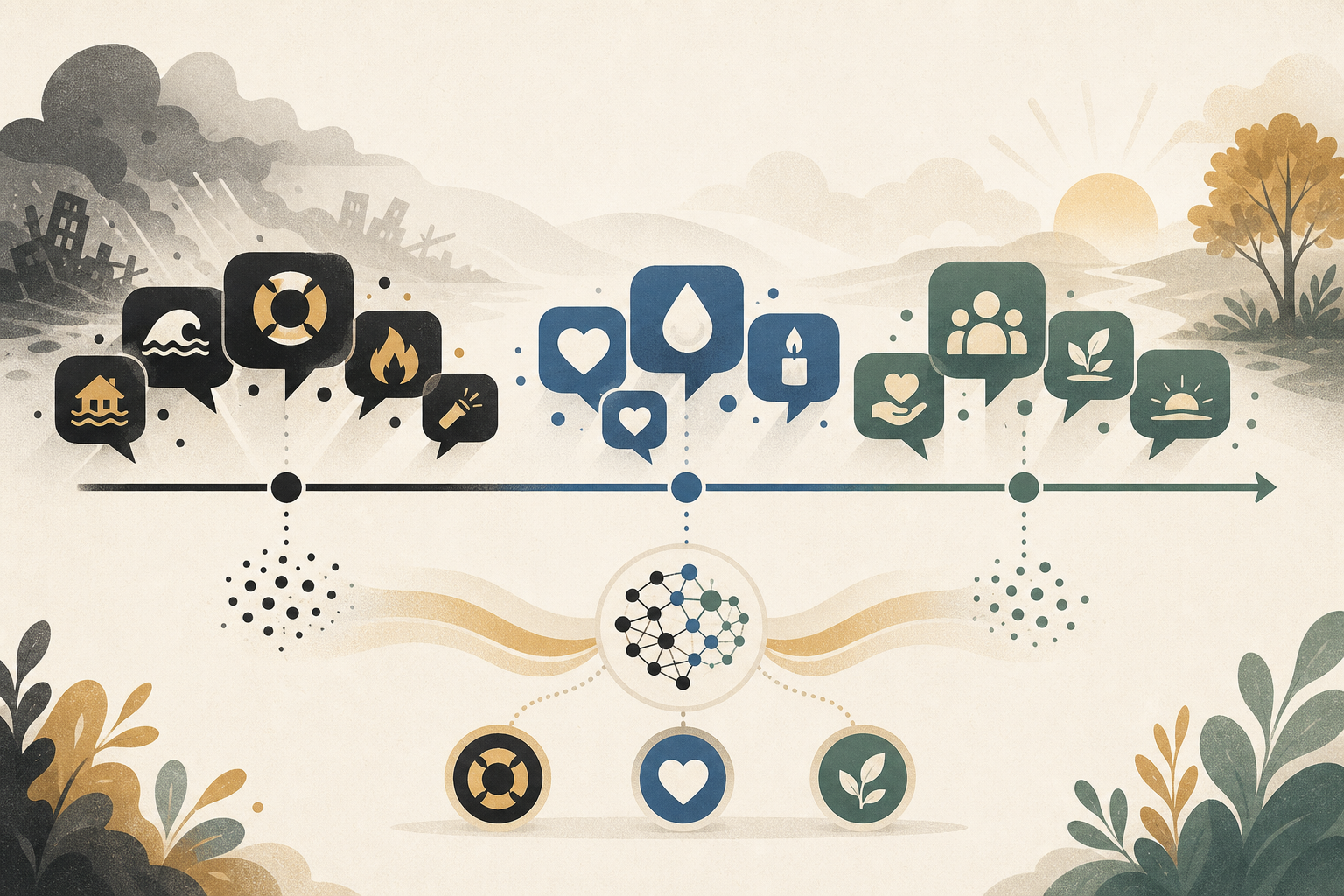
In the immediate aftermath (emergency phase), problem-focused coping dominates. The impulse to “help survivors” and “share information” floods the timeline.
But problem-focused coping declines rapidly. Once the acute physical emergency starts to stabilize, emotion-focused coping becomes the sustained mode — “feeling, empathizing, mourning” rather than “doing.”
What grows over time is meaning-making coping. Questions spread: “Why did that building collapse?” “Was the government’s response adequate?” “What do we need to change before the next earthquake?”
This dynamic closely matches what psychological coping theory predicts for individual psychology. What’s striking is that this individual-level process became visible at a macro scale, mediated by social media as a collective channel.
”Anger” Was Not a Problem-Solving Emotion
One particularly striking finding emerged from the data.
Of all emotions, “anger” showed the strongest correlation — not with problem-focused coping, but with meaning-making coping.
Intuitively, anger feels like action-oriented energy that drives problem-solving. But empirically, anger drove behavior toward attributing blame and assigning significance to events.
“Why weren’t earthquake safety standards enforced?” “Why was rescue delayed?” “Who is going to take responsibility?” — these posts are not problem-solving. They are blame attribution. And that blame attribution functioned as the mechanism through which collective grief gets channeled into social reckoning and governance critique.
Anger was not just individual emotional expression. It was part of a social meaning-making process.
For Crisis Communications Teams ── Phase-Matched Intervention
This study stops at analysis, but when applied to real crisis communication practice, the implications are actionable.
During the emergency phase (when problem-focused coping is high), the priority is information accuracy and utility. Content that immediately answers “where do I go?” and “what do I do?” aligns with how the collective is trying to cope on social media.
During the transition phase (when emotion-focused coping stabilizes), empathy and solidarity expression become more fitting. If an organization wants to express support or compassion, this window tends to be more receptive territory — though I’d approach this with care.
During the meaning-making phase (when anger and meaning-making coping increase), questions about responsibility and causes intensify. Organizations that go silent or make excuses during this phase are at high risk. Accountability and credible signals of commitment to change are what the situation calls for.
HR teams designing employee mental health support after major organizational disruptions can apply the same phase logic. Support interventions timed to match the shift from “problem-solving” to “emotional processing” to “meaning-making” are theoretically well-grounded.
Toward Organizations That Monitor “Emotional Timelines”
Most social media monitoring tools track sentiment polarity (positive/negative) and mention volume. That’s valuable. But going forward, identifying “which coping style is currently dominant” could meaningfully improve crisis response quality.
When problem-focused coping is high: lead with practical information. When emotion-focused coping dominates: lean into empathy. When meaning-making is rising: communicate explanation and intent to change.
The technology to automate this phase diagnosis is maturing. This research is one step toward demonstrating its feasibility.
Crisis events etch an emotional map. The ability to read that map may be what determines organizational trustworthiness in the years ahead.
That’s all for today!
References
- Şevval Çakıcı (2026). Coping in Crisis: Computational Modeling of Coping Styles in Digital Crisis Discourse During the 2023 Turkiye Earthquake. arXiv preprint.
* This article was written in part with AI assistance and may contain inaccuracies.