
Column
Can Talking to an AI Actually Help You Sleep?
A study tracking 1,284 users of Ash, a purpose-built mental health AI, over four weeks found measurable improvements across multiple wellbeing indicators. The surprising finding: frequency of use mattered. Volume of text did not.
Most people still carry a quiet skepticism about emotional AI.
Can a chatbot really understand distress? Does typing into an app actually help? The lack of human warmth feels like a dealbreaker when it comes to mental health support.
A study published on arXiv in June 2026 gave me reason to reconsider.
Three things this article covers
- A naturalistic study of 1,284 users of Ash, a mental health-specific conversational AI, showed statistically significant improvements across multiple functional health indicators over four weeks
- What predicted improvement was not how much people wrote, but how many days they kept coming back
- This “frequency wins, volume doesn’t” finding has real implications for how emotional AI should be designed and deployed in workplace wellness programs
① Does talking to an AI change anything?
Ash is not a general-purpose chatbot. It is purpose-built for emotional support, and the study tracked how real users engaged with it in their natural daily lives over four weeks.
The sample size was 1,284 participants. This is naturalistic engagement data, not a controlled lab setting. The researchers observed actual usage patterns and tracked changes in multiple wellbeing measures.
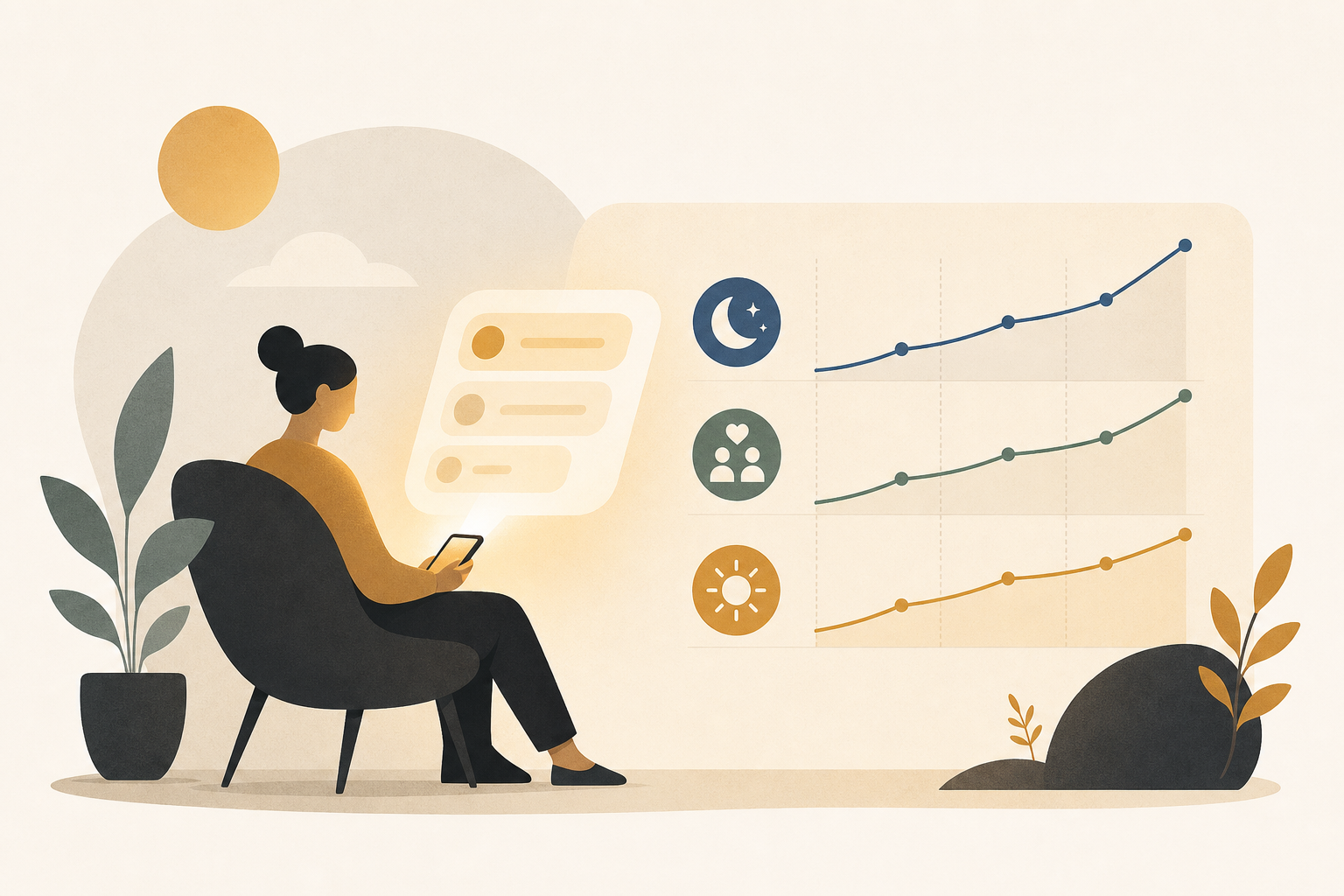
The results showed statistically significant improvements across all measured domains: life satisfaction, quality of interpersonal relationships, sleep quality, and everyday functional capacity. Effect sizes ranged from 0.14 to 0.26, which is modest but meaningful at this scale.
Importantly, the study found no evidence of adverse effects such as self-aggrandizement, which has been flagged as a concern for some emotional support tools.
② How much you typed did not matter
This is the most counterintuitive finding in the research.
Most people would assume that the more someone writes, the more they process emotionally and the more benefit they receive. Longer messages, more self-disclosure, deeper engagement.
The data said otherwise.
Message volume — the total number of characters or messages typed — was not a significant predictor of improvement. The researchers found that it contributed little to the outcomes they measured.
What did predict improvement was session frequency and the number of active use days. Returning to the app across multiple days. Maintaining a habit of contact over time.
The implication is striking: the content of what people wrote mattered less than the simple act of showing up again the next day.
③ Why frequency might be the actual mechanism
There are a few ways to think about why recurring contact would drive wellbeing outcomes.
One interpretation is that emotional regulation operates on rhythm, not volume. Regular low-effort touchpoints may be more effective at stabilizing mood than occasional intensive sessions. This parallels what is known about habit-based journaling, where consistency over weeks tends to produce more durable effects than sporadic deep-dive entries.
Another interpretation is that the AI functions as a stable anchoring presence. Knowing there is a place to go every day, even briefly, may reduce baseline anxiety. The existence of the habit is itself part of the therapeutic mechanism.
This principle likely extends beyond AI. Brief daily check-ins with a human counselor or peer support system may outperform monthly intensive sessions in terms of sustained effect. The research invites that broader re-examination.
④ Implementation for HR and EAP — redesign around frequency as the primary KPI
For organizations considering AI-based mental health tools in employee assistance programs or health insurance benefit packages, this research provides a clear design directive.
The interface features most worth investing in are not those that produce richer single conversations. They are the features that make people come back tomorrow.
Push notifications designed to prompt daily micro-check-ins rather than full sessions are now backed by evidence as a mechanism of effect, not merely a retention trick. A notification asking “how is today compared to yesterday?” serves a functional purpose.
Short-form daily check-in modules — a mood slider, a one-sentence prompt — become primary product features rather than optional extras. They lower the activation barrier to daily contact, which is where the effect lives.
Continuity-based incentives such as streaks, activity milestones, or point systems tied to active days can be defended as evidence-aligned design choices rather than gamification for its own sake.
For program managers, this suggests redefining the key performance indicator away from monthly active user count toward metrics like the proportion of users active on four or more days per week and the median number of consecutive active days per user.
The reported effect sizes of 0.14 to 0.26 are usable as business case evidence. Across an employee population of a few hundred, these numbers translate into estimable reductions in absenteeism, interpersonal friction, and sleep-related productivity loss. They are concrete enough to anchor a proof-of-concept proposal.
⑤ A design philosophy shift for emotional AI
Looking at the broader landscape of emotional AI development, most teams are currently competing on conversation quality: how empathic does the model sound, how natural is the language, how well does it handle sensitive disclosures.
This study suggests a different axis of competition may matter more: how well does the product create a habit of return.
If daily presence is the mechanism rather than conversation quality in a single session, then the design goal shifts significantly. Emotional AI should be optimized not for the best possible exchange in one sitting, but for being the thing someone wants to come back to each morning.
That is partly a product design challenge, partly a psychological one. The insight that “being there every day” may outperform “one excellent conversation” is not obvious, but it reshapes what it means to build an effective emotional AI.
Reference
- Kristen M. Van Swearingen, Thomas D. Hull, Karthik V. Sarma, Caitlin A. Stamatis (2026). Functional outcomes and naturalistic engagement with a purpose-built conversational AI for mental health (Ash). arXiv preprint.
* This article was written in part with AI assistance and may contain inaccuracies.