Column
Emotion AI Went Team-Based ── Why One LLM Can't Do It Alone
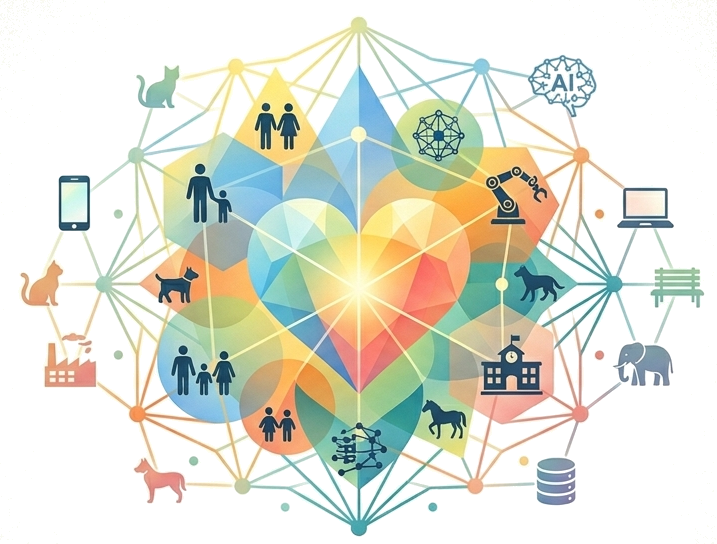
Why does a single LLM keep hitting a wall when it comes to understanding emotions? A 2026 survey revealed a clear breakthrough: collaborative architectures where multiple LLMs divide the work. Here's what it means for product teams in 5 minutes.
Hi, I’m Keito Inoshita from Affectosphere Group.
“The emotion AI demo worked beautifully — but in production, accuracy tanked.” I keep hearing this.
A customer service team deployed emotion recognition that handled English and Japanese fine, but misclassified Korean user complaints as “satisfied.” A hiring support AI misread culturally specific smile expressions and ended up frustrating candidates instead of helping them.
These failures share a common technical root.
A survey paper published on arXiv in 2026 (Wenna Lai, Haoran Xie, Guandong Xu et al., arXiv:2506.01698) gives a systematic answer to this question. Today I’m breaking it down for product managers and teams considering emotion AI deployment.
The short version: “The bottleneck in emotion AI isn’t how much the model was trained — it’s a design problem. Stop asking one model to do everything, and the way forward opens up.”
3-Line Summary
- Opportunity: Collaborative architectures — where multiple LLMs share roles — significantly outperform single models on emotion understanding and generation tasks.
- Pitfall: Assigning everything to one LLM multiplies cultural misreading and emotion reasoning errors rather than containing them.
- Implementation lens: Structured, debate-style, and autonomous collaboration strategies each exist — and the right choice depends on your use case.
Let me unpack each one.
① Why Emotion AI Became a Team Sport
For a long time, emotion AI research followed a single model paradigm: train one model on lots of emotion-labeled data, feed it text/audio/faces, predict joy/anger/sadness. That framework held for over a decade.
Then LLMs arrived and shifted the terrain.
LLMs are exceptional at contextual understanding. They can do reasonable zero-shot emotion inference right out of the box. But structural weaknesses persist in single LLMs:
- Cultural bias: Training data skews toward English and Western culture, so expressions of emotion in other cultural contexts get misread.
- Emotion reasoning errors: Sarcasm, double negation, and indirect communication get flagged as “emotionally neutral.”
- Multimodal integration difficulty: When text says “calm” but audio says “angry,” the model doesn’t have a principled way to adjudicate.
Trying to brute-force past these limits with a single, bigger model hits diminishing returns. The Lai et al. (2026) survey demonstrates that assigning multiple LLMs to collaborate substantially reduces these weaknesses.
② Three Types of Collaborative Architecture
The survey maps out the landscape of multi-LLM strategies. Three types are useful to keep in mind.
Type 1: Structured Collaboration
Clear, pre-defined role assignment.
“LLM-A handles text emotion analysis. LLM-B extracts emotion intensity from audio. LLM-C integrates both for final judgment.” Division of labor.
It’s the most tractable to implement and audit. When something goes wrong, you can trace which module failed. Enterprise deployments tend to start here.
Type 2: Debate-Style Collaboration
Multiple LLMs each produce an independent answer for the same input, then critique and revise each other’s responses.
Ask three LLMs “Is this message expressing frustration?” — each answers independently, then a majority vote or weighted aggregation produces the final output.
Research confirms that this approach reduces variance in judgment and catches cultural nuance that any single model would miss.
Type 3: Autonomous Collaboration
Each LLM operates as an independent agent, self-decomposing tasks, delegating subtasks, and re-integrating results.
Less pre-structured, more flexible, harder to control. The survey reports that this type performs especially well for emotion generation and conversational applications — think personalized emotional response chatbots.
③ Reframing This as a Design Problem
The important takeaway from this survey isn’t just that “collaborative is better.”
Most emotion AI failures aren’t “the model was weak” — they’re “the design didn’t fit the task.”
A few concrete examples:
-
A complaint detection AI in customer support that uses one LLM misses culturally loaded insults as mere “emphasis.” Splitting into “high-emotional-intensity text detector” and “cultural insult expression detector” as separate agents substantially improves precision.
-
A hiring support AI measuring candidate nervousness, given audio and text simultaneously, gets pulled by surface word choice and misses nonverbal tension signals. Breaking by modality into separate agents allows each signal to be evaluated on its own terms.
The key design decisions are: “at what granularity do you decompose the emotion task?” and “how do agents hand off information to each other?”
This means that before picking a model, teams building emotion AI should think through the collaboration architecture — who does what, and how information flows between them.
What Collaborative Emotion AI Opens Up
The survey covers both emotion understanding (recognition, inference, cause analysis) and emotion generation (dialogue generation, personalized response) sides of the problem.
On the understanding side: multimodal emotion recognition, emotion reasoning, emotion cause analysis. On the generation side: emotionally coherent dialogue, personalized affective response.
In both domains, single-LLM limits are being concretely overcome by collaborative designs.
From a product standpoint, the practical implication is this: when “adding emotion AI” is on the agenda, the conversation needs to include not just “which model?” but “how do we divide the roles?” That design decision will increasingly determine whether the deployment succeeds.
Emotion AI is moving from “a single model problem” to “a collective intelligence design problem.” This paper makes that case with care.
That’s all for today!
References
- Wenna Lai, Haoran Xie, Guandong Xu, Qing Li, S. Joe Qin (2026). When LLMs Team Up: The Emergence of Collaborative Affective Computing. arXiv preprint.
* This article was written in part with AI assistance and may contain inaccuracies.