Column
Can AI Read the Trajectory of a Mind? How Social Media Timelines Reveal Mental Health Changes
A single post tells only half the story. A new LLM-based pipeline tracks emotional shifts over time, integrating post-level sentiment analysis with user-level temporal change modeling — opening a path toward earlier intervention.
Hello. This is Miura from the Affectosphere Lab.
As someone who works in affective AI, I’ve been sitting with a question lately.
We’ve invested heavily in reading the emotional state of a person right now. Sentiment classification, facial expression recognition, vocal tone analysis — these are practically mature technologies. They tell us what someone feels in a given moment.
But what about change?
When someone’s language has been subtly darkening over three months. When posting frequency has quietly dropped. When the way a person talks about themselves has shifted. That kind of slow, gradual drift — the kind that carries the earliest warning signs — is exactly where affective AI has lagged behind.
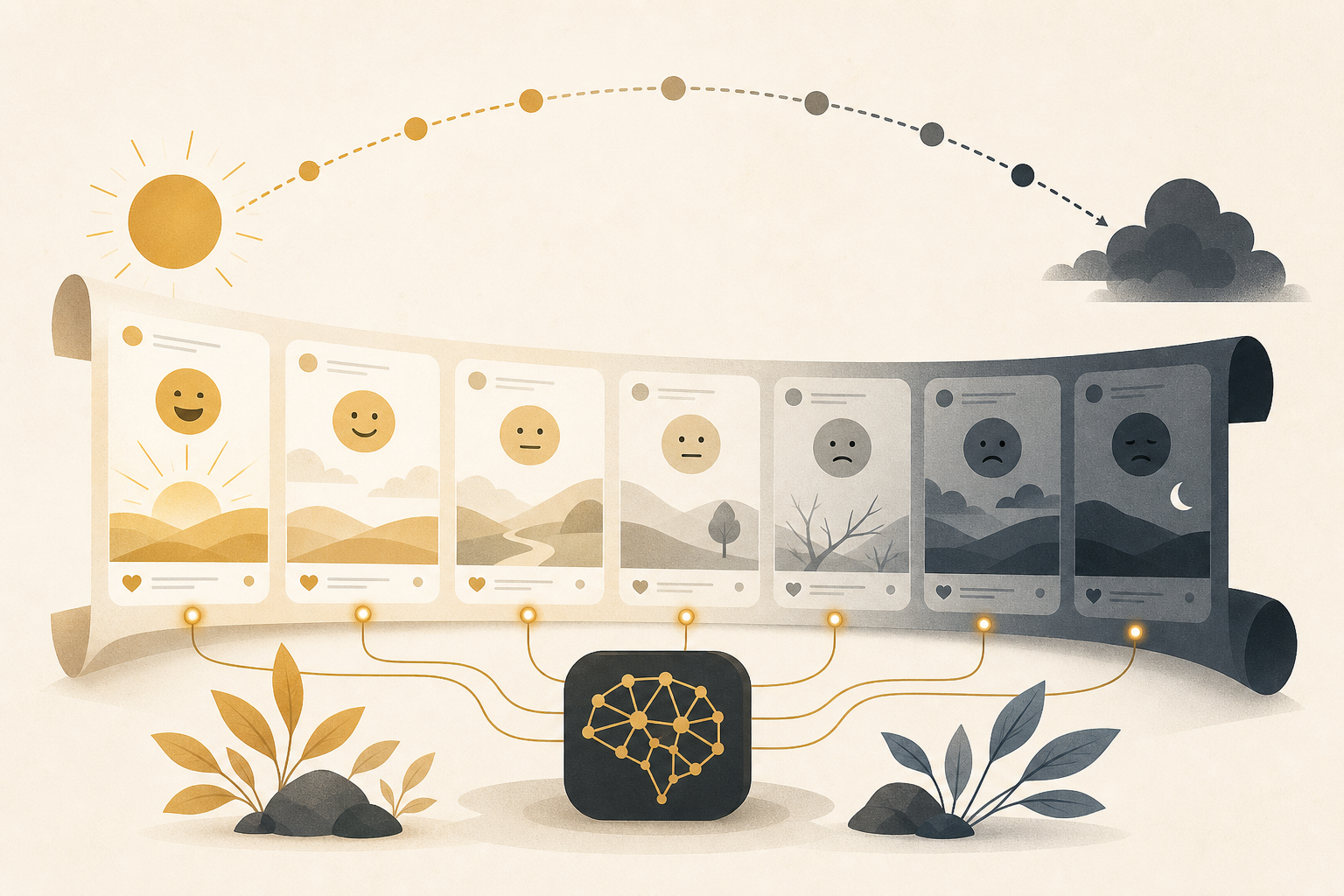
A 2026 study by Hwang et al. (arXiv:2606.31464) takes this challenge head-on. The team built an LLM-based pipeline that analyzes social media timelines as longitudinal sequences, integrating post-level emotional assessment with user-level temporal change modeling in a single unified framework.
Three Points for Today
- The next frontier for affective AI is not the “dot” but the “line” — moving from snapshot emotion recognition to tracking change trajectories over time.
- Hwang et al. built a two-layer LLM pipeline that combines fine-grained post-level analysis with user-level temporal modeling within a unified framework.
- Against the backdrop of growing global mental health burden and unequal access to care, the research points clearly toward computational approaches as a path to earlier intervention.
Why “Change” Matters More Than “State”
The history of affective AI has largely been a history of snapshots.
Is this tweet expressing anger? Is this review negative? Does this utterance convey sadness? These are snapshot questions. They have value. But from a mental health perspective, they leave something critical out.
Mental health conditions don’t appear overnight. They unfold gradually. A passing complaint becomes a pattern of self-criticism. Enthusiasm gives way to flatness. The intervals between posts grow longer. The trajectory is where early warning signals live.
This is what Hwang et al. focused on — not the emotional state at a single moment, but the movement of that state across time.
The Architecture: Two Layers Working Together
The pipeline Hwang et al. built has two layers.
The first is post-level emotional assessment. Each post is analyzed in terms of its tone, word choice, and expressive patterns. In some sense, this is an evolution of what affective AI has done well for years — close reading of individual text units.
The second is user-level temporal change modeling. Multiple posts are integrated across time to form a picture of how that user’s emotional state is shifting. Rather than treating the timeline as a flat sequence, the model treats the pattern of change itself as a feature.
The novelty lies in connecting these two layers within a unified framework. The fine-grained emotional signals at the post level flow into the user-level model, producing a richer and more accurate overall picture.
Think of it less like two separate gears and more like a precision mechanism where each layer feeds the other — granular emotional data shaping the temporal model, and temporal context shaping how individual posts are read.
From an Affective AI Perspective: Why Trajectories Change Everything
Speaking as an affective AI researcher, this design resonates deeply.
Human emotion doesn’t just exist in a moment. It exists in time. A feeling of sadness becomes clinically significant when it has persisted across days and weeks. Joy becomes more meaningful when it follows a long period of low affect. Context is everything.
If affective AI can only read the emotional state right now, it is watching a series of still photographs. The moment we add change detection, those photographs become a film.
Social media data offers exactly that — a film of emotional life, recorded voluntarily and continuously by users themselves. Reading that film carefully means we might catch signals that even the person posting hasn’t consciously recognized yet.
The Social Stakes
Behind this research lies an urgent social reality.
Mental health disorders are increasing globally. Access to professional care remains deeply unequal. Cost, geography, stigma, and waiting lists all stand between people and the help they need. For many, formal care only arrives — if it arrives at all — after a crisis has already developed.
This is where computational methods have something to offer. Not as a replacement for clinical care, but as an early signal — a way to surface patterns that might otherwise go unnoticed until they become harder to address.
The framing matters here. This research is not about AI making clinical diagnoses. It is about AI detecting meaningful change, so that humans — whether friends, counselors, or automated support systems — can step in at the right moment. Widening the doorway to support, rather than replacing what’s behind it.
What Affective AI Can and Cannot Do
I think it’s worth being honest about the limits here.
Social media posts are not transparent windows into emotional life. People perform, exaggerate, minimize, and present edited versions of themselves online. Platform conventions shape expression in ways that vary widely across communities.
And detecting that a change has occurred is very different from understanding what that change means clinically. The former is increasingly within reach for affective AI; the latter requires professional judgment that AI cannot currently replicate.
Hwang et al. are working on the former — improving the technical accuracy of change detection. That is a meaningful contribution, and it is the right contribution to make at this stage.
Beyond Mental Health: A Design Pattern Worth Generalizing
The temporal, trajectory-aware design this research demonstrates extends well beyond clinical applications.
Customer experience teams tracking emotional drift across months of interactions, not just single surveys. Community moderators monitoring the collective affective tone of online spaces before problems escalate. Wellness apps that give users a long-range mirror of their own emotional patterns rather than just a daily reading.
The shift from “measuring a state” to “reading a trajectory” is a design pattern. Once you see it, you start noticing how many affective AI applications could benefit from it.
A Direction for the Field
Affective AI is maturing. The early excitement around emotion detection — can we classify this tweet as sad? — has given way to harder, more interesting questions. Can we track the arc of a person’s emotional life? Can we catch the signal before the crisis?
Hwang et al.’s work is a serious contribution to that harder question. It is technically grounded, socially motivated, and honest about what it is trying to do.
From snapshot to trajectory. From point to line. That is the direction affective AI is heading — and it is a direction worth following.
References
- Kyomin Hwang, Hyeonjin Kim, Hyunho Lee, Nojun Kwak (2026). Team MKC at CLPsych 2026: Capturing and Characterizing Mental Health Changes through Social Media Timeline Dynamics. arXiv preprint.
* This article was written in part with AI assistance and may contain inaccuracies.