Column
The Era of AI Simulating 'What Happens If We Cut Prices' in Real Time — What the Business World Model Means
A new framework called the Business World Model (BWM) proposes encoding company environments as states, constraints, and goals so AI agents can autonomously simulate alternative scenarios. A five-minute explainer on the shift from 'instruction-based execution' to 'goal-driven autonomous planning' — for corporate strategy and planning teams.
This article is an English version of the original Japanese column. Some phrasing has been adapted for English readers.
Hello — this is Inoshita from Affectosphere Group.
“If we cut prices by 10%, what happens to revenue?”
How much time and how many people does it currently take to answer that question in your organization?
Most corporate strategy and planning teams would recognize this pattern: First, request the data from finance. Then organize past trends in a spreadsheet. Interview marketing and inventory to stack up more assumptions. By the time the scenario analysis is ready, the situation has already changed.
I think the biggest bottleneck in business decision-making is the speed of deliberation and the gap between analysis and reality.
A study published in June 2026 on arXiv (Cecil Pang, Hiroki Sayama; arXiv:2606.10044) proposes a conceptual framework called the Business World Model (BWM) to address exactly this.
Three takeaways
- The BWM framework encodes a company environment as states, dynamics, constraints, goals, and an action space.
- AI agents can simulate alternative scenarios across those encodings and evaluate future business impact in real time.
- The shift from “instruction-based execution” to “goal-driven autonomous planning” has the potential to transform executive decision-making.
Let me go through each.
1. What is BWM? — Converting a company into a simulable state
The core of the Business World Model is structured representation of a company environment.
Concretely, an organization is described with these elements:
- State: what situation the organization is currently in — revenue, inventory, headcount, customer data, etc.
- Dynamics: how the state changes — lower the price and sales volume increases, inventory decreases, etc.
- Constraints: the limits on available actions — regulations, budget, capacity, etc.
- Goals: what the organization wants to achieve — maximize profit, expand market share, cut costs, etc.
- Action Space: the set of choices that can actually be executed.
Once a company environment is encoded in these five elements, an AI agent can compute: “from the current state, if I take this action, how does the state change?”
The intuition is the same as a chess AI that learns the board state and how pieces move, then searches for the best move — applied to business decisions.
2. Simulating the chain from “price change” to “cash flow”
Where BWM becomes practically meaningful is in situations where multiple decisions chain together.
Take the single action: “cut prices by 10%.”
A simple financial model stops at revenue × volume × change rate. But real business has chains.
Lower the price and sales volume shifts. Sales volume shifts and inventory draw-down speed changes. Inventory changes and the timing of procurement changes. Procurement changes and cash flow is affected. Cash flow changes and the next investment decision changes.
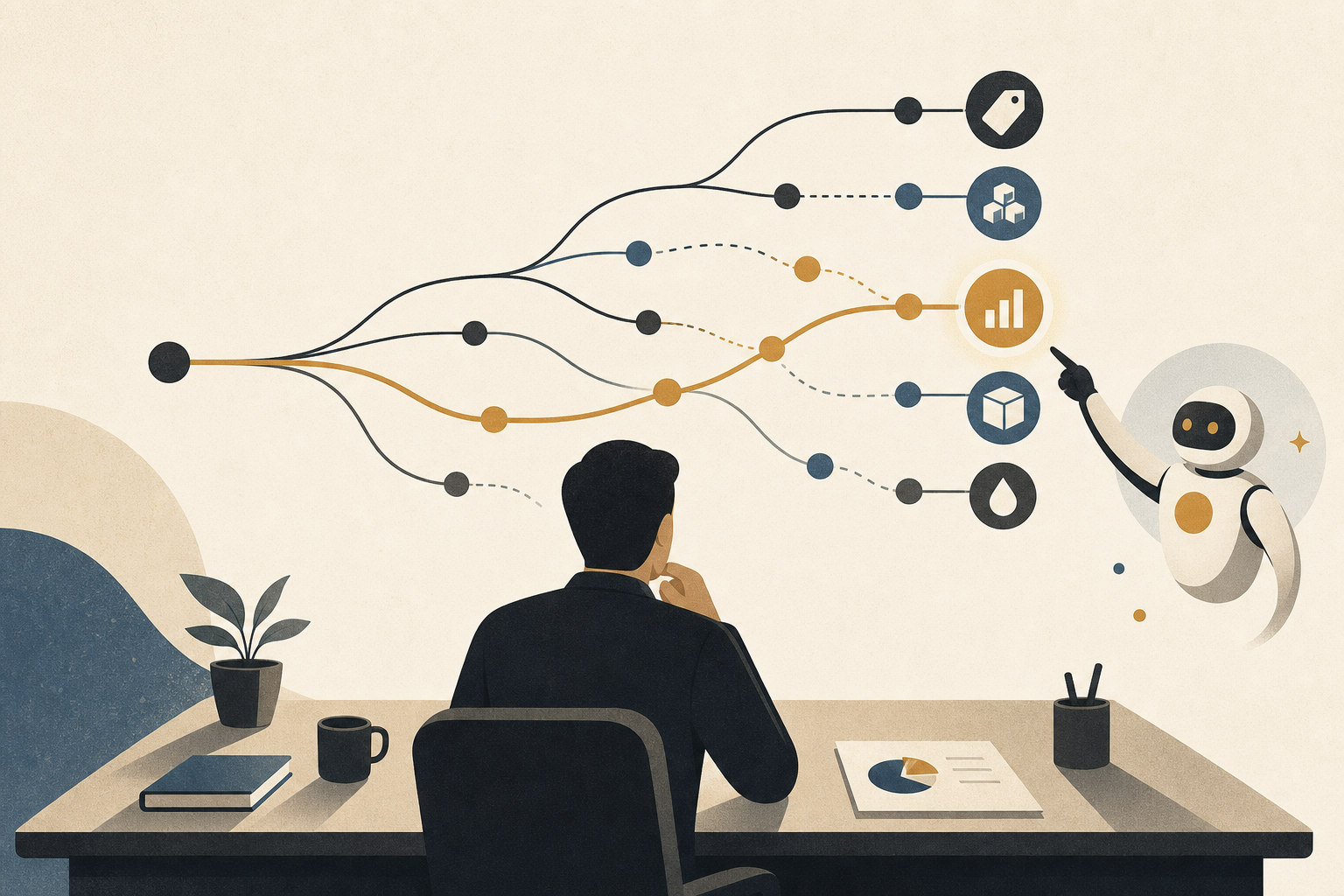
The role of the AI agent using BWM is to run this entire chain — across multiple scenarios, simultaneously, in real time.
The research proposes integrating “semantic data representation, probabilistic machine learning models, deterministic business rules, and an explicit action space.” In other words: combine “rules humans have set” (deterministic) with “uncertainty learned from data” (probabilistic) to build a model that can handle both the predictable and the unpredictable parts of a business.
3. From “execute instructions” to “achieve goals”
The fundamental change BWM is aiming at is a shift in what AI actually does.
Most current business AI is “instruction-based execution.” “Aggregate this data.” “Organize this document.” “Answer this question.” — a tool that completes tasks defined by humans.
BWM is aiming for “goal-driven autonomous planning.” You input only a goal — “improve operating profit by 15% next quarter” — and the AI autonomously plans and proposes which action sequence gets you there.
That’s a meaningful shift. Connect the data accumulated in ERP and CRM to BWM, and the AI’s role moves from “compile this month’s numbers in Excel” to “look at this month’s numbers and propose next month’s decision plan.”
Business application: compressing the CFO’s scenario analysis from days to minutes
A few concrete use cases:
For corporate planning teams, the highest-value scenario is rapid prototyping of strategic alternatives.
Right now, a “Scenario A vs. B” estimate often takes two to three days. If a company environment is encoded in BWM, questions like “what if this assumption changes,” “what if this constraint is lifted,” “what if we prioritize this goal” can generate alternative scenarios in minutes. Being able to compare 10 scenarios before a decision meeting dramatically raises the quality of the conversation.
For ERP vendors, BWM could function as the next generation of business intelligence. Existing ERP is excellent at recording and aggregating data but weak at “what should we do from here.” Layering BWM on top of ERP could bridge “historical records” to “future planning.”
For consulting firms, BWM becomes a complement to the strategy recommendation process. Build a BWM from a client company’s data, then show in real time “here’s what happens in your situation if you choose this scenario.” The persuasiveness of recommendations goes up and the effort on sensitivity analysis goes down significantly.
The most measurable KPI is reduction in the lead time of the scenario review cycle.
Important caveat about the current state
To be straightforward: this research is still at the conceptual proposal stage.
This is not “we used BWM at a company and profit improved by X%.” It is closer to a theoretical blueprint — “if a company is described in this format, AI should be able to support autonomous decision-making.”
Questions like how difficult it is to actually connect this to ERP and CRM, how much data is required, and how the approach changes by industry and type of business — these are practical questions that future research and implementation will need to answer.
Rather than “there is a product ready to deploy,” the more accurate frame is: “this architecture is likely to emerge in the next two to three years, and understanding the design philosophy now has value.” That’s the right level of expectation.
Closing
“Make decision-making faster” is a perennial challenge in management.
Organizations where people are consumed by preparing meeting materials, leaving too little time for actual judgment — that’s still very common.
What BWM points to is the direction: if a company can be structurally described, AI can use that structure to compute possible futures. This is a question of structure, not of data volume. However much data you have, if it isn’t encoded in a simulable format, all AI can do is aggregate the past.
“What would we need to describe our organization in a way that AI could simulate it?” — BWM is a useful framework for framing that question and starting to find out.
That’s it for now!
References
- Cecil Pang, Hiroki Sayama (2026). Business World Model. arXiv preprint arXiv:2606.10044.
* This article was written in part with AI assistance and may contain inaccuracies.