
Column
Autonomous Driving Risk Is Not Just a Technical Problem
A cross-domain analysis spanning NHTSA crash data, MIT Moral Machines, and five regulatory jurisdictions reframes autonomous driving risk as a three-layer challenge. What insurance underwriters, legal teams, and safety engineers need to know.
Hello. This is Keito Inoshita from Affectosphere Group.
Evaluating the “risk” of autonomous driving is harder than it looks.
An engineer frames it as probability of sensor misdetection or time-to-intervention. A lawyer asks who bears liability when an accident occurs. An ethicist asks whose life is prioritized in an unavoidable collision. A regulator asks how many incidents must be reported per mile driven.
Each group is talking about autonomous driving risk, but they’re pointing at completely different questions. That fragmentation makes industry-wide decision-making difficult.
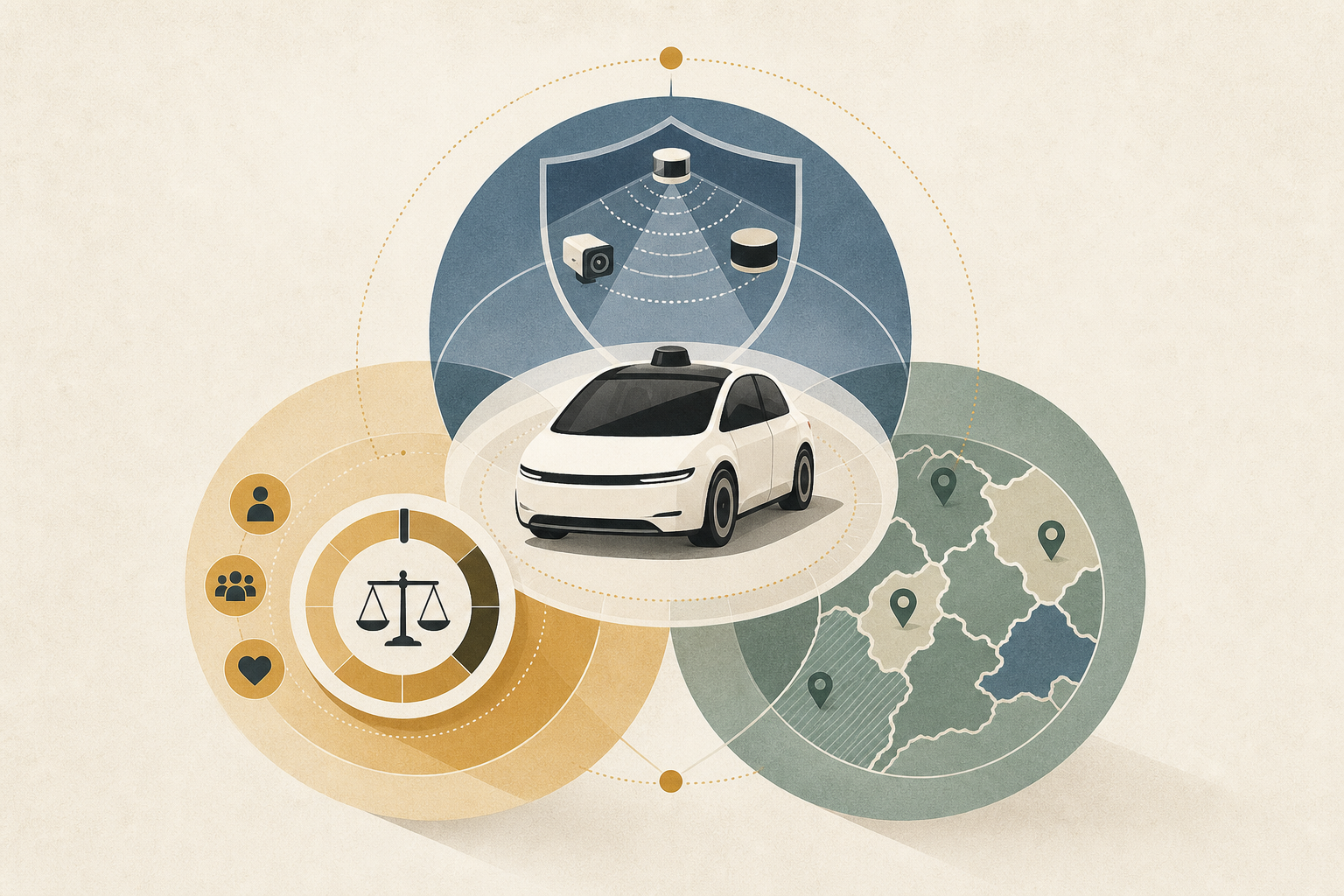
A study published on arXiv in June 2026 (Boyi Chen, Shengqin Chu, Zicheng Wang, Brian Baetz, Zhen Gao et al., arXiv:2606.06396) tries to break that fragmentation. It proposes an integrated risk assessment framework that cuts across technical, ethical, and regulatory dimensions simultaneously.
Three takeaways for today
- Analysis of NHTSA crash data identified perception and classification errors as the dominant technical failure mode in autonomous driving incidents.
- MIT Moral Machines data revealed significant cross-cultural differences in ethical decision-making preferences for emergency scenarios.
- Comparison across five regulatory jurisdictions (US, EU, China, UK, Germany) points toward the need for adaptive governance that evolves with both technology and social consensus.
① What crash data tells us about technical failure
Start with the technical layer.
The research team cross-analyzed NHTSA crash data and California DMV autonomous disengagement reports.
The dominant finding: perception and classification errors are the primary failure mode underlying reported incidents. The autonomous system either fails to detect an object correctly or misclassifies it — a pedestrian read as something else, an obstacle processed incorrectly.
For OEM safety engineers and Tier-1 suppliers, this may not be a surprise. But what distinguishes this study is placing that finding alongside ethical and regulatory data, rather than treating it in isolation. The question becomes: how does a known technical failure mode interact with ethical decision-making rules and regulatory requirements across jurisdictions? That cross-layer framing is the methodological contribution.
② How much do ethical preferences vary by culture?
The ethical layer draws on the MIT Moral Machine dataset — a large-scale study that collected preferences from millions of people worldwide on trolley-problem-style scenarios for autonomous vehicles facing unavoidable collisions.
The finding here is substantial cross-cultural variation in ethical decision-making preferences for emergency scenarios.
Whether to prioritize the young over the elderly, whether rule adherence or life maximization should come first — these preferences differ significantly across countries and cultures.
For autonomous driving manufacturers, this is a serious design problem. An ethical decision-making algorithm deemed appropriate in one market may be unacceptable in another. Global deployment of autonomous systems requires grappling with ethical pluralism in a way that product teams rarely have to confront in other domains.
The research does not resolve this tension. But it makes it concrete and quantifiable, which is a prerequisite for any practical response.
③ Regulatory fragmentation across five jurisdictions
The third layer is regulatory policy.
The study compared autonomous driving regulatory frameworks across the US, EU, China, the UK, and Germany on dimensions including liability attribution, safety standards, testing requirements, and data-sharing obligations.
The picture that emerges is significant divergence. The US has a patchwork of state-level regulations with no unified federal framework. The EU’s AI Act provides a comprehensive governance approach but autonomous-vehicle-specific rules are still developing. China has moved quickly with state-directed test corridors and policy implementation.
For automakers pursuing global deployment, regulatory fragmentation is a hidden cost. Compliance burden multiplies as each jurisdiction requires different documentation, different testing evidence, and different liability structures.
The research team’s recommendation is an “adaptive governance approach” combining technical standards, ethical deliberation, and institutional oversight. The idea is a governance model that updates continuously as technology evolves and social consensus shifts — rather than a fixed ruleset that falls behind reality.
What insurance underwriters and legal teams can do with this
Translating the three-layer framework into practice:
For insurance underwriting, the conventional autonomous vehicle model centers on accidents-per-mile. This framework enables a multi-axis model incorporating technical failure mode risk, jurisdiction-specific regulatory environment, and the ethical algorithm design philosophy of the system in question. That richer model could support more differentiated premium structures.
For legal and compliance teams, the five-jurisdiction comparison has direct reference value when planning global rollout. It functions as a checklist for identifying jurisdiction-specific requirements before market entry rather than after an incident.
KPIs worth tracking: incident counts segmented by technical failure mode; regulatory environment scores by jurisdiction; and user acceptance rates for disclosed ethical decision-making algorithms.
Organizations that speak all three languages will be ahead
An organization that frames autonomous driving risk purely in technical terms will miss the ethical and regulatory exposure. One that treats it purely as a philosophical ethics debate will lag on concrete technical response to known failure modes.
What this research offers is a shared vocabulary for talking about all three layers simultaneously.
When OEMs, Tier-1 suppliers, insurers, and regulators can discuss autonomous driving risk in the same language, the whole industry moves toward safer outcomes faster.
That’s it for today!
Reference
- Boyi Chen, Shengqin Chu, Zicheng Wang, Brian Baetz, Zhen Gao (2026). Risk Assessment of Autonomous Driving: Integrating Technical Failures, Ethical Dilemmas, and Policy Frameworks. arXiv preprint.
* This article was written in part with AI assistance and may contain inaccuracies.