
Column
Should AI Say 'I've Been in Similar Situations'? The Narrative Authenticity Gap in Caregiver Support
When an AI expresses empathy through first-person experience, does that experience actually exist? A new study on peer-like support for dementia caregivers reveals a critical design challenge for emotional AI.
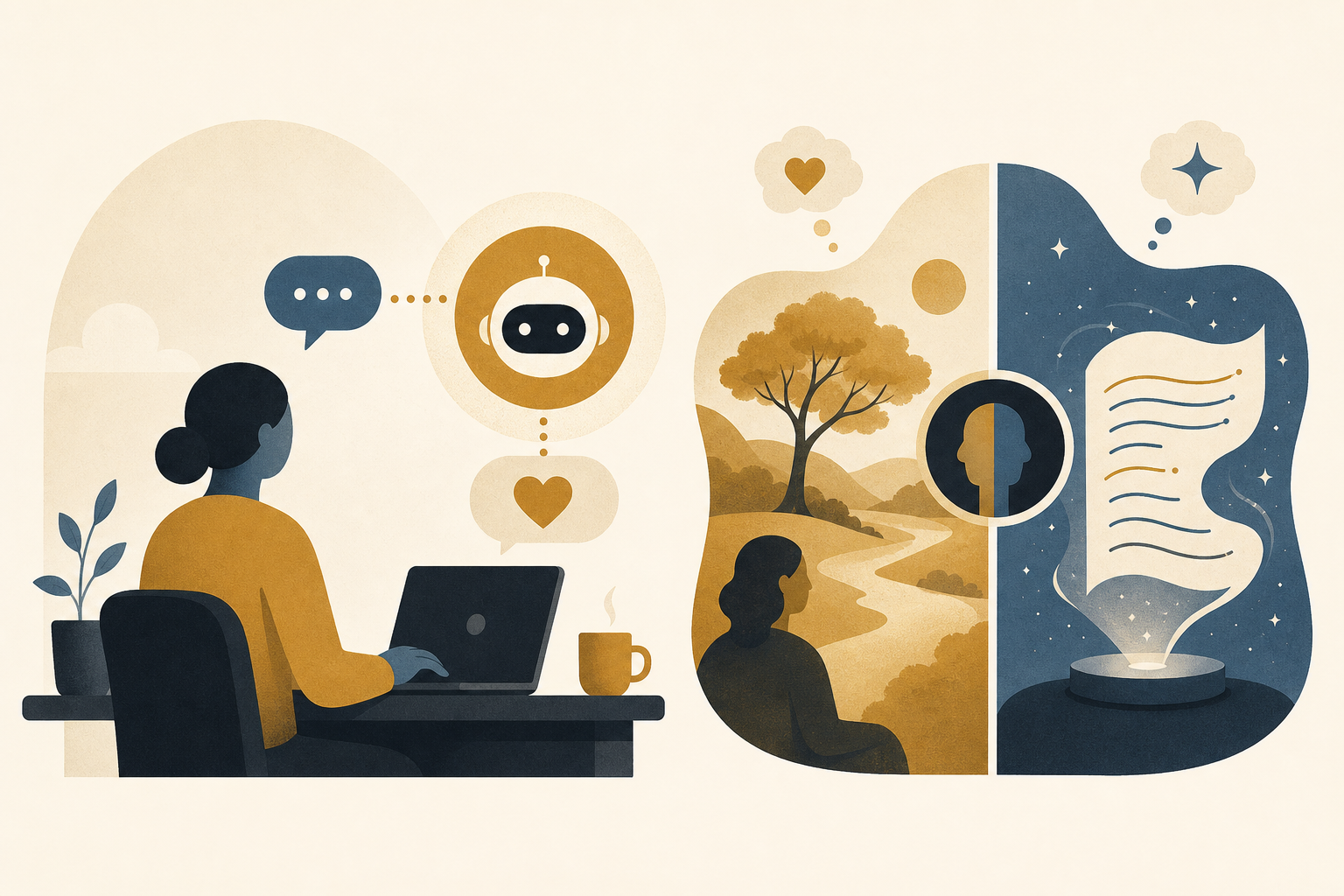
Hi there. I’m Inoshita from the Affectosphere Group.
“I understand. I’ve been in a similar situation myself…”
When someone says this to us, something shifts. The sense of isolation softens. The feeling that we’re alone in our struggle begins to dissolve.
Peer support — people with shared experiences supporting one another — works precisely because of this dynamic. The weight of those words comes not just from what is said, but from the fact that the person saying them has actually lived through something comparable.
Now consider this: what happens when an AI says the same thing?
A study published on arXiv in 2026 (Drishti Goel, Violeta J. Rodriguez, Daniel S. Brown, Ravi Karkar, Dong Whi Yoo, and Koustuv Saha; arXiv:2606.18057) tackled this question head-on. The researchers examined how three large language models — LLaMA, GPT-4o-mini, and MedGemma — generate peer-like support responses for family caregivers of dementia patients, and compared those responses psycholinguistically against those from actual human peer supporters.
The implications are significant for anyone thinking seriously about how emotional AI should be designed and deployed.
Three Key Takeaways
- AI can mimic the communicative style of peer support — but it has no experiential basis for doing so.
- This creates what researchers call a “narrative authenticity gap.”
- System design must distinguish between emotionally resonant but experientially hollow support and genuine supportive framing grounded in lived experience.
Why Peer Support Matters for Dementia Caregiving
Before getting into the research, it helps to understand the landscape.
Caring for a family member with dementia is among the most psychologically demanding caregiving roles that exist. The cognitive and emotional burden is relentless. The social isolation is often severe. And critically, the experience is hard to fully explain to someone who hasn’t lived it.
This is where peer support proves valuable. When a caregiver connects with someone who has walked a similar path — who has stayed up with a loved one who doesn’t recognize them, who has navigated the bureaucracy of memory care facilities, who has felt the strange grief of mourning someone still alive — something happens that professional support alone rarely provides.
The shared lived experience is the foundation. It is what makes the words credible.
Now, there’s growing interest in whether AI can fill some of this role. The case for it is understandable: AI-based support can be available around the clock, can scale to reach caregivers in underserved regions, and doesn’t require scheduling or travel. For a demographic that often struggles to find time for self-care, this accessibility matters.
But the researchers behind this study push back on a crucial assumption: that the communicative style of peer support can simply be replicated by AI without confronting what gives that style its meaning.
What the Study Found
The psycholinguistic analysis compared AI-generated responses from three models against human peer support responses across multiple dimensions — emotional tone, self-disclosure patterns, narrative structure, and language use.
The finding that stands out is this: AI models are capable of generating responses that sound like peer support. The models produce first-person emotional framing, use language that signals shared understanding, and adopt a tone that is warmer and more personal than clinical interaction.
But there’s a critical gap beneath the surface.
Human peer supporters draw on actual memories. When they say “I’ve been in a situation like this,” there is a specific experience — a real history — behind that statement. The language is grounded in something.
When an AI generates the same kind of statement, it is drawing on patterns from training data, not personal history. The language sounds grounded but is experientially hollow.
The researchers introduce the term “Synthetic Lived Experience” to describe this phenomenon: the AI’s generation of first-person experiential language that mimics lived experience without possessing any. And they identify the gap between this synthetic experience and authentic human lived experience as the “narrative authenticity gap.”
Why This Gap Matters
“But if it helps the caregiver feel better, does it matter?” This is a reasonable question. And it deserves a serious answer.
There are at least two reasons to take the gap seriously.
The first is about the basis of trust.
The effectiveness of peer support is not purely about the words exchanged. It is bound up with the caregiver’s confidence that they are talking to someone who genuinely knows what this experience is like. That confidence shapes how they receive and process what they hear.
When an AI generates peer-like language without any underlying experience, there is a mismatch between what the language implies (shared lived knowledge) and what is actually present (pattern-matched text generation). If the caregiver’s trust is partly built on an implicit belief that the AI “knows” in the way a peer would know, that trust rests on something that isn’t there.
The second is about design ethics.
Because AI can generate emotionally resonant language so fluently, there’s a temptation to deploy it in support contexts without being transparent about what it is and isn’t. Dementia caregivers are, by definition, already under significant psychological strain. Deploying systems that allow — or even encourage — misunderstanding about the nature of the support being offered raises ethical concerns that deserve explicit attention in the design process.
The Design Challenge
The study’s core contribution is not to argue that AI should never be used in caregiver support contexts. The accessibility benefits are real and meaningful. Rather, it identifies a design imperative: systems that use AI for emotional support must grapple with the narrative authenticity gap explicitly.
The researchers draw a distinction between two types of AI response that are worth sitting with:
The first is support that is emotionally resonant but experientially false — where the AI uses first-person experiential language that implies a lived history it does not have.
The second is support that uses a “supportive framing” approach — where the AI expresses empathy, validation, and care in ways that do not require claiming a shared experiential history.
A statement like “That sounds incredibly difficult, and I want you to know you’re not alone in feeling this way” can be supportive without implying the AI has been through something similar. It offers emotional presence without synthetic experience claims.
A statement like “I’ve been through something like this too…” does something different. It makes an implicit claim about a shared history that doesn’t exist.
The design work is in understanding which kind of language AI systems are producing — and ensuring the former is prioritized over the latter in high-stakes support contexts.
Implications for Emotional AI
At the Affectosphere Group, we think a lot about what it means for AI systems to engage with human emotion responsibly. This study surfaces a tension that is central to that work.
Emotional AI has real value. Systems that can offer consistent, accessible, non-judgmental support have the potential to meaningfully extend the reach of mental health and caregiving resources. We’re not skeptical of that potential.
But the effectiveness of emotional AI depends on the integrity of the framing it uses. When AI systems adopt the language of shared experience without the experience itself, they risk building support on a kind of implicit fiction.
For caregivers who are already navigating enormous complexity — cognitive, logistical, emotional — systems that are unclear about what they are and aren’t may not serve those caregivers as well as systems that are honest about their nature and still capable of offering genuine support.
The researchers suggest that distinguishing between emotionally resonant but experientially hollow support and supportive framing is a design and policy priority. We’d put it even more directly: transparency about the nature of AI support is not just an ethical nicety. It may be what makes that support genuinely useful.
What Honest AI Support Can Look Like
To be concrete about what this suggests in practice:
AI systems in caregiver support contexts should not use first-person experiential language that implies they have personal histories analogous to the caregiver’s situation.
They can and should be designed to offer warm, emotionally present, validating responses that don’t depend on claimed shared experience.
Where AI is being used in a context that might be mistaken for peer support — by a person, or by a trained peer supporter — that distinction should be made clear to the caregiver.
Systems should be evaluated not just on whether caregivers feel better after interacting with them, but on whether caregivers have an accurate understanding of what they’re interacting with.
None of this prevents AI from being genuinely helpful. It just requires that helpfulness be built on honesty rather than the simulation of a shared history that doesn’t exist.
Conclusion
This study offers a careful and timely analysis of a problem that will only grow more important as AI systems become more integrated into mental health and caregiving support.
The finding that AI can fluently generate peer-like language is not surprising. What matters is what the study reveals about the gap between that fluency and the experiential grounding that makes peer support meaningful.
For those building emotional AI systems — and for those making decisions about deploying them in sensitive support contexts — the concept of the “narrative authenticity gap” is a useful frame. The question it poses is simple: when AI speaks in the language of lived experience, is it being honest about what it is?
Getting that right matters. Particularly when the people on the receiving end are already carrying a very heavy load.
Reference
Goel, D., Rodriguez, V. J., Brown, D. S., Karkar, R., Yoo, D. W., & Saha, K. (2026). When AI Says ‘I have been in similar situations’: Synthetic Lived Experience in Peer-Like Caregiver Support. arXiv:2606.18057.
* This article was written in part with AI assistance and may contain inaccuracies.