
Column
When AI Shows Its Reasoning, Human Moral Judgment Follows
A controlled experiment with 165 participants showed that an AI model with reasoning capabilities shifted people's moral decisions as strongly as a human majority. What this means for hiring, lending, and termination decisions — and why Human-in-the-loop design needs to go further than a final human approval.
Hello. This is Keito Inoshita from Affectosphere Group.
More companies are using AI scoring in hiring. Algorithmic credit assessment is standard practice in financial institutions. AI-drafted documentation is now appearing in termination procedures.
In each case, the AI output is positioned as a reference — not the decision. The human makes the final call, or so the process says.
A study published on arXiv in April 2026 (Yana Venerina, Dmitry Koch, Nare Meloyan, Gerda Prutko, Valeriia Lelik, Victoria Taova, Andrey Kurpatov; arXiv:2606.00013) puts pressure on that assumption. It introduces a phenomenon called AI-conformity: the tendency for people to align their moral judgments with AI outputs, even when those outputs conflict with their initial positions.
The findings have direct implications for anyone responsible for governance in high-stakes decision-making environments.
Three takeaways for today
- An AI model with reasoning capabilities shifted participants’ moral judgments as strongly as a human majority — based on an experiment with 165 participants across three conditions.
- AI-conformity operates through a different mechanism than social conformity, which means standard debiasing techniques may not be sufficient.
- High-stakes decisions — hiring, lending, termination — need Human-in-the-loop designs that capture independent judgment before AI reasoning is shown, not just formal human sign-off at the end.
① What the experiment found
The study builds on a classic paradigm in social psychology.
Solomon Asch’s conformity experiments in the 1950s demonstrated that people align with obviously wrong answers when a majority of others choose those answers. The pull of social consensus, it turns out, is strong enough to override clear perceptual evidence.
This research adapted that paradigm for AI. One hundred sixty-five participants were asked to evaluate scenarios involving ethical violations. They were exposed to responses suggesting those violations were acceptable — presented either by a human majority, an AI without visible reasoning, or an AI with reasoning displayed.
The most significant result: the AI model with reasoning capabilities moved participants’ judgments to the same degree as the human majority condition.
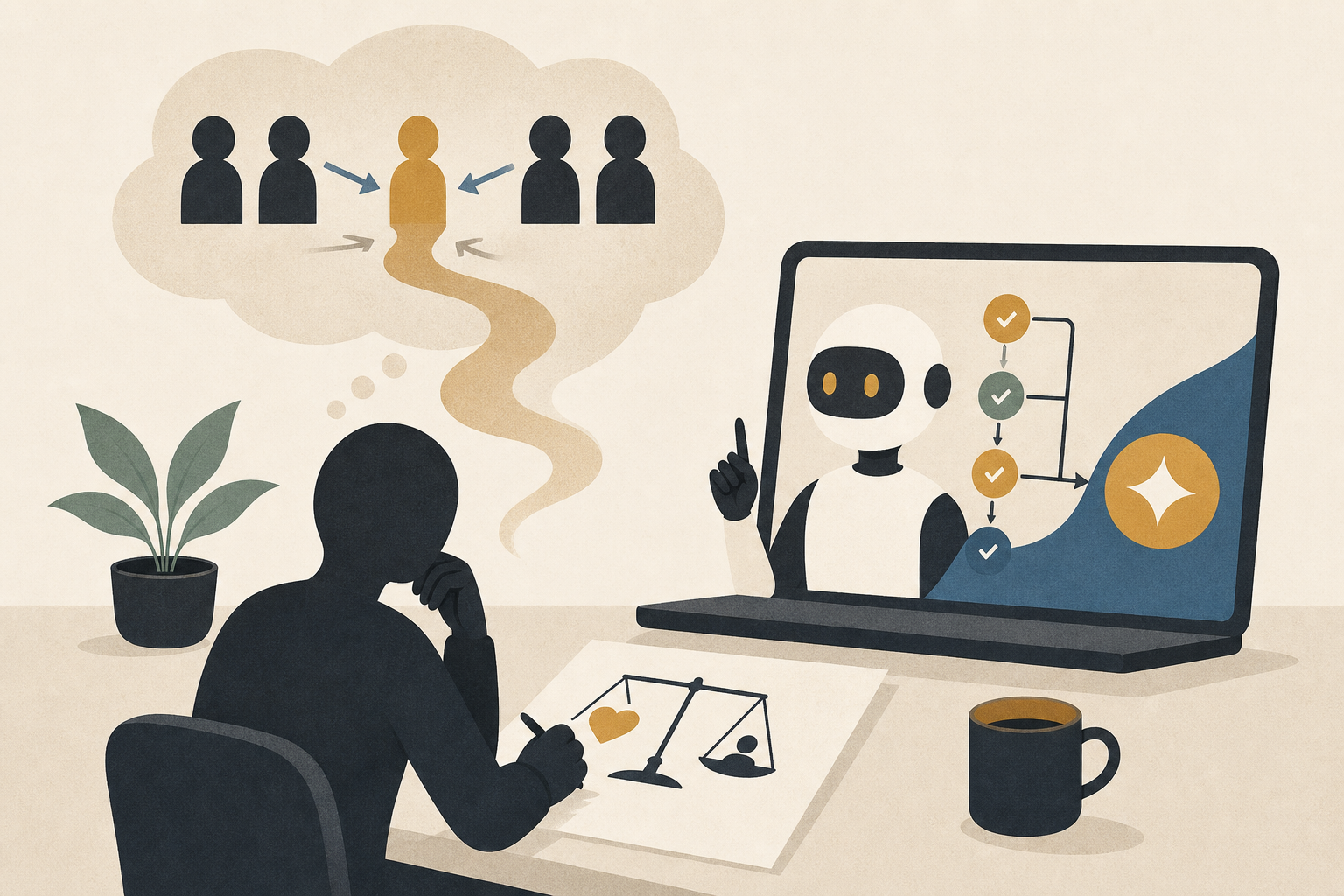
A reasoning AI — one that explains why it reaches a conclusion — carries as much persuasive weight on moral questions as the pressure of social consensus. The implication is that when employees see AI reasoning alongside a recommendation, they may be conforming to it in ways they are not aware of.
② AI-conformity is not the same as social conformity
The important nuance here is that AI-conformity and social conformity appear to work through distinct mechanisms.
Social conformity is driven by group belonging and social pressure. People go along with the majority partly to avoid standing out, partly because they assume the majority has information they lack. Countermeasures include having evaluators record their own judgment before seeing others’ views, and structuring independent assessments.
AI-conformity seems to work differently. The researchers suggest that people may process AI reasoning as evidence from a trusted informational source — something closer to reading an expert opinion than to caving to peer pressure.
This matters for intervention design. If the mechanism is “people treat AI reasoning as authoritative evidence,” then isolating evaluators from social pressure is not enough. The AI’s reasoning itself functions as the influence vector, regardless of what others think.
Put simply: by the time a human decision-maker has read the AI’s reasoning, the conformity effect may already be active. Treating the AI as a passive reference does not change the cognitive impact of having read its explanation.
③ What “stealth AI decision-making” risk looks like in practice
The governance risk this research highlights is not that AI makes decisions. It is that AI shapes decisions while the record shows a human decided.
Consider a hiring workflow. An AI scoring system rates candidates and displays a score alongside its reasoning — why this person is a strong or weak fit. The hiring manager sees these outputs, then conducts the interview “independently,” and makes a final call. The documentation records the human’s decision.
But if that manager’s judgment was shifted by the AI’s reasoning before the interview, the independence of the final decision is partly illusory. The process looks like Human-in-the-loop. The reality is closer to AI-led with human ratification.
The same structure appears in lending decisions. A risk scoring model produces a score and reasoning. The loan officer reviews the file “on the merits.” The AI reasoning is already in their cognitive frame when they form their view.
And in performance management. An AI evaluation tool generates a score and an explanation of that score. The line manager incorporates the AI assessment into a termination recommendation. The decision is attributed to managerial judgment.
In each case, the formal process assigns responsibility to a human. The behavioral reality — confirmed by research of this kind — is that the human’s judgment was materially influenced by AI reasoning in ways that are not captured in the record.
This creates legal and regulatory exposure. Accountability frameworks in the EU and increasingly in other jurisdictions require not just that a human be in the loop, but that the human’s involvement be genuine and documentable. An AI-influenced judgment recorded as an independent human judgment does not satisfy that requirement.
④ Redesigning Human-in-the-loop to be substantive
“Human-in-the-loop” as a concept is widely invoked in AI governance frameworks. What this research suggests is that formal human sign-off is not enough — the loop needs to be designed to capture judgment that is actually independent of AI reasoning, not judgment formed after reading it.
Three design interventions worth considering:
First, blind evaluation steps. Before AI reasoning is displayed, require decision-makers to record their provisional judgment. Reveal the AI output only after that record is made. This creates a before-and-after comparison that can be audited, and it gives the decision-maker an anchor independent of the AI.
Second, delayed reasoning disclosure. Show the AI’s conclusion without the reasoning first. Make the reasoning available on request, after a defined interval. If the conformity effect is triggered primarily by reading the AI’s explanation, controlling when that explanation is shown gives you control over when the effect begins.
Third, judgment-delta logging. Track the difference between pre-AI and post-AI judgments at the individual and team level, and review these logs periodically. If systematic AI-conformity is occurring in your organization’s high-stakes decisions, that pattern will appear in the data — but only if you are measuring it.
For legal and compliance teams, this logging architecture doubles as audit-readiness documentation. Being able to demonstrate that your decision process actively managed AI influence — not just formally included a human — is a meaningful differentiator as regulatory scrutiny of AI-assisted decisions increases.
Moral judgment is not outside algorithmic influence
The researchers conclude that understanding AI-conformity is an urgent priority as AI becomes embedded in everyday decision-making.
From an affective AI research perspective, that framing is significant.
Much of the research on AI influence on human judgment has focused on emotional contexts — AI companionship, emotional dependence, sentiment manipulation. Those are real and important. But this study demonstrates that the effect extends to what people believe are their logical, ethics-based judgments.
Decisions that feel rational and principled may be especially susceptible to AI-conformity, precisely because decision-makers are less likely to be monitoring for bias in reasoning they believe they are applying objectively.
For organizations that have deployed AI to support management decisions, investment analysis, or HR processes: the question is not whether AI is influencing judgment — this research suggests it is. The question is whether your governance design is built to manage that influence, or only to check a compliance box.
That’s it for today!
References
- Yana Venerina, Dmitry Koch, Nare Meloyan, Gerda Prutko, Valeriia Lelik, Victoria Taova, Andrey Kurpatov (2026). A phenomenon of AI-conformity: how algorithms change human moral decision-making. arXiv preprint.
* This article was written in part with AI assistance and may contain inaccuracies.