Column
How Well Can LLMs Read Human Emotions? A 13-Class Benchmark Reveals a Zero-Shot Ceiling at Roughly 40%
Claude, GPT-5.4, and Gemini were benchmarked zero-shot on a 13-class emotion taxonomy across 131,306 sentences — and all three plateaued at around 40% accuracy. Here is what the 'affective gap' means before you build emotion AI into your product.
Hello. I am Miura from Affectosphere Group.
“Our chatbot is built on an LLM, so it can also read customer emotions.” Sales pitches like this are everywhere lately.
But how far can that claim actually go?
A paper published on arXiv in July 2026 (Obiuwevwi et al., arXiv:2607.00968) answers this question head-on, with numbers. The short version: entrusting fine-grained emotion recognition to a zero-shot LLM is, for now, a risky design choice.
Three takeaways
- Claude, GPT-5.4, and Gemini were evaluated under identical zero-shot conditions on a 13-class emotion classification task spanning 131,306 sentences. The best accuracy was roughly 40%.
- The accuracy differences between the three models were not statistically significant — every model converges on the same zero-shot ceiling. Claude, however, showed a distinctly low Macro-F1, revealing a prediction bias on imbalanced classes.
- All three models shared the same failure pattern: strong on sarcasm and desire, weak on love, confusion, and shame. For HR and healthcare use cases that hinge on subtle emotions, fine-tuning or ensembling with dedicated models should be the default.
① The experiment: 13 classes, 131k sentences, one level playing field
What makes this study useful is how strictly the comparison conditions were controlled.
The subjects were three frontier commercial models: Claude, GPT-5.4, and Gemini. The task was fine-grained 13-class emotion classification on a large dataset of 131,306 sentences. Prompts were unified, and no additional training was applied. In other words, the setup reproduces exactly what happens when a company takes an off-the-shelf LLM and uses it directly as an emotion classifier.
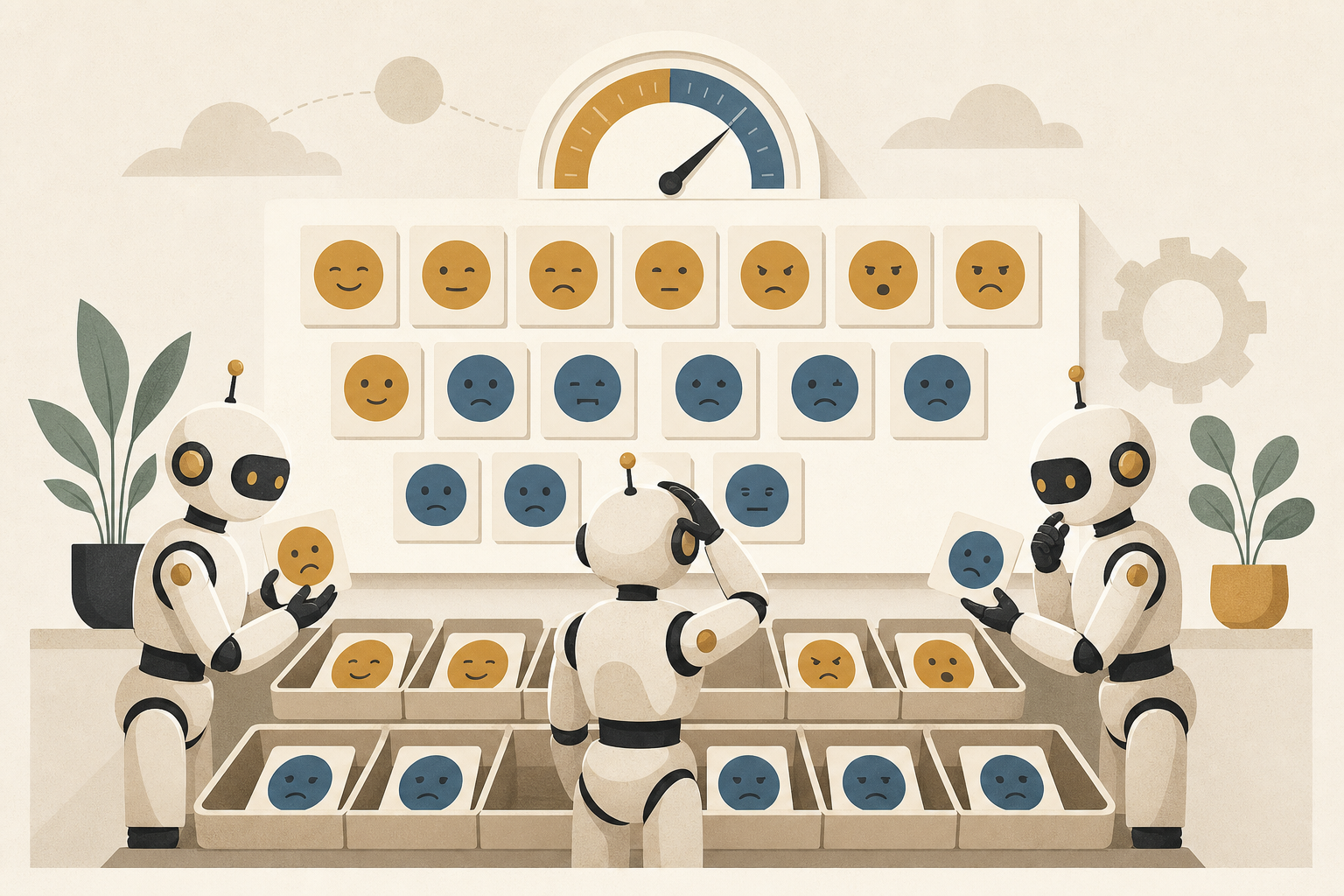
The results: Gemini led with 39.9% accuracy and a Macro-F1 of 0.363, followed by GPT-5.4 at 38.8% (Macro-F1 0.291) and Claude at 38.0% (Macro-F1 0.159).
Forty percent accuracy. With 13 classes it is well above chance, but for any product claiming to “understand emotions,” that is a sobering number.
② The shared ceiling matters more than the ranking
Here is the interesting part.
When the pairwise accuracy differences were tested with McNemar’s test, none were statistically significant. Which LLM you pick barely matters for this task — all of them hit the same ceiling, what the research team calls the “affective gap.”
That said, the models fail in qualitatively different ways. Claude’s Macro-F1 of 0.159 stands out as unusually low, indicating a prediction bias that misses minority classes. Two models with the same overall accuracy can differ enormously in how they treat rare emotions — and for some applications, that difference is fatal.
The study also found a failure pattern common to all three models. Sarcasm and desire were recognized well. Love, confusion, and shame were consistently poor.
③ Why failing to read “shame” is a business problem
You might think: for complaint detection, recognizing anger is enough — who needs love or shame?
Consider attrition-risk detection. The first signals from an employee starting to consider leaving are rarely loud emotions like anger. They are subtle states closer to confusion or shame: “I feel overlooked,” “I am embarrassed to ask for help.” If a system cannot pick up this stage, it detects resignation risk only after it is too late.
In healthcare and mental health the stakes are higher still. Shame is one of the biggest barriers to seeking care, and misreading it breaks the entire design of how a system should reach out to users.
The emotions zero-shot LLMs are worst at are precisely the subtle, high-business-value ones. That is the heaviest implication of this paper.
A practical proposal: use this as a procurement standard for emotion AI
For teams building emotion AI into products, this result is actually good news — it converts directly into an architectural decision rule.
First, add a checklist item to procurement and design reviews: is the emotion recognition zero-shot, or fine-tuned? When a vendor claims “it’s an LLM, so it understands emotions,” ask for Macro-F1 on a fine-grained taxonomy. Overall accuracy alone hides minority-class failures, as the Claude result shows.
Second, tier your requirements by use case. Zero-shot may be fine for entertainment features. For consequential domains — HR, healthcare, credit — make fine-tuning or ensembling with a dedicated emotion model an internal standard.
Third, monitor per-class recall on subtle emotions as a KPI. Pick two or three classes that matter for your use case, such as shame or confusion, and re-evaluate quarterly on real data. This also catches silent performance drift when models are updated.
Raising the resolution of “LLMs can do everything”
LLMs are astonishing at many language tasks, but at fine-grained emotion reading they remain far from human intuition — this paper demonstrates that at the scale of 131k sentences.
The point is not to dismiss LLMs as emotionally blind. The point is to know, with numbers, where the capability ends.
If you are about to put emotion AI into a product, this is a paper worth reading before the design review.
Cheers!
References
- Obiuwevwi, Lawrence, Rechowicz, Krzysztof J., Johnson, Jessica M., Ashok, Vikas, Shetty, Sachin, & Jayarathna, Sampath (2026). Quantifying the Affective Gap: A Zero-Shot Evaluation of LLMs on Fine-Grained Emotion Taxonomies. arXiv preprint.
* This article was written in part with AI assistance and may contain inaccuracies.