Column
AI Doesn't Need Emotions — Designing Affective Dynamics as a Control Layer for Human-AI Collaboration
A new survey reframes the question from 'should AI have emotions' to 'how should affective dynamics be engineered as a control layer for Human-AI collaboration.' From trust calibration to delegation decisions to over-reliance prevention, this paper presents emotion as an engineering design variable.
Hello. This is Keito Inoshita from Affectosphere Group.
Should AI have emotions? That question keeps being asked, but perhaps the framing itself needs to change.
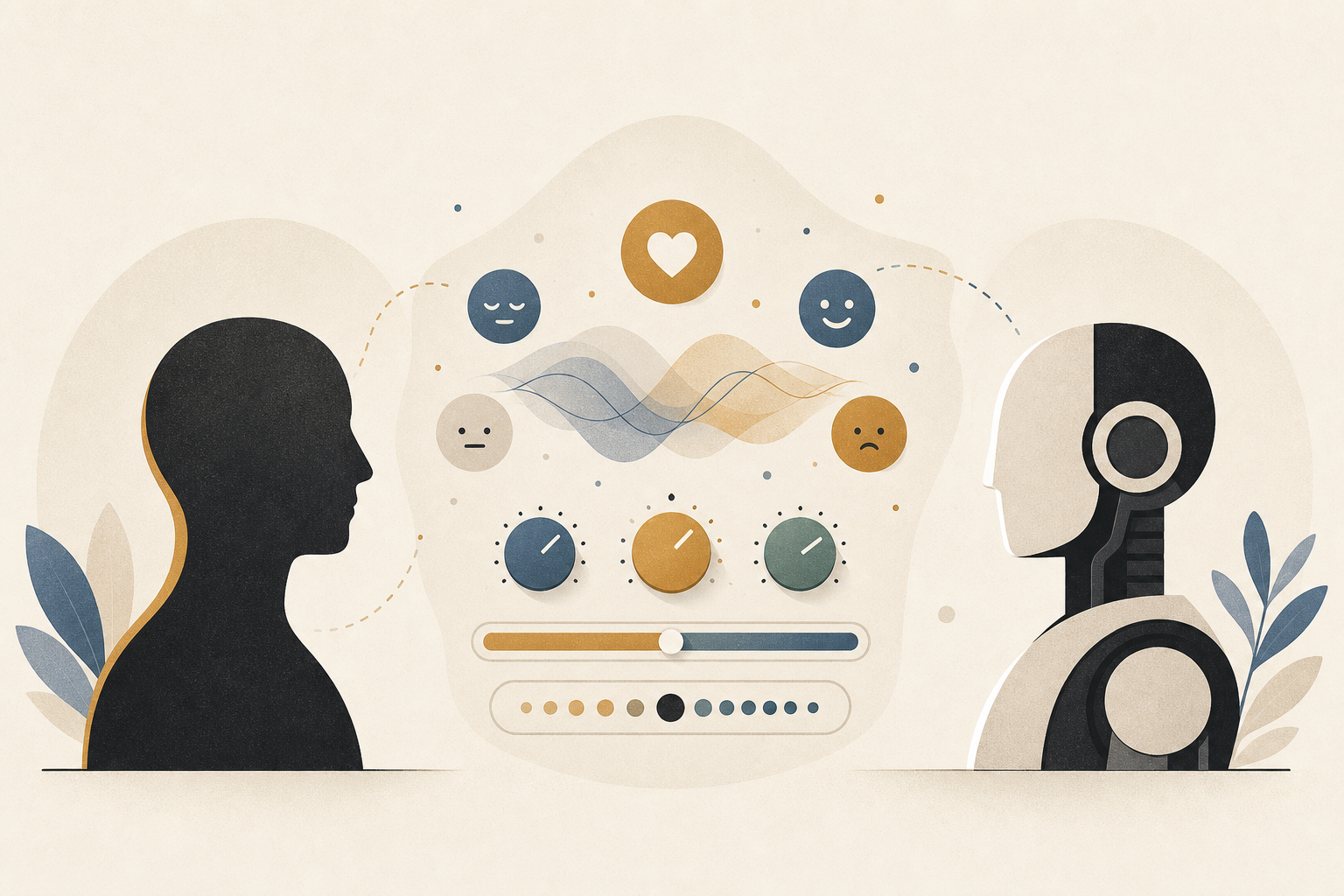
A survey published on arXiv in June 2026 (Xu et al., arXiv:2606.18259) proposes a different lens: emotion is not an internal property of AI, but rather a negotiation layer through which humans and AI agents coordinate capability, uncertainty, and responsibility.
Instead of treating emotion as something to detect or generate, this paper treats it as an interface layer that controls collaboration.
Today’s 3 Points
- Affective dynamics function as a control variable that directly influences trust calibration and delegation decisions toward AI agents.
- The design of an agent’s emotion-like responses can regulate both over-reliance and under-reliance.
- Emotion should be engineered not inside the AI, but as a negotiation layer between human and AI.
① Affective Dynamics as a Trust Calibration Valve
The central insight this research organizes: the emotional cues an agent emits (tone of voice, politeness, empathic expressions) directly influence user trust calibration.
When an AI honestly expresses uncertainty (“I’m not confident about this judgment”), it doesn’t lower trust — it calibrates trust to an appropriate level. Conversely, an AI that always responds with full confidence invites over-reliance and suppresses error-correction behavior.
This research systematizes these effects as “the function of affective dynamics as a control layer.”
Not a binary choice between having or not having emotions, but which emotional signals to emit in which situations — treated as design variables.
② Engineering Effects on Delegation and Error Correction
Affective dynamics also influence whether humans delegate tasks to AI.
When AI provides moderate emotional responses (empathic confirmation, polite uncertainty expression), users perceive “this AI understands my intent” and delegate more readily. However, excessive emotional responses generate distrust: “this AI is trying to do more than it can.”
For error correction: when AI makes a mistake, an emotionally neutral report versus an emotionally considerate report changes user correction behavior.
The key insight is that these aren’t matters of “good vs. bad” but controllable design variables. Different situations call for different emotional responses — building trust where needed, maintaining appropriate vigilance elsewhere.
③ A New Governance Axis: Monitoring Affective Dynamics
This research also carries implications for AI governance.
Current governance evaluates accuracy, fairness, and transparency. But the control-layer aspect of affective dynamics is overlooked.
For example, a chatbot designed to be “always empathic” may encourage over-reliance, ultimately degrading users’ autonomous decision-making capability. This risk isn’t captured by accuracy or fairness metrics.
The paper proposes evaluating “how affective dynamics design affects user decision-making autonomy” as a new governance axis.
Implementation Implications
For product teams designing AI agents: add “affective dynamics design specifications” explicitly to response design. Instead of just prompting “be polite” or “be empathic,” manage situation-specific emotional response patterns as design variables.
For governance teams: monitor AI delegation rates. If users accept AI suggestions without modification too frequently, it may signal over-reliance risk rather than good UX.
A New Paradigm for Affective AI
“Should AI have emotions?” is the old question.
The new question is: “How should affective dynamics be designed, and at which points in Human-AI collaboration?”
Beyond emotion recognition and emotion generation lies emotion as a designed control layer — and that field may just be beginning.
Reference
- Xu, J., Wu, X., Zhang, Z., Xu, Y., Yang, Y., Zhu, J., Xiao, L., Wu, W., & He, L. (2026). Caring Without Feeling: Affective Dynamics as the Control Layer of Human-AI Agent Collaboration. arXiv preprint.
Note: This article was partially written with AI assistance and may contain inaccuracies.