Column
Breaking the Cultural Wall in Emotion AI ── What 61% Bias Reduction Actually Means
When emotion AI sounds warm to American users but cold to Japanese users, that's not an accuracy problem — it's a structural bias problem. A 2026 paper introducing the Affective-CARA framework cut cultural expression bias by 61% using a knowledge graph approach. Here's what that means for global HR and CX teams.
Hi, I’m Keito Inoshita from Affectosphere Group.
A pattern is showing up in global HR Tech and CX platforms: the emotion AI generates natural, warm empathetic responses for Western users, but East and South Asian users find the same system “cold” or “off.” Deploy emotion AI globally, and experience quality differs visibly by cultural region.
This isn’t a precision problem.
It’s a structural bias problem — the model’s “emotional baseline” is anchored to the cultural background of its training data, and that anchor doesn’t move.
A 2026 arXiv paper (Nirodya Pussadeniya, Bahareh Nakisa, Mohammad Naim Rastgoo, arXiv:2506.14166) proposes a practical answer. The Affective-CARA framework — combining a cultural emotional knowledge graph with reward-based policy optimization — reduces cultural expression bias by 61% across three test datasets.
Today I’ll walk through the research and what it means for organizations deploying emotion AI globally.
3 Points for Today
- Value: Affective-CARA automatically generates culturally appropriate emotional responses, opening a path toward experience quality parity across global teams.
- Validated results: 61% reduction in cultural expression bias, Cultural Semantic Density score of 9.32/10 across three datasets.
- Core design insight: why “baking culture in from the start” via knowledge graph outperforms “adding culture later” via fine-tuning.
① Why Emotion AI Trips on Culture
Two structural reasons explain why emotion AI struggles with cultural variation.
The first is style-of-expression differences. Some cultures express emotions explicitly and linguistically; others express them indirectly, contextually, or non-verbally. “I’m so frustrated right now” is natural in English-speaking contexts. In Japanese contexts, directly stating emotional states is less common — the same frustration might be expressed through topic avoidance, pausing, or word choice. A model that can’t bridge this gap will misclassify emotional states across cultural lines.
The second is value-of-emotion differences. “Expressing anger” is self-assertive and often positive in some cultural contexts; in others, it signals a loss of composure and is viewed negatively. The same emotional state carries different valence judgments across cultures.
Emotion AI trained on predominantly English and Western cultural data treats these differences as outliers. But for billions of global users, having their cultural context treated as an edge case shows up as direct experience degradation.
② How Affective-CARA Works
The core insight of Affective-CARA is: don’t adjust for culture after the fact — build culture into the center of the system.
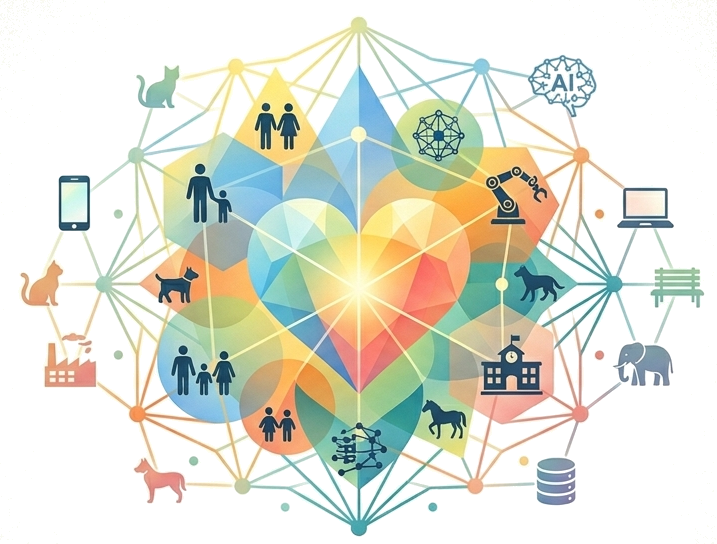
The Cultural Emotional Knowledge Graph
At the heart of the system is a knowledge graph annotated with Valence, Arousal, and Dominance scores across cultural contexts.
This graph comprehensively maps relationships between emotion words, cultural contexts, and expression patterns. It encodes knowledge like: “In this cultural context, silence may indicate anger.” “In this other context, indirect expression rather than direct emotional statement is a politeness signal.” These relationships are structured and queryable.
Reward-Based Policy Optimization
The response-generating agent references this graph while optimizing its response policy via reinforcement learning. Responses that correctly reflect cultural context receive high reward; culturally biased responses receive penalties.
Validation Across Three Datasets
Tested on three independent datasets, Affective-CARA achieved a Cultural Semantic Density score of 9.32/10 and a 61% reduction in cultural expression bias.
③ Why “Built-In” Beats “Bolted-On”
The conventional approach to cultural bias in emotion AI has been: build the base model, then fine-tune per region.
The problems with this are cost and continuity.
Culture isn’t static. “Japanese cultural emotional expression” today is meaningfully different from twenty years ago. Continuously chasing cultural change through iterative fine-tuning is computationally expensive and doesn’t scale.
Affective-CARA manages cultural knowledge in an updatable graph structure. When the graph changes, the policy optimization follows automatically. Cultural shifts can be absorbed without full model retraining.
From a global HR Tech or CX platform perspective, this significantly reduces the operational overhead of “maintaining separate regional models.”
What This Means for Multinational Teams
When emotion AI is deployed in multinational team contexts, cultural fairness is no longer a nice-to-have.
If a system reports “Person A is highly stressed, Person B is fine,” and Person A happens to come from a cultural background where indirect emotional expression is the norm — that judgment may be reflecting AI bias rather than actual emotional state.
When these systems feed into HR evaluations or hiring decisions, cultural bias can produce discriminatory outcomes.
What Affective-CARA demonstrates is that cultural fairness in emotion AI is not just “ethically desirable” — it is “technically achievable.” The knowledge graph approach makes it an engineering choice, not a research aspiration.
“Emotion AI that crosses cultural walls” is no longer a vision statement. With the right design, it’s deployable now.
That’s all for today!
References
- Nirodya Pussadeniya, Bahareh Nakisa, Mohammad Naim Rastgoo (2026). Affective-CARA: A Knowledge Graph Driven Framework for Culturally Adaptive Emotional Intelligence in HCI. arXiv preprint.
* This article was written in part with AI assistance and may contain inaccuracies.