Column
Affect Prediction vs. Affect Forecasting: Why These Are Two Completely Different Problems
Emotion AI has long treated 'estimating the current emotional state' and 'predicting future emotional change' as the same task. A 2026 longitudinal text study proves they rely on fundamentally different information sources — and that conflating the two is holding back the field.
Hi, I’m Keito Inoshita from Affectosphere Group.
When emotion AI “handles emotions,” two fundamentally different tasks are usually being conflated.
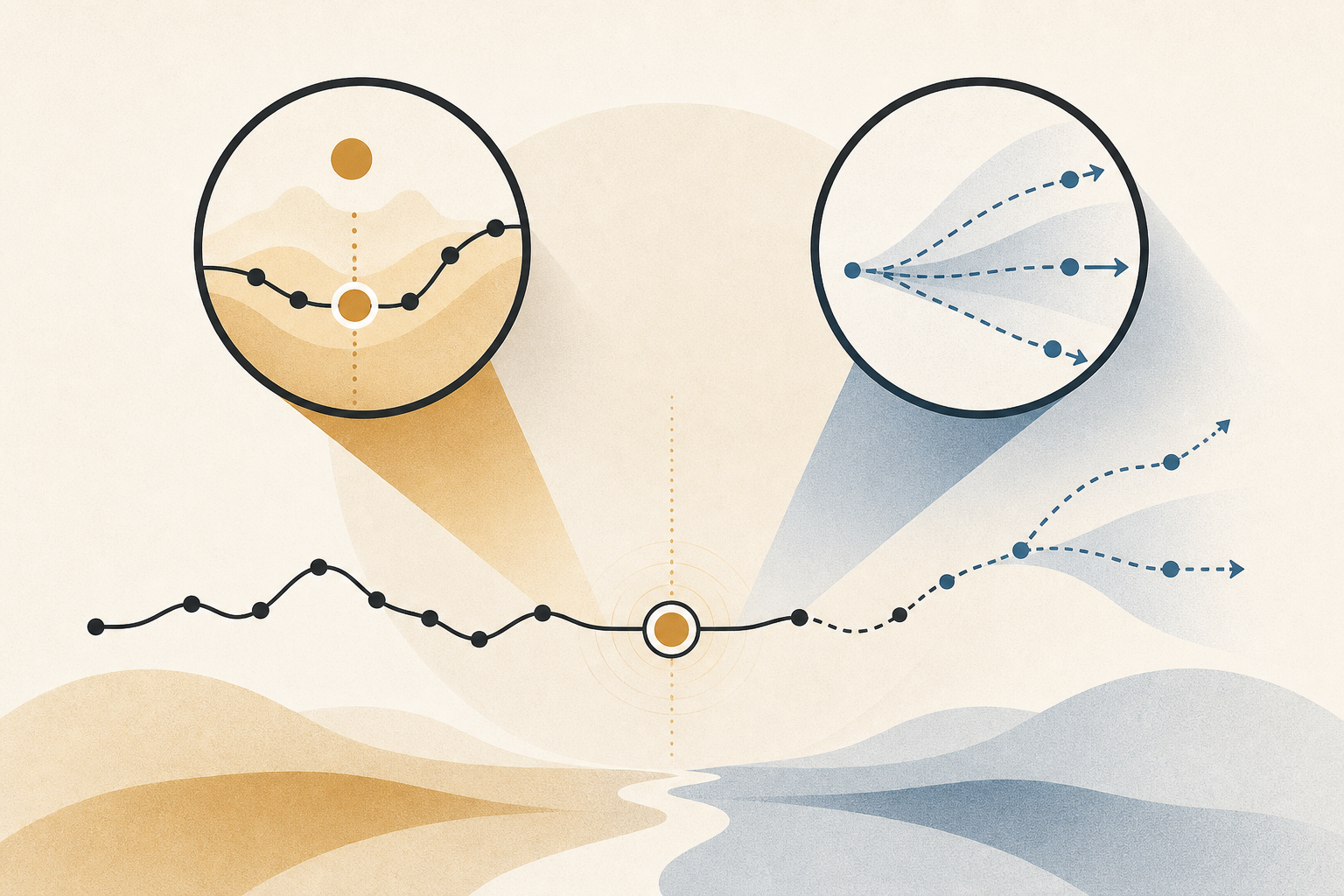
The first is estimating what emotional state a person is in right now. The second is predicting how that person’s emotional state will change going forward.
These two have long been treated as the same problem. Build an “emotion prediction model,” and you can do both. That has been the default assumption.
A 2026 arXiv paper (Sadia Noor, Seemab Latif, Raja Khurram Shahzad, Mehwish Fatima, arXiv:2606.16687) challenges this assumption with data.
The information sources that work for estimating current emotional state and those that work for forecasting future emotional change are fundamentally different. This divergence was empirically demonstrated using longitudinal text — diaries and essays written over time by the same individuals.
Today I want to look at what this means for how we design emotion AI systems.
3 Points for Today
- Value: Affect prediction and affect forecasting are distinct tasks, each requiring a different model design approach.
- The demonstrated divergence: Text semantics are effective for current-state estimation (valence r=0.670), while numerical trajectory patterns outperform for future-change forecasting (r=0.659).
- Design implication: Trying to cover both tasks with a single “emotion model” may be the source of the precision ceiling many systems hit.
What Is the Difference Between Affect Prediction and Affect Forecasting?
Let me define the terms.
The research proposes a framework for treating affective modeling as two separate tasks.
“Affect Prediction” is the task of estimating current emotional state from text. Given what someone wrote in a diary today, how depressed or energized are they right now?
“Affect Forecasting” is the task of predicting future emotional change. Given everything we know about this person, how is their mood likely to shift over the next week?
A weather analogy makes this intuitive. Observing “it’s cloudy today” and forecasting “tomorrow will rain” use completely different data and methods. Yet in the emotion AI world, these two tasks have been merged under the label “emotion prediction model” and built with the same architecture.
The research team formalized this distinction as the Trait-State Affective Prediction (TSAP) framework. Using longitudinal text — diaries and essays produced by the same authors over extended periods — they tested the two tasks separately and measured which information sources serve each one.
The Divergence: Text vs. Numerical Trajectories
The central finding is a striking divergence in which information sources power each task.
For current-state estimation, text semantics worked powerfully. For valence (the pleasant-to-unpleasant dimension), the model achieved a Pearson correlation of r=0.670. This is intuitive: if someone writes “today was genuinely terrible,” the text carries the emotional signal clearly.
But for future-change forecasting, text semantics lose much of their power.
What proved effective instead were numerical trajectory patterns — the historical sequence of affective scores, the rhythm of ups and downs, the rate and direction of past change. Using these time-series features yielded a correlation of r=0.659 for emotional change prediction.
In other words: to know where someone is emotionally headed, the pattern of where they have been numerically matters more than what they wrote today.
This raises a fundamental question for emotion AI design.
Reading current affect: read the written words. Forecasting affect change: read the numerical history.
If you try to do both with a single model, you end up compromising one or the other.
Why Longitudinal Text?
The choice to use longitudinal text in this study is significant.
Longitudinal text refers to text produced by the same person over an extended period — diaries, personal essays, sequential social media posts. Not one-shot utterances, but data with a time axis.
Emotions change over time. Today’s mood feeds into next week’s. Seasonal patterns emerge. Life events cause large shifts. Capturing this temporal dynamic requires longitudinal data.
This matters because most emotion AI research to date has focused on single-point estimation — inferring emotion from a single document or utterance. But real-world applications — mental health support, long-term wellbeing management, emotional coaching — need to know not just “how is this person feeling now” but “how will they feel over time?”
It is precisely the longitudinal design that makes the divergence between the two tasks visible. This is one of the key contributions of the research.
What This Means for Emotion AI System Design
The core practical takeaway is: stop trying to do both tasks with one model.
Most current emotion AI systems build a single text-to-affect estimation model and deploy it as the “emotion recognition engine” across a range of applications — mental health apps, emotional coaching platforms, wellbeing management tools.
But following this research, current-state estimation and future-change forecasting should have separate designs.
For current-state estimation, a design emphasizing text encoders and semantic feature extraction is appropriate — building deep sensitivity to what the written words mean.
For future-change forecasting, a design that handles time-series numerical data is appropriate — learning trajectory patterns from historical affective scores.
In an emotional coaching system, “here is your emotional state today” and “here is how your mood is likely to shift next week” may need to be powered by separate backend models.
In mental health support contexts, this becomes even more critical. Early detection of crisis states requires detecting anomalies in historical trajectory patterns — and the information source for that is not today’s text but the numerical pattern of past change.
Rethinking the Premise That “Emotion AI Reads Text”
What this research challenges most broadly is the premise that “emotion AI reads emotion from text.”
Text is strong for current-state estimation. It is weak for future-change forecasting.
This may seem surprising given how tightly emotion AI has developed alongside language models. But it means that even as LLMs become better at deeply understanding emotionally expressive writing, that improvement does not automatically translate into better affect forecasting.
Forecasting emotional change requires understanding the temporal dynamics of emotion — the numerical structure of how affect has moved over time. That is not text semantics; it is time-series structure.
Designing emotion AI purely as a “language-reading system” will keep hitting the same ceiling when it comes to affect forecasting. This research puts that ceiling in view with concrete numbers.
“Affect prediction AI” and “affect forecasting AI” are different systems. Starting the design of emotion AI from that recognition is, I think, a key step toward the next generation of affective intelligence systems.
That’s all for today!
References
- Sadia Noor, Seemab Latif, Raja Khurram Shahzad, Mehwish Fatima (2026). From Affect Prediction to Affect Forecasting: Evidence for Distinct Information Sources in Longitudinal Text. arXiv preprint.
* This article was written in part with AI assistance and may contain inaccuracies.